
Search Results
63 Results Found for “circulating tumor DNA”

ESMO 2026 presented new data across multiple myeloma, lymphoma and myeloid malignancies, exploring investigational bispecific antibodies, ADCs and targeted therapies. The studies selected for this round-up examine investigational approaches in relapsed/refractory disease and newly diagnosed settings, including combinations designed to deepen responses and emerging targets in patients with limited treatment options.

At European Society for Medical Oncology (ESMO) Congress 2026, new data from VOLGA, KEYNOTE-B15, ENERGIZE, KEYNOTE-866 and POTOMAC examine perioperative treatment combinations, circulating tumor DNA (ctDNA) and bladder-preserving strategies across muscle-invasive and non-muscle-invasive bladder cancer.
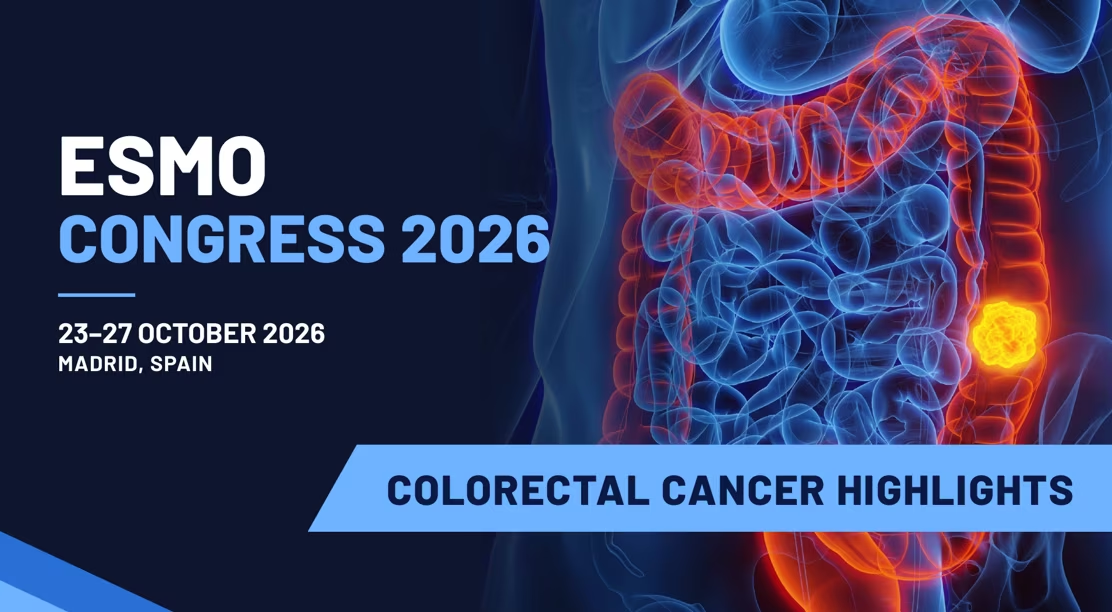
What are the most important developments in lower gastrointestinal oncology from ESMO 2026? Five selected studies examine key questions across locally advanced rectal cancer and metastatic and early-stage colorectal cancer. From the potential for immunotherapy to support organ preservation in dMMR/MSI-H rectal cancer, to longer-term survival outcomes with dual checkpoint inhibition and strategies to overcome acquired resistance to targeted therapy, these findings offer insights into evolving treatment approaches and their potential implications for clinical practice.

How might new treatment combinations and emerging biomarkers inform bladder cancer management? Five studies selected from ESMO 2026 address this question across different disease settings: VOLGA, KEYNOTE-B15/EV-304, ENERGIZE, KEYNOTE-866 and POTOMAC. Their findings examine perioperative treatment intensification, the potential of circulating tumor DNA (ctDNA) to characterize treatment response and the addition of immunotherapy to bacillus Calmette–Guérin (BCG) in high-risk non-muscle-invasive disease.

ESMO 2026 brought phase 3 data on an individualized mRNA-based therapy for resected melanoma, a histone deacetylase inhibitor combination for advanced melanoma, and updated survival results for adjuvant cemiplimab in cutaneous squamous cell carcinoma. Dr Rodrigo Munhoz selects the key abstracts shaping the melanoma and skin cancer landscape.

Gastrointestinal (GI) cancers constitute a major contributor to global cancer incidence and mortality and remain among the leading causes of cancer-related death worldwide despite advances in prevention, screening and supportive care.1,2 Collectively encompassing malignancies of the esophagus, stomach, liver, biliary ...
Urothelial carcinoma (UC) is the 11th most common cancer in the UK, with approximately 11,000 new bladder cancer diagnoses annually.1 Globally, bladder cancer accounts for approximately 635,000 new diagnoses and 228,000 deaths annually, based on the latest GLOBOCAN estimates for 2024.2 Bladder cancer constitutes ...
Choosing the appropriate adjuvant therapy in patients with melanoma undergoing neoadjuvant treatment
This article examines current evidence supporting the use of neoadjuvant immunotherapy in patients with resectable macroscopic stage III melanoma and critically discusses the selection of appropriate adjuvant therapy following surgery. It is written in the context of emerging evidence from ...
Circulating tumor DNA (ctDNA) has emerged as an innovative and minimally invasive tool in precision oncology. With a short half-life of 30–120 min, ctDNA provides real-time insight into tumor dynamics.1 In early-stage breast cancer, there is growing evidence supporting its potential ...

For almost two decades, R-CHOP has remained the established frontline standard for DLBCL, yet approximately 40% of patients are not cured with first-line therapy. At EHA 2026, Prof Georg Lenz presented new phase 3 data from the frontMIND study suggesting that this long-standing backbone may now be open to improvement. The study showed that adding tafasitamab and lenalidomide to R-CHOP significantly improved progression-free survival (PFS) in previously untreated patients with high-risk DLBCL and high-grade B-cell lymphoma (HGBL), marking one of the first positive frontline intensification trials in this setting in recent years.

Abderrahim Oussalah discusses findings from the SEPT9_CROSS study evaluating circulating methylated SEPT9 as a blood-based biomarker for HCC detection in cirrhosis. “These findings support a two-tier surveillance framework in which mSEPT9 and AFP work together to improve both the ...

Several late-breaking gastrointestinal oncology studies presented at ASCO 2026 highlighted how treatment selection is continuing to evolve across colorectal, hepatobiliary, gastric, and esophageal cancers, with new data on ctDNA-guided adjuvant therapy, earlier integration of targeted agents, and intensified perioperative strategies. In this round-up, we have selected six of the most important late-breakers, and examine the latest data from CIRCULATE, BREAKWATER, EMERALD-3, Neo-CRAG, SCIENCE, and RC48-C027.

The 38th Annual Congress of the European Association of Nuclear Medicine (EANM) in Barcelona brought together over 9,400 participants, marking a major milestone. The meeting highlighted major advances in oncologic imaging and theranostics, with a strong emphasis on precision medicine and combination treatment strategies. Across plenary sessions, debates, and late-breaking discussions, the meeting underscored how nuclear medicine is increasingly central to cancer diagnosis, treatment selection, and therapeutic delivery.

At EBCC15, Dr Elisa Agostinetto presented compelling evidence that circulating tumor DNA (ctDNA) at completion of neoadjuvant therapy could be a game-changer biomarker for predicting breast cancer relapse. In the Q&A below, Dr. Agostinetto discusses the implications of her findings and the path toward integrating ctDNA into routine clinical practice.

The 15th European Breast Cancer Conference (EBCC15) showcased a wave of research poised to reshape breast cancer care. Below, we spotlight the key highlights from this year’s conference.

Emerging strategies in head and neck cancer focus on personalizing therapy and reducing toxicity. ctDNA-guided chemotherapy with pembrolizumab in recurrent HNSCC achieved a 73% response rate, while ozuriftamab vedotin showed promising activity in pretreated HPV-positive OPSCC. Long-term results from the Quarterback trials indicate that reduced-dose chemoradiation after induction chemotherapy maintains durable control in selected patients. These findings support further exploration of molecular-guided, targeted, and de-escalated approaches to optimize outcomes.
2025 has brought exciting developments in oncology, with groundbreaking research and real-world progress showcased at ASCO, ESMO, EHA, ASH and many more leading conferences around the world. We asked our key faculty to share what they believe has been most impactful so far this year – here’s what they told us.
Project Cure CRC, the dynamic research initiative by the leading nonprofit Colorectal Cancer Alliance (Alliance), has awarded five new grants to advance urgent science in the colorectal cancer (CRC) space. To date, Project Cure CRC has received more than 400 research proposals and has invested almost $12 million in innovative colorectal cancer studies, with 29 grants funded. Project Cure CRC aims to accelerate and advance cutting-edge treatments to improve patient outcomes. As the largest nonprofit dedicated to ending this disease, the Alliance is prioritizing the initiative to help fill gaps from recent research funding cuts in the U.S.
Log into your Touch Account
Keep track of your clinical interests and newsletter subscriptions.
Sign up with an Email
Or use a .
Register now for FREE access
Already registered? Login below.
