
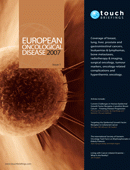
EUROPEAN ONCOLOGICAL DISEASE – VOLUME 3 ISSUE 2 – WINTER 2007
This issue of European Oncological Disease highlights the multifaceted area of oncology. To treat a patient with cancer is not the role of a single physician, but rather a task for a multidisciplinary team. It is the performance of the multidisciplinary team that really matters when it comes to outcome. Outcome is not only a […]
Current Issues
Nutrition is an important factor in the treatment and progression of cancer. The majority of cancer patients experience weight loss as their disease progresses and, in general, weight loss is a major prognostic indicator of poor survival and impaired response to cancer treatment.1 The incidence of malnutrition among patients with cancer has been estimated at […]
In 1933, cancer researchers recognised a need to share knowledge and expertise globally, and founded the International Union Against Cancer (UICC).1 Since then, the UICC has grown into a respected forum for all cancer professionals. Today, the UICC is the leading international non-governmental organisation (NGO) dedicated exclusively to the global control of cancer.2 Currently, cancer […]
Cancer is predominantly a disease of adults and the elderly. Fifty per cent of cancers occur after the age of 70 years, and 150,000 new cancers are diagnosed in France every year. Most adult cancers are slowgrowing adenocarcinomas. In contrast, childhood cancers (occurring before the age of 16 years) represent around 1% of all cancers, […]
Haematological Cancer
Non-Hodgkin’s lymphoma (NHL) is a heterogeneous group of lymphoid malignancies that most commonly occur in individuals over the age of 60 years. Aggressive (high-grade) subtypes progress rapidly but are potentially curable, whereas indolent (low-grade) subtypes grow more slowly but usually relapse after conventional treatment. The introduction of immunotherapy and its combination with chemotherapy greatly improved […]
Chronic myeloid leukaemia (CML) is the only molecularly defined myeloid disorder to date and is distinguished by a unique chromosomal abnormality – the Philadelphia (Ph) chromosome – and expression of the BCR-ABL fusion oncoprotein.1 The treatment of CML was transformed by innovative molecularly targeted therapy, tyrosine kinase inhibitors (TKIs), namely imatinib mesylate (Gleevec®, Novartis). In […]
Secondary acute myeloid leukaemia (sAML) evolves from a prior myelodysplastic syndrome (MDS) or myeloproliferative disorder (MPD) or occurs due to prior exposure to leukaemogenic therapy – also called treatment-related AML (tAML).1 Patients with sAML have an extremely poor prognosis, with only approximately 25% achieving remission following therapy with the standard regimen of bolus daunorubicin for […]
Multiple myeloma (MM) is a chemotherapy-resistant malignancy. For decades, the only active drugs have been alkylating agents and high-dose corticosteroids. The introduction of novel agents (thalidomide, bortezomib and lenalidomide) is changing the management of MM patients for front-line therapy and during relapse. These agents have different modes of action and can act not only on […]
Head and Neck Cancer
Head and neck cancer is the sixth most common cancer, representing about 5% of all cancers. Each year, more than half a million new cases are diagnosed worldwide.1–3 Over the past decade, the important role of different growth factors and their receptors and signal transduction pathways in the genesis and progression of tumours has been […]
Squamous cell cancer of the head and neck (SCCHN) accounts for approximately 3% of adult malignancies in the US and is the seventh leading cause of cancer death worldwide.1,2 SCCHN has been classified into four stages: • stages I/II are classified as early disease; • stages III/IV M0 are divided into resectable and non-resectable disease; […]
Oesophageal adenocarcinoma is currently the most rapidly increasing cancer in the US and Western Europe.1,2 This type of tumour is frequently detected at an advanced stage and requires multimodal treatment. Despite improvements in its detection, surgical resection and neoadjuvant therapy, the overall survival of oesophageal cancer remains lower than that of other solid tumours.3 In […]
Breast Cancer
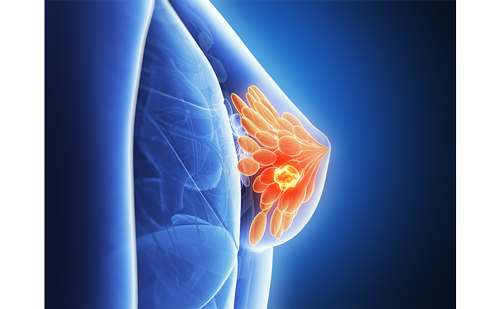
Breast cancer remains the most common malignancy among women, with an average lifetime risk of approximately 10%. Despite the continued rise in incidence of the disease, with almost half a million deaths annually worldwide, mortality rates have fallen over the past two decades. This is testimony to the success of interventional strategies such as screening […]
Treatment of breast cancer has come a long way. The recent elucidation of distinctive molecular breast cancer subtypes through gene expression profiling has shed light on the heterogeneous clinical behaviour and outcomes of seemingly alike morphological breast cancers.1 This information could be translated in the scenario of clinical trials and clinical practice as a streamlined […]
Breast cancer is the most common malignancy in women living in industrialised countries. Worldwide, it is still the most common cause of cancer death and the most common cause of death in women between 35 and 55 years of age. However, breast cancer mortality has been decreasing in recent years in many industrialised countries such […]
Lung Cancer
Primary lung cancer is the most common cause of cancer-related death, causing 3 million deaths per year worldwide (World Health Organization [WHO] figures). Current incidence rates vary between 40 and 100 per 100,000 in Europe and 83 per 100,000 in the US.1 Since 1960, the rate of rise in lung cancer deaths in women has […]
Gastrointestinal Stromal Tumours
Prior to 2000, the outlook for patients with gastrointestinal stromal tumours (GISTs), the most common gastrointestinal (GI) sarcoma, was poor. This life-threatening disease is highly resistant to traditional management with chemotherapy and radiation, and patients with metastatic GISTs had only one viable treatment option: surgical resection. Even with surgery, many patients suffered relapse and experienced […]
Liver Cancer
In the US, colorectal cancer is the second most common cause of cancerrelated mortality. Unfortunately, about 35–55% of patients with colorectal cancer develop hepatic colorectal metastases. At present, surgical resection of these lesions represents the main therapeutic option and is the only chance for cure and long-term survival. In patients with extensive metastatic disease who […]
Hepatocellular carcinoma (HCC), a primary malignancy of the hepatocyte, is increasing in incidence worldwide. Chronic liver damage is the most important risk factor. The incidence of HCC is directly related to that of hepatitis B and C infection, and cirrhosis is present in 80% of cases.1 It is the fifth most common primary malignancy worldwide, […]
Colorectal Cancer
Each year, there are an estimated one million newly diagnosed cases of colorectal cancer (CRC) worldwide. Approximately half of all patients with CRC will develop metastases, and the majority of these patients will die from the cancer. Without treatment, the median survival for patients with metastatic CRC is five to six months. However, the last […]
Liver metastasis presents in approximately 50% of colorectal cancer patients, of whom 30% will already have liver metastases upon primary tumour diagnosis.1 Moreover, upon post mortem, liver metastasis is the primary site of cancer spread in one-third of colorectal cancer patients.2 A five-year survival rate of 21–43% has been noted in resectable colorectal cancer after […]
Colorectal cancer (CRC) is the third most common cancer among men and women and the second leading cause of cancer death in the Western world.1 Nearly 25% of all patients have metastatic disease at initial diagnosis, with a five-year survival rate of less than 10%.1 In addition, despite curative surgery, around 40–50% of these patients […]
Gynaecological Cancer
Even with the many recent advances in cytoreductive surgery and combination chemotherapy, ovarian cancer is still associated with poor survival prognosis and remains a significant threat to women all over the world. Ovarian cancer is the fourth most common cancer of the female reproductive system and represents the highest mortality of all malignancies of the […]
Ovarian cancer accounts for 4% of all cancers in women and is the leading cause of death from gynaecological malignancies. In Europe, estimates suggest that 61,000 new cases of ovarian cancer are diagnosed and that the disease is responsible for 39,000 deaths each year.1 Epithelial ovarian carcinoma is usually diagnosed at an advanced stage. Only […]
Ovarian cancer is the fifth most common malignancy in women. In the US, approximately 22,000 new cases occur each year.1 In Germany, about 8,000 new cases are diagnosed each year. About 80% of patients suffer from advanced-stage disease (International Federation of Gynaecology and Obstetrics [FIGO] III/IV) with an unfavorable prognosis. Due to the lack of […]
Prostate Cancer
Measurement of blood levels of prostate-specific antigen (PSA) and greater awareness have led to the detection of prostate cancer at an earlier and potentially more curable stage. As certain kinds of prostate cancer progress very slowly, some patients choose to undergo clinical observation (‘watchful waiting’) rather than active treatment. Alternatively, surgery and radiation therapy (RT) […]
Neurological and Brain Cancer
Anaplastic astrocytomas, oligoastrocytomas and oligodendrogliomas (World Health Organization (WHO) grade III) and glioblastomas (WHO grade IV) are collectively referred to as malignant gliomas, whereas WHO grade I and II gliomas are designated low-grade gliomas.1 For decades, neurosurgical resection – whenever possible – and post-operative radiotherapy have been the cornerstones of treatment for malignant gliomas. Most […]
Dermatological Cancer
The incidence of melanoma has increased considerably over the last few decades. In fact, according to the World Health Organization (WHO), the number of melanoma cases worldwide has continued to rise at a rate that exceeds that of any other form of cancer.1 GLOBOCAN estimates indicate that 41,400 newly diagnosed cases of melanoma and 10,800 […]
General Principles
Imaging and Radiotherapy
Prostate cancer is the most commonly diagnosed malignancy in men. Greyscale ultrasound (US)-guided systematic biopsy is the standard of care for prostate cancer detection in men with elevated prostate serum antigen (PSA) or an abnormal digital rectal examination (DRE). Previous reports have demonstrated that contrast-enhanced US (CEUS) investigations of the blood flow of the prostate […]
Prostate cancer is the most commonly diagnosed cancer and the second leading cause of cancer death in American men, with an estimated 186,320 new cases diagnosed and 28,660 prostate cancer deaths expected in the US in 2008.1 With the use of prostate-specific antigen (PSA)-based screening, the number of prostate biopsies performed to diagnose prostate cancer […]
Saliva’s fluid characteristics allow cleansing and lubrication of the oral cavity and mucosa. It is responsible for facilitation of taste perception, mastication, swallowing and speech. It contains a number of proteins that serve to maintain oral health and function.1 Any salivary gland dysfunction can result in reduced saliva secretion and inadequate composition, as well as […]
Computed tomography (CT) utilizing kilovolt (kV) X-rays was not developed until the early 1970s. For the first time this imaging modality provided three-dimensional (3-D) information about tumor location and at the same time about the electron density distribution required to perform 3-D dose calculations. Therefore, it was a natural choice to develop CT-based radiation treatment […]
Hyperthermic Therapy
For high-risk soft-tissue sarcomas (HR-STS) in adults, new treatment strategies are needed to improve outcome with regard to local control and overall survival. Systemic chemotherapy has been integrated either after (adjuvant) or before (neoadjuvant) optimal local treatment by surgery and radiotherapy in HR-STS. This short article summarises the results of this combination with regional hyperthermia […]
Diagnosis
Early cancer detection is known to improve clinical outcome. For screening purposes, it is possible to make a diagnosis of malignancy by cytological analysis, circumventing the need for an invasive procedure and tissue biopsy. Minimally invasive methods of harvesting cellular specimens from an anatomical site include direct sampling of surface cells by taking a smear […]
Cancer-related Complications
Chemotherapy-induced nausea and vomiting (CINV) has long been a nightmare, primarily for patients with cancer but also for nurses and oncologists. Those who were working in chemotherapy delivery units in the 1970s remember nurses rushing from one patient to the next with basins, trying to hide a vomiting patient from the others. For the patients, […]
Trending Topic
Chemotherapy-induced myelosuppression has long been considered a toxicity that limits the dose of cytotoxic agents, which contributes to significant morbidity and mortality.1 Sub-optimal dose intensity may decrease the efficacy of therapy, thereby compromising progression-free survival (PFS) and overall survival (OS) benefits.2 Chemotherapy-induced myelosuppression is often managed with granulocyte-colony stimulating factors (G-CSFs) and erythropoiesis-stimulating agents (ESAs) […]
Journal Archive
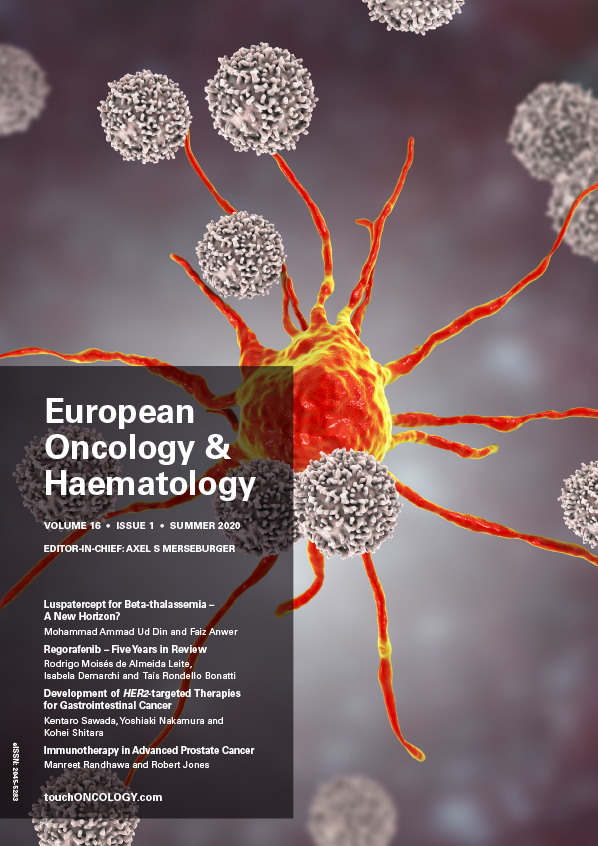
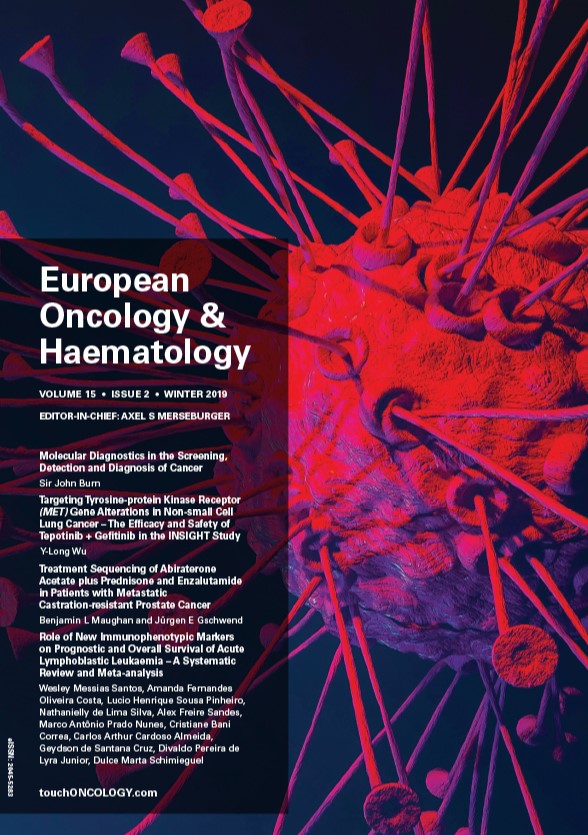
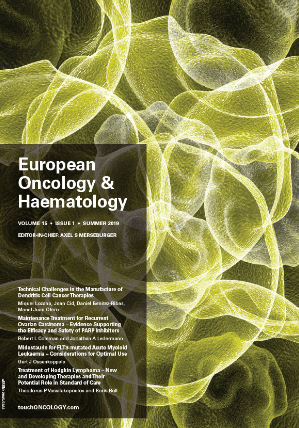
Comprising articles contributed by renowned thought leaders, European Oncology & Haematology is a peer reviewed, free-to-access, bi-annual journal that aims to disseminate best practice through review articles addressing the most important and salient developments in the Oncological & Haematology field in practical terms.
European Oncology & Haematology
Frequency: Two print issues per year (Summer & Winter); ePub ahead of print throughout the year.
Print ISSN: 2045-5275 Electronic ISSN: 2045-5283
Indexing: EMBASE, Google Scholar, Genamics JournalSeek
Log into your Touch Account
Keep track of your clinical interests and newsletter subscriptions.
Sign up with an Email
Or use a .
Register now for FREE access
Already registered? Login below.