
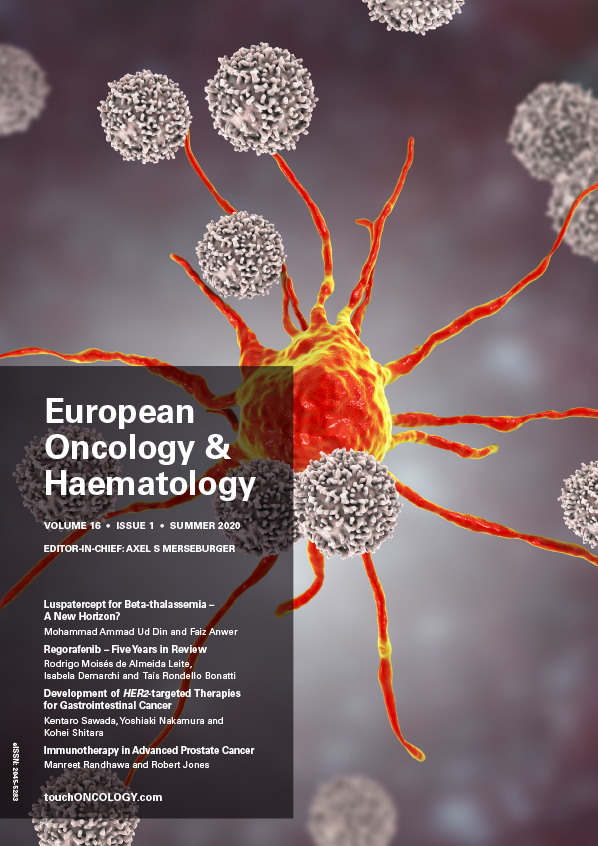
EUROPEAN ONCOLOGY & HAEMATOLOGY – VOLUME 16 – ISSUE 1 – SUMMER 2020
Welcome to the summer 2020 issue of European Oncology & Haematology, full of free-to-access, topical content for busy oncologists. This issue contains some thought-provoking content on topics ranging from the impact of the COVID-19 pandemic on cancer care, to advances in treatment of central nervous system metastases, and development of HER2-targeted therapies in gastrointestinal cancer, among others.
We extend our thanks to all authors featured in this issue and hope you enjoy reading it. We are now welcoming submissions for our Winter 2020 and Spring 2021 editions. If you’re interested in submitting an article, please don’t hesitate to contact us directly.
Foreword

Welcome to the summer edition of European Oncology & Haematology. The COVID-19 pandemic has had a devastating impact on cancer and other illness care. In addition to the heightened susceptibility of patients with cancer to infections, lockdown has resulted in delayed screening and reduced treatment of early-stage disease. However, things are starting to move in the […]
Editorials
As of June 2020, the COVID-19 pandemic has swept across 188 countries infecting more than 10 million people worldwide.1 Despite its proximity to China, Pakistan’s death toll from the virus, as of the end of June 2020, has fortunately remained under 5,000;1 however, the reported number of cases continues to increase and the death toll is […]
The chronic anaemia of beta-thalassemia major (b-thal) results from defective erythropoiesis secondary to a genetic defect in haemoglobin synthesis.1 Consequently, patients with moderate-to-severe disease rely on blood transfusions to maintain an adequate level of haemoglobin.2 Over time, this causes an iron-overloaded state, in addition to the possible blood-borne infections resulting from repeated transfusions.3 The widespread use of iron […]
At initial diagnosis of metastatic disease, central nervous system (CNS) metastases are present in 22–33% of patients with anaplastic lymphoma kinase (ALK)-rearranged (ALK+) non-small cell lung cancer (NSCLC). After crizotinib failure, the incidence can reach up to 70%, compared with 40% in all comers.1 The presence of CNS disease is an indicator of poor prognosis in […]
Reviews
Regorafenib was approved as a third-line treatment for colorectal cancer in 2013. Notwithstanding its promising pharmacodynamics, 5 years after its introduction, only a small subgroup of patients has profited from this drug, and in those who did, the treatment effects were surprisingly restricted.1 Regorafenib is an oral multikinase inhibitor against vascular endothelial growth factor receptor […]
Human epidermal growth factor receptor 2 (HER2) is encoded by a proto-oncogene with important roles in the promotion of cell proliferation, differentiation and angiogenesis via the activation of Phosphatidylinositol-3-kinase (PI3K)/protein kinase B (AKT)/mammalian target of rapamycin (mTOR) and mitogen-activated protein kinase (MAPK) downstream signalling after it forms homodimers or heterodimers with other HER family members.1–2 HER2 overexpression, […]
Historically, chemotherapy represented the only available treatment for patients with advanced non-small-cell lung cancer (NSCLC) who did not show any target molecular driver, such as epidermal growth factor receptor (EGFR), anaplastic lymphoma kinase (ALK) or the receptor tyrosine kinase ROS1. Unfortunately, limited efficacy was reported using chemotherapy alone.1 The advent of immunotherapy, a treatment based on […]

Prostate cancer is the second most common cause of cancer mortality in men, with most deaths occurring as a result of metastatic disease that has become resistant to androgen deprivation therapy (ADT).1 Most recently, immunotherapy, in the form of immune checkpoint inhibitors, has been successful in the treatment of a variety of advanced common solid tumours, […]

Trending Topic
It is with great pleasure that we present the latest edition of touchREVIEWS in Oncology & Haematology. This issue highlights the remarkable progress and innovation shaping the fields of oncology and haematology, featuring articles that delve into both emerging therapies and the evolving understanding of complex malignancies. We open with an editorial by Mohammad Ammad […]
Journal Archive
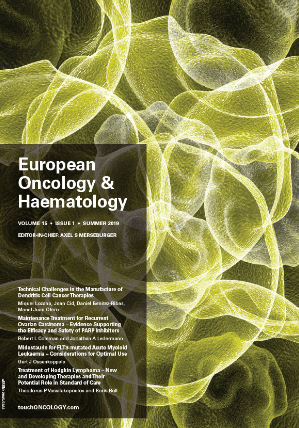
Comprising articles contributed by renowned thought leaders, European Oncology & Haematology is a peer reviewed, free-to-access, bi-annual journal that aims to disseminate best practice through review articles addressing the most important and salient developments in the Oncological & Haematology field in practical terms.
European Oncology & Haematology
Frequency: Two print issues per year (Summer & Winter); ePub ahead of print throughout the year.
Print ISSN: 2045-5275 Electronic ISSN: 2045-5283
Indexing: EMBASE, Google Scholar, Genamics JournalSeek
Log into your Touch Account
Keep track of your clinical interests and newsletter subscriptions.
Sign up with an Email
Or use a .
Register now for FREE access
Already registered? Login below.