
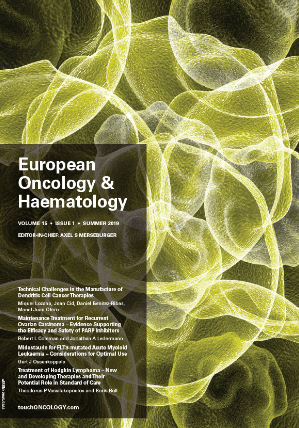
EUROPEAN ONCOLOGY & HAEMATOLOGY – VOLUME 15 – ISSUE 1 – SUMMER 2019
Welcome to the summer edition of European Oncology and Haematology! This issue features a wide variety of articles that illustrate the increasingly personalised, multidisciplinary approach to the management of cancer and haematological diseases.
Our expert interviews aim to provide a snapshot of topical issues in haematology and haematological malignancies. In an editorial piece, new editorial board member Daniel Kelly examines the increasing complexity of the cancer nurse’s role and emphasises the need for better recognition of cancer nursing across Europe. Our review articles highlight the scope of the field of oncology, discussing topics such as the investigation of dendritic cells in cancer therapy, PARP inhibitors in recurrent ovarian cancer, Midostaurin treatment for patients with AML in combination with standard chemotherapy and novel and emerging treatments in the treatment of elapsed/refractory disease Hodgkin lymphoma.
European Oncology and Haematology would like to take this opportunity to thank all participants on this edition. We would like to thank our contributors and reviewers for providing us with insightful and informative review articles. We are grateful to members of our editorial board for their continued involvement and advice. Thanks also go to all organisations and media partners for their ongoing support. We hope that you will find this edition an enjoyable and thought-provoking read.
Foreword

Welcome to the summer edition of European Oncology and Haematology. This issue features a wide variety of articles that illustrate the increasingly personalised, multidisciplinary approach to the management of cancer and haematological diseases. We begin with three expert interviews, which aim to give a snapshot of topical issues in haematology and haematological malignancies. Maria Domenica Cappellini […]
Expert Interviews
Gaucher disease is the most common of the lysosomal storage disorders.1 Although individually rare, these disorders as a group are relatively common, with an incidence of about 1 in 8,000 live births,2 and therefore represent an important health problem. Gaucher disease is characterised by an enzyme deficiency causing the deposition of glucocerebroside in cells of […]
Large B-cell lymphoma includes diffuse large B-cell lymphomas, primary mediastinal B-cell lymphoma and transformed follicular lymphoma. These have historically been treated with rituximab, cyclophosphamide, doxorubicin, vincristine and prednisone (R-CHOP). High-dose salvage chemotherapy and autologous stem-cell transplantation (SCT) can be used in case of relapse, however, patients who fail R-CHOP or relapse following SCT have a […]
Editorial

Cancer is a growing problem that demands the best from all sectors of the global health workforce.1 Cancer nurses make up the largest proportion of this workforce and, as well as being responsible for direct care delivery, also aim to address the unmet needs of patients and carers, such as the management of side-effects. Nurses care […]
Reviews

Therapeutic cancer vaccination is a promising strategy that aims to treat late stage disease by using the patient’s own immune system.1 The immune system has the potential to eliminate cancer cells, since cancer cells express antigens that are unique to the tumour or are over-expressed in the tumour. However, despite many years of research, the effective […]
Worldwide, ovarian cancer is the seventh most common cancer and the eighth most common cause of cancer death in women.1 The GLOBOCAN study estimated there were 239,000 new cases in 2012 and 152,000 deaths due to this disease. There are nearly 600,000 women living within 5 years of an ovarian cancer diagnosis.1 In the EU, age-adjusted ovarian […]
Acute myeloid leukaemia (AML) is a complex and heterogeneous disease characterised by a multitude of molecular abnormalities. Better understanding of the mutational landscape has resulted in the development of targeted treatments in the last decade.1,2 AML is the most common myeloid leukaemia in adults; the latest age-adjusted incidence rate of AML in the United States and […]
Hodgkin lymphoma is a B-cell lymphoma that predominantly affects adults between 20–40 years of age, with a second incidence peak in those 55 years of age or older.1,2 It is also the most common form of lymphoma in adolescents, occurring in nearly two-thirds of patients with lymphoma between the ages of 15–19.3 Overall, the annual incidence of […]
Trending Topic
Marginal zone lymphoma subtypes Marginal zone lymphoma (MZL) is an indolent non-Hodgkin lymphoma (NHL) that accounts for 5.0%–10.0% of NHLs.1 There are three subtypes of MZL: extranodal (including mucosa-associated lymphoid tissue [MALT]), splenic and nodal.1 Extranodal MZL (EMZL) is the most common type of MZL and accounts for about 70% of all cases of MZLs, occuring in […]
Journal Archive
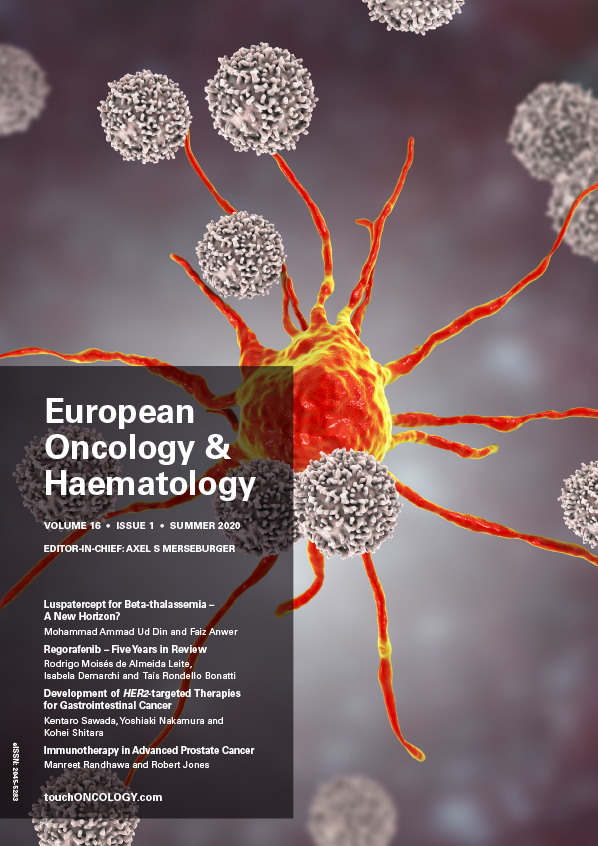
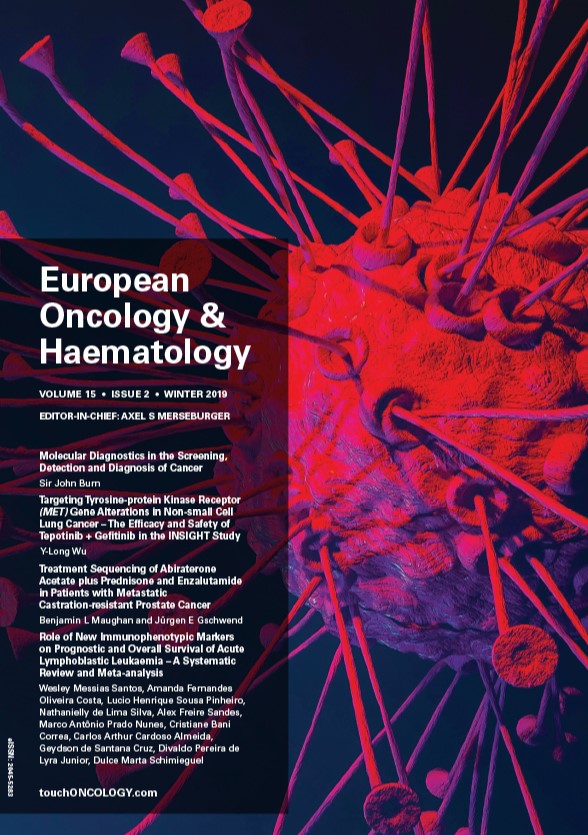
Comprising articles contributed by renowned thought leaders, European Oncology & Haematology is a peer reviewed, free-to-access, bi-annual journal that aims to disseminate best practice through review articles addressing the most important and salient developments in the Oncological & Haematology field in practical terms.
European Oncology & Haematology
Frequency: Two print issues per year (Summer & Winter); ePub ahead of print throughout the year.
Print ISSN: 2045-5275 Electronic ISSN: 2045-5283
Indexing: EMBASE, Google Scholar, Genamics JournalSeek
Log into your Touch Account
Keep track of your clinical interests and newsletter subscriptions.
Sign up with an Email
Or use a .
Register now for FREE access
Already registered? Login below.