New data from AZUR-1, CheckMate 8HW, UNION, IROCAS and TRIDENTE explore immunotherapy, treatment intensification and targeted therapy rechallenge, with findings that could inform treatment decisions across colorectal and rectal cancer

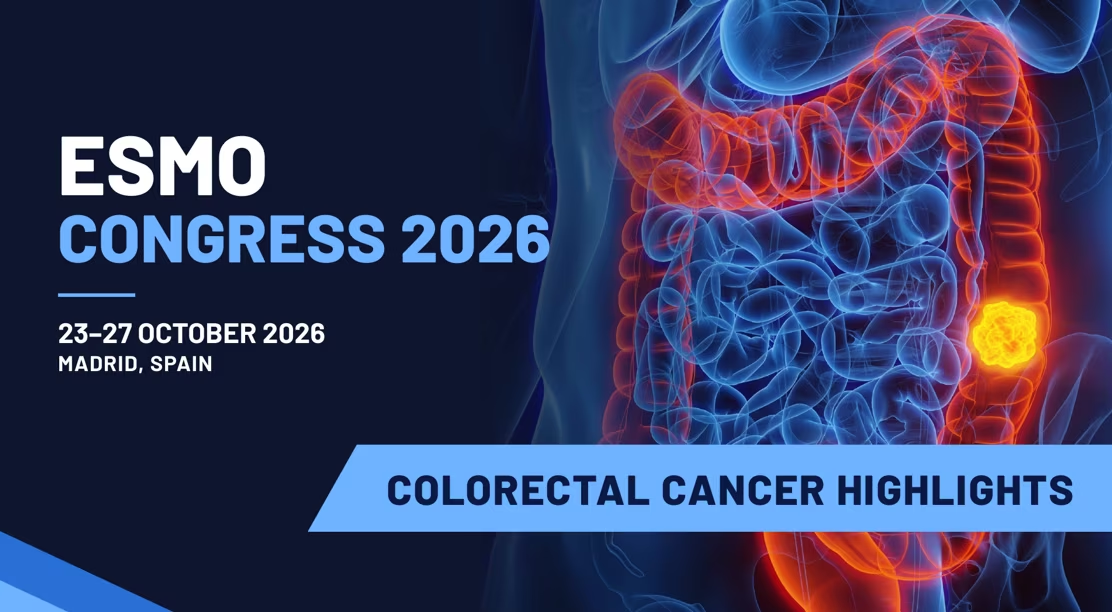
What are the most important developments in lower gastrointestinal oncology from the European Society for Medical Oncology (ESMO) Congress 2026?
Five selected studies examine key questions across locally advanced rectal cancer and metastatic and early-stage colorectal cancer. From the potential for immunotherapy to support organ preservation in dMMR/MSI-H rectal cancer, to longer-term survival outcomes with dual checkpoint inhibition and strategies to overcome acquired resistance to targeted therapy, these findings offer insights into evolving treatment approaches and their potential implications for clinical practice.
AZUR-1: Dostarlimab monotherapy in dMMR/MSI-H locally advanced rectal cancer
Abstract: LBA87 | ClinicalTrials.gov: NCT05723562 | Phase: II
AZUR-1 is the first global registrational trial evaluating dostarlimab monotherapy in patients with mismatch repair-deficient/microsatellite instability-high (dMMR/MSI-H) locally advanced rectal cancer (LARC). The single-arm study investigated whether programmed cell death protein 1 (PD-1) blockade could achieve sustained clinical complete responses (cCRs), potentially avoiding conventional multimodal treatment with chemotherapy, radiotherapy and surgery.
Patients received intravenous dostarlimab 500 mg every 3 weeks for nine cycles. At the April 20, 2026 data cutoff, 154 patients had been enrolled, with a median follow-up of 26.3 months. Among 144 patients with at least 12 months of follow-up, 68% achieved a sustained cCR for 12 months following the end of treatment, according to investigator assessment. The composite rate of cCR12 or pathological complete response (pCR) was 76%. Independent central review found a cCR12 rate of 47% among evaluable patients. Overall, 98% of patients who achieved cCR remained in cCR for at least 12 months, with no recurrences reported to date among patients achieving cCR or pCR. Grade ≥3 immune-mediated adverse events occurred in four patients.
Key clinical takeaway: Dostarlimab monotherapy demonstrated durable clinical responses in dMMR/MSI-H LARC, with the potential to reduce the need for chemotherapy, radiotherapy and surgery in selected patients. Longer-term follow-up will be important to establish the durability of these responses and further define the role of non-operative management.
UNION: Neoadjuvant short-course radiotherapy followed by camrelizumab and chemotherapy in locally advanced rectal cancer
Abstract: 3530O | ClinicalTrials.gov: NCT04928807 | Phase: III
UNION is a phase III trial investigating an immunotherapy-containing neoadjuvant strategy in LARC, addressing the limited evidence for immunotherapy-based approaches in the predominantly proficient mismatch repair/microsatellite-stable population. The study compared short-course radiotherapy (25 Gy in five fractions) followed by camrelizumab and capecitabine plus oxaliplatin (CAPOX) with conventional long-course chemoradiotherapy followed by CAPOX.
A total of 231 patients were randomized to the experimental (n=113) or standard-of-care (n=118) groups. At a median follow-up of 36.8 and 35.6 months, respectively, the 3-year event-free survival (EFS) rate was 91.3% with the camrelizumab-containing regimen versus 77.4% with standard treatment (hazard ratio [HR], 0.33; 95% confidence interval [CI], 0.15–0.71; P=0.0029). Grade ≥3 treatment-related adverse events occurred in 51.3% and 48.2% of patients, respectively.
Key clinical takeaway: The addition of camrelizumab to a short-course radiotherapy and CAPOX-based neoadjuvant strategy significantly improved 3-year EFS compared with long-course chemoradiotherapy and CAPOX. These phase III findings support further consideration of immunotherapy-containing neoadjuvant approaches in LARC.
CheckMate 8HW: Final overall survival results with nivolumab plus ipilimumab in MSI-H/dMMR metastatic colorectal cancer
Abstract: LBA32 | ClinicalTrials.gov: NCT04008030 | Phase: III
CheckMate 8HW evaluated nivolumab plus ipilimumab versus nivolumab or chemotherapy in patients with microsatellite instability-high/mismatch repair-deficient (MSI-H/dMMR) metastatic colorectal cancer (mCRC). Previous analyses demonstrated progression-free survival (PFS) benefits with dual checkpoint inhibition across treatment lines. The latest analysis reports prespecified final overall survival (OS) results and updated efficacy and safety outcomes.
After a median follow-up of 68.1 months, nivolumab plus ipilimumab demonstrated a significant OS benefit compared with nivolumab across all treatment lines (HR, 0.61; 95% CI, 0.46–0.82; P=0.0009) and compared with chemotherapy in the first-line setting (HR, 0.37; 95% CI, 0.24–0.57; P<0.0001). In the first-line comparison with nivolumab, OS favored the combination (HR, 0.66; 95% CI, 0.44–0.99; P=0.0432), although this did not meet the prespecified statistical significance threshold. The objective response rate (ORR) was 72% with nivolumab plus ipilimumab versus 58% with nivolumab across all treatment lines. No new safety signals or additional treatment-related deaths were reported.
Key clinical takeaway: The final OS analysis reinforces the long-term clinical benefit of dual immune checkpoint blockade in MSI-H/dMMR mCRC. The findings provide important evidence supporting nivolumab plus ipilimumab as a first-line treatment option, although the first-line OS comparison with nivolumab alone did not meet the prespecified significance threshold.
G-HOPE-001: CLDN18.2-targeted ADC improves progression-free survival in previously treated gastric cancer
Abstract: LBA77 | ClinicalTrials.gov: NCT06238843 | Phase: III
G-HOPE-001 investigated arcotatug tavatecan (IBI343/TAK-921), a CLDN18.2-targeted antibody-drug conjugate (ADC), against treatment of physician’s choice (TPC) in patients with previously treated, advanced gastric or GEJ adenocarcinoma expressing CLDN18.2. Eligible patients had received 2–4 prior treatment regimens. In the first interim analysis, 408 patients were randomized to arcotatug tavatecan or TPC. Median progression-free survival (PFS), assessed by independent review, was significantly longer with arcotatug tavatecan (5.5 vs 2.9 months; HR 0.47; 95% CI, 0.34–0.65; P<0.0001). Median OS was 9.9 versus 7.4 months (HR 0.63; 95% CI, 0.45–0.89), although only 34.8% of OS events had occurred at the analysis. The objective response rate (ORR) was 23.6% versus 5.3%. Grade ≥3 treatment-emergent adverse events (TEAEs) occurred in 45.8% versus 57.9% of patients, respectively.
Key clinical takeaway: The results provide phase III evidence supporting CLDN18.2-targeted ADCs as a potential treatment approach in previously treated gastric and GEJ adenocarcinoma. The magnitude of the PFS improvement and observed response rates are notable, although longer follow-up will be required to establish the OS benefit.
IROCAS: Adjuvant mFOLFIRINOX versus mFOLFOX6 in high-risk stage III colon cancer
Abstract: LBA29 | ClinicalTrials.gov: NCT02967289 | Phase: III
IROCAS investigated whether intensifying adjuvant chemotherapy with modified FOLFIRINOX (mFOLFIRINOX) could improve outcomes compared with modified FOLFOX6 (mFOLFOX6) in patients with high-risk stage III colon cancer (T4 and/or N2). The randomized phase III trial enrolled 795 patients following R0 resection, with 398 assigned to mFOLFIRINOX and 397 to mFOLFOX6. Both regimens were administered every 2 weeks for 12 cycles.
After a median follow-up of 55 months, the 3-year disease-free survival (DFS) rate was 65.6% with mFOLFIRINOX versus 66.3% with mFOLFOX6 (HR, 1.07; 95% CI, 0.84–1.36; P=0.61). Three-year OS was 91.2% versus 86.7%, respectively (HR, 0.85; 95% CI, 0.61–1.21; P=0.37), although OS data remain immature. Grade ≥3 adverse events occurred in 62.2% and 62.1% of patients, respectively. Grade ≥3 diarrhea (15.6% vs 3.8%) and fatigue (7.3% vs 1.8%) were more frequent with mFOLFIRINOX.
Key clinical takeaway: Adjuvant treatment intensification with mFOLFIRINOX did not improve 3-year DFS compared with mFOLFOX6 in patients with high-risk stage III colon cancer. These findings do not support empirical chemotherapy intensification based on T4 and/or N2 status alone.
TRIDENTE: Encorafenib, binimetinib and cetuximab rechallenge in BRAF V600E-mutant metastatic colorectal cancer
Abstract: 789RO | Trial registration: jRCTs031210511 | Phase: II
TRIDENTE is a multicenter, single-arm phase II study investigating rechallenge with encorafenib, binimetinib and cetuximab in patients with BRAF V600E-mutant mCRC who previously responded to encorafenib and cetuximab-based treatment before experiencing disease progression. The rationale is based on evidence of BRAF/MEK inhibitor rechallenge activity in melanoma and the possibility of restoring sensitivity to targeted treatment following an encorafenib-free interval.
The study enrolled 21 patients who had previously achieved at least a partial response to encorafenib and cetuximab-based treatment, followed by disease progression. An encorafenib-free interval of at least 4 months was required. The primary endpoint was met, with an ORR of 19.0% (90% CI, 6.8–38.4%), including four partial responses. Stable disease was observed in 12 patients, while tumor shrinkage occurred in 11 (52.4%). Median PFS was 2.8 months and median OS was 9.6 months. No unexpected adverse events were observed. Exploratory circulating tumor DNA (ctDNA) analysis showed an ORR of 25.0% in patients without baseline resistance-associated genomic alterations versus 12.5% in those with alterations.
Key clinical takeaway: Encorafenib, binimetinib and cetuximab rechallenge demonstrated clinical activity in a subset of patients with previously treated BRAF V600E-mutant mCRC. The findings support further investigation of targeted therapy rechallenge and the potential role of ctDNA in identifying patients who may benefit. The small study population and median PFS of 2.8 months highlight the need for further evaluation.

This content has been developed independently by Touch Medical Media for touchONCOLOGY. It is not affiliated with the European Society for Medical Oncology (ESMO). Views expressed are the speaker’s own and do not necessarily reflect the views of Touch Medical Media. This article was created by the editorial team utilizing AI as an editorial tool (Claude.AI and ChatGPT 5.5). The content was developed and edited by human editors. No funding was received in the publication of this article.
Cite: ESMO 2026 colorectal cancer round-up: Five trials to watch. touchONCOLOGY. 3rd November 2026.
Editor: Sophie Nickelson