Cancer in a Changing Global Landscape: Challenges & Commitments
The European Cancer Summit 2025 brought together a unique gathering of oncology leaders, researchers, policymakers and patient advocates to review Europe’s Beating Cancer Plan and tackle barriers to equitable care. Discussions focussed on accelerating HPV elimination, strengthening screening and prevention and preparing health systems for artificial intelligence. The take-home message was of practical solutions, collaboration and sustained investment to ensure high-quality cancer care across Europe.
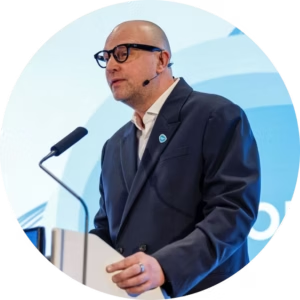 “We did not retreat in the face of uncertainty. We did not sidestep the issues. We leaned into them – in one session after another… You could hear it in the words of the speakers: no denial, no false optimism, just an unflinching commitment to protect the many advances we’ve achieved together through Europe’s Beating Cancer Plan”
Prof. Csaba Dégi
President, European Cancer Organisation
Not Just Treatment: The Power of Prevention and Cancer Screening
Organised by the HPV & Hep B Action Network
Presenter: Dr Isabel Rubio, President-Elect of the European Cancer Organisation
“At the European Cancer Summit, our session on prevention, early detection and screening delivered a call to action with the launch of our Screening Policy Status Report, which highlights how they are affected by factors including persistent health inequalities and reveals where gaps still undermine progress.
It also sets out clear, actionable recommendations to strengthen EU-level coordination and embed cancer screening priorities into the next Multiannual Financial Framework.”
The session reinforced that prevention remains Europe’s most powerful – but unevenly used – cancer control tool. With tobacco still responsible for over a quarter of cancer cases, and new nicotine products gaining popularity among young people, speakers called for clearer regulation and sustained public health investment. Advances in early detection technologies, meanwhile, offer the potential to shift diagnoses to earlier, more treatable stages.
Artificial Intelligence and Cancer Care: A Paradigm Shift in Progress
Organised by the Digital Health Network
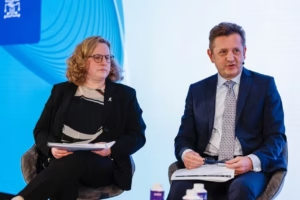 The Summit’s discussion on artificial intelligence (AI) highlighted both the promise and the practical challenges of integrating new technologies into cancer care. Professor Wim Oyen, Co-Chair of the ECO Digital Network and a member of the European Association of Nuclear Medicine, emphasised the need for political and financial backing to realise AI’s potential. ‘Institutional support from both the EU and its member states is key… This is the only way to ensure competitive European health systems’.
Speakers also stressed that innovation must be grounded in safety. Dr Annemiek Snoeckx, Co-Chair of the ECO Digital Network and a member of the European Society of Radiology, warned: ‘Rushing AI could cost lives instead of saving them. It is up to all of us to ensure safe delivery’. Ensuring clinicians have the skills to work confidently with AI tools is equally critical. As Dr Alex Eniu, Co-Chair of the ECO Digital Network and a member of the European School of Oncology, noted: ‘Training for healthcare professionals must keep pace with AI’s rapid evolution’.
The session drew on insights from the ECO report on AI, underscoring priorities such as AI literacy, ethical governance and secure, interoperable data systems. Real-world examples illustrated how AI is already influencing prevention, early detection and treatment. AI holds significant potential, but its benefits will depend on thoughtful, well-supported implementation across Europe.
Towards the Finish Line: Accelerating Momentum for HPV-related Cancers Elimination in Europe
Organised by the HPV & Hep B Action Network
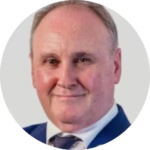 Presenter: Professor Daniel Kelly, past President of the European Oncology Nursing Society and co-chair of the ECO HPV Action Network
“HPV vaccination and screening are the keys to the elimination of cervical cancer and tackling other HPV cancers. This includes the rising rates of oropharyngeal cancers in men. Across Europe there is a wide variation in uptake and availability of HPV vaccines. This meeting focused on our recent work with countries in South East Europe. We will continue our collaborative efforts in 2026 to help ensure that HPV vaccination and screening are available across all countries in the WHO Europe region.”
Europe’s drive to eliminate HPV-related cancers has entered a decisive phase. This session highlighted how growing political commitment, stronger cross-country collaboration and new scientific tools are shaping the shift from planning to implementation. Speakers presented insights from the latest ECO paper on cervical cancer and HPV screening, updates from the European Centre for Disease Prevention and Control (ECDC) on vaccination monitoring and plans for a revised HPV Elimination Atlas. The session underscored that while momentum is strong, achieving elimination will depend on ensuring that progress translates into impact across all regions and communities.
This focus on regional equity continued in the Special Meeting on HPV Elimination in Southeast Europe, where experts and national representatives explored coordinated strategies to accelerate vaccination and screening uptake. The discussion reflected a broader Summit theme: that progress is only as strong as its reach, and regional collaboration remains essential for durable impact.
Together, these discussions underscored a unifying theme: Europe’s cancer community is advancing, but progress requires sustained coordination, investment and a commitment to ensuring that innovations reach all who need them.
 The European Cancer Organisation is a not-for-profit federation uniting oncology professionals and patients to drive policy, improve cancer care and reduce the cancer burden across Europe. Guided by values of patient centricity, scientific integrity, collaboration and transparency, it works to ensure every patient has access to high-quality, multidisciplinary care. Building on four decades of progress, the organisation strengthens partnerships with European institutions and member societies to advance impactful, evidence-based policy and a cancer-free future.
Cite: Key messages from the European Cancer Summit 2025. touchONCOLOGY. November 27th, 2025
Disclosure: This short article was produced in collaboration with the European Cancer Organisation. No funding or publication fees were involved in the publication of this article.
Related content
- Professor Mark Lawler on Europe’s Beating Cancer Plan: Progress, challenges and the future
- 12 million reasons for action: Transforming cancer care for women
- World Cancer Day 2025: A new era for cancer and rare disease advocacy in Europe
SIGN UP to touchONCOLOGY!
Join our global community today for access to thousands of peer-reviewed articles, expert insights, and learn-on-the-go education across 150+ specialties, plus concise email updates and newsletters so you never miss out.