 Professor Benjamin Besse discusses his priorities for EORTC, the challenges facing academic cancer research and the need to make clinical trials more representative of real-world patients.
As EORTC enters a new chapter under the Presidency of Professor Benjamin Besse (Paris-Saclay University and Gustave Roussy Institute, Villejuif, France), the organization is looking to accelerate academic research while keeping patients at its core. In this detailed and in-depth Q&A, Prof Besse shares his priorities for EORTC; from supporting the next generation of investigators and broadening clinical trial populations, to giving greater weight to quality of life and patient perspectives. He also considers how emerging technologies, including artificial intelligence, could reshape the way cancer research is conducted.
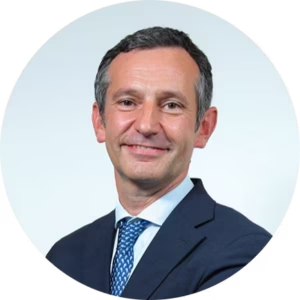
Congratulations on your new appointment as President of EORTC! What are your main priorities, and what would you most like to achieve for the society and the wider cancer community during your tenure?
The goal of EORTC has always been to improve patient survival and quality of life, and these will remain my main priorities. Maintaining our independence is also essential. EORTC is a nonprofit, fully independent organization, meaning that we own the data and conduct our own analyses of the primary endpoint. This is a very important aspect of academic clinical research.
At the same time, we need to improve. We need to be faster and better, and we need to bring the scientific expertise of all our strong networks into clinical trials. We cover almost all solid tumors, which gives us considerable strength. It is also important to develop common teams across the group because, although oncology involves many different organs and tumor types, many of the scientific and methodological challenges are shared across cancers. We need to emphasize this multidisciplinary approach.
Another priority is training the next generation. Early-career investigators are a very strong component of our network. They represent nearly one-third of our more than 4,000 members, making them a substantial community within EORTC. We need to help them develop, lead future studies and maintain the independence of academic research.
Finally, EORTC will make a financial investment in clinical research. We are a well-resourced organization, but if we want to accelerate academic research, we need to invest in it. Using our own resources to accelerate research and ultimately change the standard of care will therefore be a major priority.
What do you see as the greatest challenges facing academic cancer research today, and how can EORTC help address these?
Running a clinical trial today is more challenging than it was in the past, particularly because of the increasingly complex regulatory environment. Another major challenge for academic groups is funding and access to drugs. We can challenge the standard of care by comparing existing treatments, but our objective is often to improve the standard of care by introducing innovation. This often requires collaboration with the pharmaceutical industry while maintaining our independence. We need to demonstrate to our pharmaceutical partners that conducting studies in an academic environment provides important advantages. Through our strong networks, we can analyze patient samples, understand how a drug works and investigate how resistance emerges. These are important contributions that can help maximize the value of clinical research.
A further challenge is the underrepresentation of certain patient populations in clinical trials. In lung cancer, for example, the median age of patients enrolled in clinical trials is usually around 60. This does not reflect the reality of the age at which lung cancer is diagnosed in Europe or the USA. Eligibility criteria are often so restrictive that the patients enrolled do not adequately represent the broader patient population. We therefore need to understand how these treatments perform in patients who are not typically included in clinical trials, particularly in terms of benefit and toxicity. A few examples: older adults are often underrepresented, as are patients with brain metastases. Patients receiving steroids may also be excluded from immunotherapy trials, despite this being a common clinical situation.
Another area where EORTC has a strong background is rare cancers. Collectively, rare cancers affect a 20–25% patients, but they comprise a myriad of individual diseases. Pharmaceutical companies may be reluctant to invest because of the relatively small patient populations. EORTC has an important role to play in supporting innovation for these patients.
Finally, EORTC’s decision to invest its own resources in academic research can help address some of these challenges. We want to be not only the engine of clinical research, but also the fuel that drives it forward.
How can we ensure that quality of life and patient-reported outcomes are given greater weight alongside traditional measures such as survival when evaluating new cancer treatments?
EORTC is a leader in quality-of-life research. Our questionnaires are used worldwide, and we have a very strong group dedicated to understanding innovation in this area. The first step is to ensure that quality of life is incorporated into all clinical studies and analyzed appropriately. We then need to consider how quality-of-life assessment will evolve. One particularly interesting question concerns the role of new technologies, including wearable devices. A digital watch, for example, can provide information about physical activity and other aspects of daily life. We need to determine whether this type of information can provide greater insight than traditional questionnaires or information collected through conversations with patients during consultations.
Another important issue is how we assess treatment toxicity. We use the Common Terminology Criteria for Adverse Events (CTCAE), with each toxicity assigned a grade. However, this system was developed primarily in the context of chemotherapy. We now have targeted therapies, immunotherapies and new types of chemotherapy, such as antibody-drug conjugates (ADCs).
Unlike traditional chemotherapy, which was often administered for a relatively short period, many of these treatments are given chronically. Chronic toxicities are therefore increasingly important but are not always adequately captured. For example, grade 2 diarrhea is defined as 3-7 stools per day. If 15% of patients experience grade 2 diarrhea, it might appear relatively reassuring when looking only at the toxicity table. However, if patients remain on treatment for two years, this ongoing toxicity could have a substantial impact on quality of life.
We have tools to assess quality of life, but these often provide an overall picture that combines many different indicators. We need to consider how best to capture and report the specific impact of chronic treatment-related toxicities. This is an area where further investment is needed.
How can we strengthen collaboration between researchers, clinicians and patients to ensure that the questions being asked in cancer research truly represent patients’ needs?
As investigators, we develop questions that are usually scientifically sound, but patients should be involved from the beginning to help shape those questions and determine whether they truly reflect what matters to them. They may also identify additional questions that investigators have not considered. Patient involvement should continue throughout the study. For example, when a patient enrols in a clinical trial, they may receive 40 pages of informed consent information. Although this is reviewed by an ethics committee that includes patients, the language can still be difficult to understand.
We should consider systems in which patients can explain clinical trials to other patients. This is something we do not currently do enough. Patients could be involved not only in the design of a trial, but also in its implementation, helping to make the process easier for newly diagnosed patients who are already dealing with a great deal of information and uncertainty. New technologies could support this. For example, a QR code could allow a patient to access a video in which another patient explains the clinical trial in their own words. These are practical approaches that we should explore.
More fundamentally, we need to ask what questions patients want answered. It should not always be the investigator who brings forward the research question. Patients should have the opportunity to identify the questions that matter to them, with investigators then helping to translate those priorities into clinical trials.
What role can EORTC play in bringing together researchers, policymakers, regulators and patients to ensure that advances in cancer research translate into meaningful improvements in cancer care?
EORTC sits at the intersection of the different groups involved in clinical research, from patients to regulators, because we interact with all of these key stakeholders. Our network is also exceptionally strong. We cover all solid tumors and some hematological malignancies, giving us a broad perspective across oncology. Because oncology is so diverse, we have decided to focus on specific areas that we consider particularly important, often emerging topics. This is why we have created task forces with the Scientific Chairs Council.
Task forces provide a multidisciplinary environment in which we can accelerate development in a specific area. Minimal residual disease (MRD) is one example. MRD assessment can help determine whether a patient is truly free of disease following curative treatment. New blood-based tests may offer a highly specific way of detecting residual disease, and this is a question that extends across different cancer types, including breast, colorectal and lung cancer. These task forces bring together researchers developing new technologies and clinicians who can determine when and how they should be used. We can then define the key research questions. For example, is a blood test better than a CT scan for monitoring patients? The objective is to design the appropriate studies and endpoints to generate evidence that can convince regulators and the wider clinical community that it is appropriate to move from one follow-up modality to another.
Looking ahead, which innovations and current EORTC initiatives do you believe have the greatest potential to shape the future of cancer research?
We have already discussed the importance of quality of life and the new tools that may improve how we assess it. This will be an important area for future research. Education is also a key priority for EORTC because many of these new tools and innovations will come from the younger generation. Artificial intelligence will undoubtedly play an important role in clinical research. We already have models that can automatically extract data and populate databases without human intervention. However, we need to understand the quality of the data generated and how these tools can be applied reliably in prospective trials. AI is bringing a range of potentially valuable tools, and I am confident that it will accelerate research. The challenge is determining where these technologies can be properly validated. EORTC is well positioned to contribute because we are multidisciplinary, cover all types of cancer and have the networks required to assess and validate new technologies. I would therefore say that the evaluation and validation of AI and other emerging technologies should be one of the key new areas for EORTC.
About EORTC
The European Organisation for Research and Treatment of Cancer (EORTC) is an academic clinical research organisation, which unites clinical cancer research experts across the globe to define better treatments for cancer patients to prolong survival and improve quality of life. Both international and multidisciplinary, EORTC’s network comprises of over 4200 collaborators involved in cancer treatment and research in 1100 institutions across 74 countries. Conducting translational research, and phase 2 and 3 trials, EORTC offers an integrated approach to therapeutic strategies and quality of life. EORTC Headquarters, a unique international clinical research infrastructure, are based in Brussels, Belgium, from where its various activities are coordinated and run by over 240 staff.
For further information, please visit the EORTC website: www.eortc.org
This content has been developed independently by Touch Medical Media for touchONCOLOGY in collaboration with EORTC. Views expressed are the speaker’s own and do not necessarily reflect the views of Touch Medical Media.
Cite: President Prof Benjamin Besse: Shaping the future of cancer research at EORTC. touchONCOLOGY. 6th October 2026.
Editor: Sophie Nickelson