“We want to bridge the gap between evidence and practice so older patients benefit from the research”

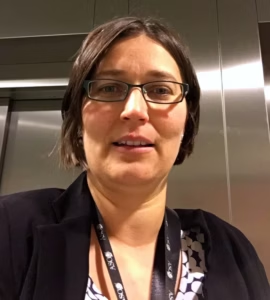 As the International Society of Geriatric Oncology (SIOG) marks its 25th anniversary in Ghent on 20th–22nd November, 2025. Prof. Dr. Lore Decoster, Head of Medical Oncology at UZ Brussel, Jette, Belgium and this year’s scientific program chair – reflects on the society’s evolving role. With a theme of ‘Bridging research and clinical practice‘, the 2025 SIOG Annual Meeting aims to empower clinicians to deliver evidence-based, individualized care to older adults with cancer. From global care models to tumour-specific sessions and innovations in supportive care, Prof. Decoster shares her vision for impactful discussions – and a strengthened, interdisciplinary community dedicated to transforming oncology for an aging population.
Q1. What are the key themes or priorities guiding the scientific program this year?
This year we will celebrate the 25th Anniversary of SIOG in Ghent with an opening celebration session where we will have a look at the past, present, and future of SIOG. The main theme of this year’s SIOG annual meeting is ‘Bridging research and clinical practice in geriatric oncology’. The scientific committee really wanted to focus on the integration of scientific evidence into daily clinical care to improve outcomes for older adults with cancer. This means that we will have sessions focusing on research in geriatric oncology, but also sessions focusing on the daily clinical practice and how to apply these research results in the clinic after the meeting.
Q2. How has the field evolved in the past few years, particularly in the integration of geriatrics and oncology?
Different randomized controlled trials have demonstrated the benefit of performing a comprehensive geriatric assessment in older adults with cancer, including improvement in quality of life and decrease in serious toxicity from systemic therapy. The ASCO guidelines therefore recommend performing such a comprehensive geriatric assessment with a subsequent care plan in all older adults with cancer who are candidates for systemic therapy. However, many barriers for its implementation in daily practice remain. At SIOG 2025, different care models will be presented, and participants can learn from each other to overcome these barriers.
Q3. Are there specific sessions or studies at this year’s meeting that you believe will be practice-changing or provoke important discussions?
I hope all sessions will lead to important discussions and messages to take home to our daily clinical practice. I certainly believe the opening session where different care models for the integration of geriatrics in oncology will be presented, will provoke interesting discussions. We have had an enormous reply from the SIOG community with members from all over the world sending us their care model. Unfortunately, we could only select a few for oral presentation but I am happy that all models will also be presented as a poster. This session will give the participants the opportunity to adapt or integrate their geriatric oncology approach in their hospital.
As usual I am also excited about the tumor specific sessions in breast cancer, lung cancer and hematological malignancies. I also believe the session on the integration of exercise in the care of older adults with cancer will be important.
Q4. How can young investigators and clinicians be encouraged to engage with geriatric oncology and contribute to its growth?
Everyone involved or working in oncology: doctors, nurses, physiotherapists, pharmacists, patient advocates and others should realize that older adults are today the majority of our cancer patients and that this heterogeneous population has specific needs. Engaging in geriatric oncology should almost be mandatory in order to improve care for these patients. SIOG is the only organization that focusses on the care of older adults with cancer and therefore I would encourage all young health care workers involved in the field of oncology to become part of the SIOG family. Learn from experts, engage in different groups such as Young SIOG and SIOG Nurses Allied Health and Scientist group and participate in the annual meeting, online webinars or the Treviso masterclass.
Q5. What are your aspirations for the future of the SIOG Annual Meeting and its scientific mission?
For the SIOG annual meeting of 2025 I believe we have an exciting program and I hope participants will go home and realize that on the next Monday they are able to offer better care for their older adults with cancer. I also hope that this meeting will encourage young participants to engage in geriatric oncology research and in SIOG as an organization. Finally, I hope this meeting will further strengthen the SIOG family which includes physicians of all kind (oncologists, hematologists, surgeons, radiotherapists) as well as nurses, pharmacists and last but not least patient advocates.
It is together that we are able to improve care of older adults with cancer in the future!
About Prof. Dr. Lore Decoster
Prof. Dr. Lore Decoster obtained her medical degree from the VUB in 2002 and subsequently completed her training in internal medicine with a subspecialization in medical oncology. Prof. Decoster has been a staff member in the medical oncology department of the UZ Brussel since 2008, where she is currently head of department. She is an expert in the treatment of lung cancer and thyroid cancer. In addition, she has a specific interest in the treatment of elderly people with cancer, the subject of her doctoral thesis. Prof. Decoster is a member of various professional associations such as BSMO, ESMO, ASCO, and SIOG. She is the national representative for Belgium at the International Society of Geriatric Oncology.

About the International Society of Geriatric Oncology
Founded in 2000, the International Society of Geriatric Oncology, commonly referred to by its French acronym SIOG (Société Internationale d’Oncologie Gériatrique), is an international multidisciplinary network of healthcare professionals treating older cancer patients. The network spans over 80 countries and includes geriatricians, medical oncologists, surgical oncologists, radiation oncologists, anaesthesiologists, as well as nursing and allied health professionals.
Disclosure: This short article was prepared by touchONCOLOGY in collaboration with the International Society of Geriatric Oncology (SIOG). No fees or funding were associated with its publication.
Cite: SIOG 2025: Marking 25 years of advancing geriatric oncology. touchONCOLOGY. July 29th, 2025
SIGN UP to touchONCOLOGY!
Join our global community today for access to thousands of peer-reviewed articles, expert insights, and learn-on-the-go education across 150+ specialties, plus concise email updates and newsletters so you never miss out.