
This website is intended for healthcare professionals only

Trending Topic

3 mins

Trending Topic

Developed by Touch
Mark CompleteCompleted
BookmarkBookmarked

This issue of touchREVIEWS in Oncology & Haematology brings together a diverse collection of articles reflecting the growing complexity of cancer care and the continued evolution of precision medicine across tumour types. From rare malignancies and treatment-related challenges to emerging targeted therapies and novel biological insights, the contributions highlight both recent progress and the significant […]

Key takeaways from EBCC15: Less invasive, more effective

5 mins
Share
Facebook
X (formerly Twitter)
LinkedIn
Via Email
Mark CompleteCompleted
BookmarkBookmarked
Copy LinkLink Copied
Published Online: Apr 2nd 2026

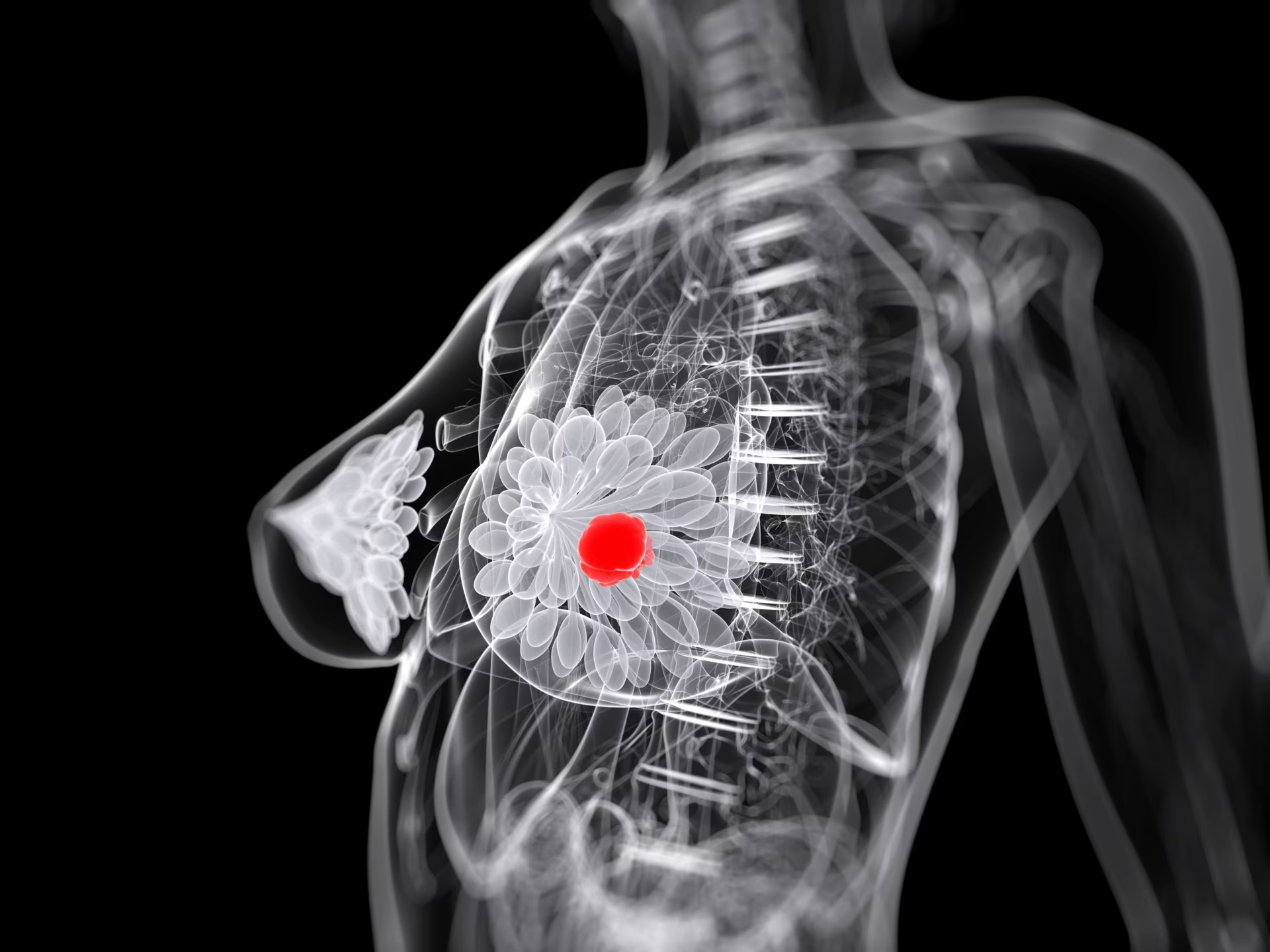
Inflammation of the breast in women. Female breasts with signs of the disease. A low-poly construction of interconnected lines and points. Blue background.

The 15th European Breast Cancer Conference (EBCC15) showcased a wave of research poised to reshape breast cancer care. From safely scaling back surgery in low-risk DCIS to targeted radiotherapy strategies, innovative implants and breakthrough therapies easing treatment side effects, these studies signal a shift toward more precise, patient-friendly care. Early findings also hint at the power of blood-based biomarkers to predict relapse, potentially transforming post-surgery monitoring. Below, we spotlight the key highlights from this year’s conference.


LORD trial: Early data support de-escalation in low-risk DCIS care

Early data from the LORD trial (NCT02492607) suggest active surveillance may be a safe alternative to surgery for low-risk DCIS.1,2 In this multicentre study across ~60 Dutch hospitals, 1,423 patients (grade 1–2, screen-detected DCIS) were followed for ~2 years; most (1,025 vs 330) chose surveillance after an initial randomised phase. Invasive cancer occurred in 33/363 (9%) receiving surgery versus 63/1060 (6%) under surveillance. Tumours detected during surveillance were slightly larger (9mm vs 6mm) but not more aggressive. These findings indicate no worse short-term outcomes with monitoring, supporting de-escalation strategies, although longer follow-up is essential before practice changes.

ADARNAT: Less invasive radiotherapy may cut lymphoedema in breast cancer

In the ADARNAT phase III pilot trial, axillary radiotherapy (ART) showed comparable cancer control to axillary lymph node dissection (ALND) while reducing lymphoedema risk.3-5 In this randomised study of 272 patients post-neoadjuvant therapy, outcomes were analysed in 46 ART and 56 ALND patients over two years. No axillary recurrences occurred with ART versus 1.8% with ALND; distant metastases were 4.4% vs 5.5%, with two deaths (4.3%) in the ALND arm. Lymphoedema rates were lower with ART (18.9% vs 26.7%). Despite higher acute skin toxicity (27.8% vs 13.3%), effects were transient. ART appears feasible, but definitive phase III data are needed before practice change.

OASIS 4: Elinzanetant cuts vasomotor symptoms across endocrine therapies

Polyurethane-coated breast implants may significantly reduce post-mastectomy complications in radiotherapy-treated patients, new EBCC15 data suggest.8,9 In this retrospective, multicentre analysis of 1455 women (2016–2024), outcomes were compared between polyurethane-coated (n=475) and standard implants (n=980). Capsular contracture occurred in 32.8% versus 47.5%, while reoperation rates were 9.3% versus 25.7%, respectively. Risks of major infection and implant removal were also lower with polyurethane coating. Follow-up lasted two-and-half to three years. Although non-randomised, the findings indicate implant type may meaningfully influence outcomes, supporting polyurethane-coated implants as a strategy to reduce complications and improve reconstructive durability after radiotherapy.

Tailored radiotherapy keeps breast cancer recurrence under 3%

The ten-year Dutch study shows breast cancer recurrence remains very low when radiotherapy is tailored to patients’ post-chemotherapy risk.10,11 Researchers followed 848 women with small tumours and limited lymph node involvement, categorising them into low, intermediate, and high-risk groups based on residual cancer in lymph nodes. Low-risk patients received minimal or no radiotherapy, intermediate-risk received breast-only radiotherapy, and high-risk received breast plus lymph node radiotherapy. Over ten years, just 24 of 838 patients (2.9%) experienced recurrence—2.4% low-risk, 3.2% intermediate, 2.8% high-risk. The findings support risk-adapted radiotherapy, reducing treatment burden without compromising safety.

Blood test predicts breast cancer relapse after pre-surgery therapy

Fragments of tumour DNA circulating in blood can predict breast cancer recurrence, especially after neoadjuvant treatments.12,13 In a prospective study of 81 women (median age 48) with mostly lymph node–positive, triple-negative tumours, researchers analyzed ctDNA at treatment start, post-neoadjuvant therapy, and during ~7 years’ follow-up. ctDNA was detected in 57% of patients at baseline and fell to 17% after treatment. Patients with post-treatment ctDNA were 3.5 times more likely to relapse, even if imaging suggested complete tumour clearance. Findings suggest ctDNA could guide post-surgery therapy and identify high-risk patients for closer monitoring.


References

  1. Abstract no: 2LBA, “De-escalating treatment for low-risk Ductal Carcinoma In Situ: early safety of active surveillance without endocrine therapy in the prespecified interim analysis of the LORD-trial* (BOOG 2014-04)”, Oral abstract session, 08:30-10:00 hrs CET, Friday 27 March, rooms 113-116
  2. EBCC15. Early results from a trial of active surveillance for low-risk DCIS are ‘reassuring’. Available at: https://event.eortc.org/ebcc15/2026/03/27/early-results-from-a-trial-of-active-surveillance-for-low-risk-dcis-are-reassuring/ (Date last accessed: 2nd April 2026)
  3. Abstract no: 7, “Axillary radiotherapy as an alternative to axillary dissection for node-positive breast cancer after neoadjuvant therapy: two-year survival results from the ADARNAT pilot phase”, Thursday 26 March, Oral abstract plenary session, 09:30-11:00 hrs CET, rooms 113-116
  4. Abstract no: 28, “What Is the Real Impact of Axillary Radiotherapy on Treatment-Related Toxicity? A Randomized Comparison with Axillary Lymph Node Dissection in the ADARNAT Trial”, Friday 27 March, 11:00-11:30, Poster in the Spotlight session, Exhibition Hall
  5. EBCC15. Radiotherapy rather than surgery may help reduce risk of lymphoedema in patients with breast cancer: results from pilot study. Available at: https://event.eortc.org/ebcc15/2026/03/26/radiotherapy-rather-than-surgery-may-help-reduce-risk-of-lymphoedema-in-patients-with-breast-cancer-results-from-pilot-study/ (Date last accessed: 2nd April 2026)
  6. Abstract no: 3, “Efficacy of elinzanetant for the treatment of vasomotor symptoms in women with breast cancer: subgroup analysis of the OASIS-4 trial by type of endocrine therapy”, Thursday 26 March, Oral abstract session, 09.30-11:00 hrs, room 113-116
  7. EBCC15. Elinzanetant reduces severity and frequency of hot flushes and night sweats, regardless of type of hormone treatment breast cancer patients receive. Available at: https://event.eortc.org/ebcc15/2026/03/26/hormone-treatment-breast-cancer/ (Date last accessed: 2nd April 2026)
  8. Abstract no: 2, “The impact of polyurethane coated implants on the risk of capsular contracture after immediate prepectoral breast reconstruction in the setting of postmastectomy radiotherapy: the OPBC-09 PRExRT study”, in Plenary session ‘Opening of the 15th European Breast Cancer Conference and Awards’, 09:00-10:30 hrs, Wednesday 25 March, rooms 113-116
  9. EBCC15. Breast reconstruction using polyurethane-coated implants reduces scarring and the need for further surgery. Available at: https://event.eortc.org/ebcc15/2026/03/25/breast-reconstruction-using-polyurethane-coated-implants-reduces-scarring-and-the-need-for-further-surgery/ (Date last accessed: 2nd April 2026)
  10. Abstract no: 1, ‘Radiotherapy Long term results of Radiation therapy de-escalation in cT1-2N1 breast cancer After Primary CHEMotherapy (RAPCHEM: BOOG 2010-03): 10-year follow-up results of a Dutch, prospective, registry study’, by Fleur Mauritz et al, presented in ‘Opening of the 15th European Breast Cancer Conference and Awards’, Plenary session, rooms 113-116, 09:00-10:30 hrs CET, Wednesday 25 March.
  11. EBCC15. Breast cancer recurrence remains low, even after ten years, with radiotherapy tailored to patient’s individual risk. Available at: https://event.eortc.org/ebcc15/2026/03/25/breast-cancer-recurrence-remains-low-even-after-ten-years-with-radiotherapy-tailored-to-patients-individual-risk-2/ (Date last accessed: 2nd April 2026)
  12. Abstract no: 12, “Circulating tumor DNA at completion of neoadjuvant therapy is an independent prognostic marker: an individual patient-level pooled analysis of two prospective studies”, Friday 27 March, Oral abstract plenary session, 08.30-10.00 hrs CET, rooms 113-116
  13. EBCC15. Tumour DNA circulating in patients’ blood after pre-surgery treatments predicts whether breast cancer will return. Available at: https://event.eortc.org/ebcc15/2026/03/27/tumour-dna-circulating-in-patients-blood-after-pre-surgery-treatments-predicts-whether-breast-cancer-will-return/ (Date last accessed: 2nd April 2026)

Cite: Key takeaways from EBCC15: Less invasive, more effective. touchONCOLOGY. 2nd April, 2026

Disclosure: This short article was prepared by touchONCOLOGY. The content was developed and edited by human editors. No fees or funding were associated with its publication. touchONCOLOGY utilize AI as an editorial tool (ChatGPT (GPT-4o) [Large language model]. https://chat.openai.com/chat).

Editor: Sophie Nickelson (Editorial Director)

Register now for FREE access

Already registered? Login below.

Register
Login


Related content

Share
Facebook
X (formerly Twitter)
LinkedIn
Via Email
Mark CompleteCompleted
BookmarkBookmarked
Copy LinkLink Copied
Close Popup