Open Nav
Open Nav

Check your Inbox
We've sent your certificate

Thank you
for your Feedback!
Activity Overview
Faculty & Disclosures
Activity Overview
Faculty & Disclosures

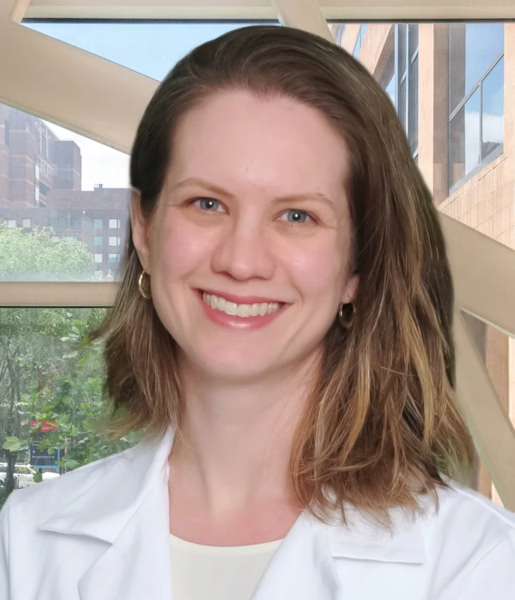
Prof. Beatrice Razzo
Thomas Jefferson University, Philadelphia, PA
Biography
Beatrice Razzo, MD, is an Assistant Professor of Medicine at Thomas Jefferson University in Philadelphia, Pennsylvania. Her clinical expertise centres on multiple myeloma and related plasma cell disorders. Her research focuses on clinical and translational strategies to better inform the selection, sequencing and optimal duration of T-cell–redirecting therapies in multiple myeloma. Prof. Razzo has led and contributed to pragmatic clinical trials and real-world studies evaluating teclistamab in relapsed/refractory multiple myeloma, with an emphasis on treatment effectiveness, toxicity and the role of immune fitness.
Disclosures
Advisory board honoraria from Johnson & Johnson. Honoraria from touchMEDICAL.
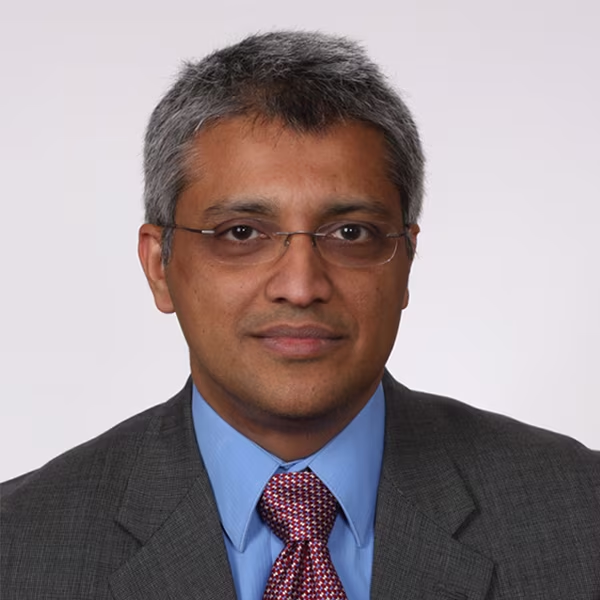
Prof. Shaji K Kumar
Mayo Clinic Comprehensive Cancer Centre, Rochester, MN
Prof. Shaji K Kumar
Mayo Clinic Comprehensive Cancer Centre, Rochester, MN
Biography
Shaji K. Kumar, MD, is a Consultant in the Division of Hematology and the Mark and Judy Mullins Professor of Hematological Malignancies at the Mayo Clinic in Rochester, Minnesota. He serves as Chair of the Myeloma, Amyloidosis and Dysproteinemia Disease Group at the Mayo Clinic, as well as Research Chair for the Division of Hematology. Prof. Kumar’s research centres on developing new drugs and drug combinations for treating myeloma; he is the Principal Investigator of multiple Phase 1, 2 and 3 clinical trials. Additionally, he studies the mechanisms behind disease progression from precursor conditions and risk stratification of plasma cell disorders. His laboratory aims to understand the role of the bone marrow microenvironment in the development and progression of myeloma. Prof. Kumar serves as Chair of the NCCN Multiple Myeloma Guidelines Panel, and he is the President of the International Society of Amyloidosis and the Vice President of the International Myeloma Society.
Disclosures
Research support for clinical trials from AbbVie, Adaptive, Celgene, Janssen, Kite, MedImmune/AstraZeneca and Takeda. Advisory Board honoraria from AbbVie, Adaptive, Celgene, Janssen, Kite, MedImmune/AstraZeneca, Merck, Novartis, Roche, Sanofi and Takeda. Independent Review Committee participation for Oncopeptides. Honoraria from touchMEDICAL.
Prof. Beatrice Razzo
Thomas Jefferson University, Philadelphia, PA
touchEXPERT INSIGHTS
This content is intended for healthcare professionals only.
Please confirm you are a healthcare professional

This activity is supported with funding from Legend Biotech. This activity is provided by touchMEDICAL for touchONCOLOGY.
Close Popup
Could not verify Country/IP Address.
We were unable to verify your IP address, please try again later. If you are using a method to hide your IP address, such as a VPN or proxy, please disable this and try again.
This activity is supported with funding from Legend Biotech.
This activity is supported with funding from Legend Biotech. This activity is provided by touchMEDICAL for touchONCOLOGY.
Unapproved products or unapproved uses of approved products may be discussed by the faculty; these situations may reflect the approval status in one or more jurisdictions. The presenting faculty have been advised by touchMEDICAL to ensure that they disclose any such references made to unlabelled or unapproved use. No endorsement by touchMEDICAL of any unapproved products or unapproved uses is either made or implied by mention of these products or uses in touchMEDICAL activities. touchMEDICAL accepts no responsibility for errors or omissions.
The views and opinions expressed are those of the faculty and do not necessarily reflect those of any sponsor.
Date of preparation: May 2026
Log into your Touch Account
Keep track of your clinical interests and newsletter subscriptions.
Sign up with an Email
Or use a .
Register now for FREE access
Already registered? Login below.