“The European Cancer Organisation is where professionals, patients and policymakers build the trust and consensus that makes real change possible”
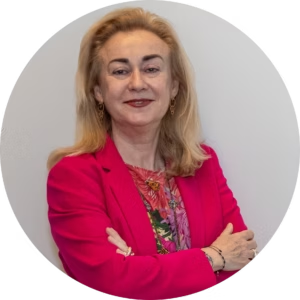
 As President of the European Cancer Organisation, Dr Isabel Rubio is leading Europe’s fight against cancer with a clear vision: sustained investment, stronger coordination and measurable progress. From groundbreaking research to policy innovation, she is driving change where it matters most – for patients. In this Q&A with touchONCOLOGY, Dr Rubio explains her priorities for shaping Europe’s cancer landscape over the next two years.
There is so much I want to achieve during my two-year Presidency, but there are three goals that are paramount.
– First: to secure sustained funding for cancer care and cancer control within the EU’s next long-term budget. The progress achieved through Europe’s Beating Cancer Plan must not be allowed to stall.
– Second: to strengthen global partnerships, because cancer cannot be addressed in isolation. We are all stronger when we work collaboratively.
– Third: to improve data and ensure we have timely, reliable and comparable evidence to identify inequities, guide investment and measure progress.
If, by next year, we have helped achieve a strong, sustained EU commitment to cancer care and cancer control in the EU’s 2028–2034 Multiannual Financial Framework, I would consider that a meaningful legacy. It would safeguard what Europe’s Beating Cancer Plan and the allied Europe’s Cancer Mission have started, and would prevent fragmentation for many years to come.
I would want to see a credible pathway toward sustained investment (including the kind of dedicated funding ECO is advocating), stronger coordination via a European Cancer Institute so initiatives are not duplicated and can scale up, and clearer targets and data that allow Europe to track progress and close disparities between countries and within countries. And I would want ECO to be recognised as the place where cancer professionals, patients and policymakers build the trust and consensus that makes those outcomes politically possible.
Europe’s Beating Cancer Plan is the cornerstone of EU action on cancer, and ECO’s role is to help ensure its ambitions translate into tangible, equitable improvements for patients across Europe. We do this by acting as a bridge between policymakers, professionals, and patient communities – turning shared priorities into practical, coordinated action. ECO adds real value in three areas:
Protecting long-term momentum. The progress achieved under the Plan must be sustained beyond the current funding cycle. That is why ECO is mobilising the cancer community around the next EU budget to ensure cancer remains a clear political and financial priority, so today’s initiatives continue to deliver impact well into the next decade.
Strengthening accountability through data and measurable goals. ECO supports the evolution of cancer policy toward clearer targets, stronger monitoring, and better use of comparative data—so we can track progress, identify inequalities, and guide smarter investment where needs are greatest.
Ensuring coordination across Europe’s cancer ecosystem. With so many valuable initiatives underway, ECO’s convening role is essential to connect stakeholders, align efforts, and help successful projects move from pilots to sustainable, system-wide improvements adopted across countries.
ECO’s contribution is not to duplicate institutional work, but to help it function better by building consensus, maintaining political momentum, and ensuring that European cancer policy translates into real benefits for every patient, everywhere in Europe.
Europe’s Beating Cancer Plan is one of the most ambitious public health initiatives ever launched at EU level, and it has already helped place cancer firmly on the political agenda across Europe. One of its major achievements has been stimulating renewed attention to national cancer strategies and strengthening collaboration across countries. At the same time, the next phase of implementation will require addressing several practical challenges.
Many of the initiatives launched under the Plan are still closely linked to the current EU funding cycle. To maintain progress, it will be essential to secure continued investment beyond 2027 so that successful programmes can move from pilot projects to sustainable, system-wide improvements.
The Plan has generated an impressive number of projects and partnerships, which is a positive sign of momentum. But it also means that stronger mechanisms are needed to align efforts, avoid duplication, and help successful initiatives scale across countries. This is why ECO is exploring proposals such as a European Cancer Institute that could help improve coordination across Europe’s cancer ecosystem.
To ensure the Plan delivers measurable improvements for patients, Europe needs robust indicators that allow us to track progress and identify where inequalities persist. More quantified objectives would make it easier to evaluate impact and guide investment toward the areas where it can have the greatest effect. What is important is that these challenges are addressed constructively. Europe’s Beating Cancer Plan has created an unprecedented framework for collaboration. The task now is to consolidate that progress – ensuring sustained funding, stronger coordination, and clearer measurement of results so that its ambitions translate into lasting improvements in cancer outcomes across Europe.
One of the most transformative changes has been the shift toward patient-centred care and shared decision-making. Communication with patients, listening to their fears and uncertainties, and supporting them throughout treatment are now recognised as essential components of good cancer care. We have also seen major advances in screening, multidisciplinary care, and treatment innovation.
Yet one of the most frustrating, persistent challenges remains inequality: unequal access to screening, specialist care, and innovation, and you can see it across Europe. What drives me most is seeing the real human consequences of these disparities. When screening participation is high, cancers are detected early and survival improves. When participation is low, outcomes suffer dramatically. Policy efforts must focus on sustained investment in prevention, early detection, and high-quality care. Without political commitment and resources, progress cannot be maintained.
ECO’s added value is that we convene the whole cancer ecosystem: clinicians across disciplines, patient organisations, and policymakers around focused topics where Europe can move faster if we act together. Practically, that means building consensus through our Member Societies, Patient Advisory Committee and nine Focused Topic Networks, and translating that consensus into clear, implementable policy recommendations with a transparent approval pathway.
We are also strengthening collaboration by grounding debates in shared evidence. Tools like the European Cancer Pulse help make inequalities visible and comparable across countries, so we can agree not only on priorities, but on where action will have the greatest impact and then measure whether we’re actually closing gaps. Finally, we keep the link to decision-makers active through structured engagement that brings parliamentarians together with the cancer community to learn from best practices and co-develop data-driven recommendations that can be taken up in national and EU policy.
This year, there are several important ECO initiatives that reflect both our immediate priorities and our longer-term vision for strengthening cancer care across Europe.
A central focus is sustaining political momentum and investment. The Reach Higher for Cancer Care campaign, launched last year at the European Cancer Summit, brings the cancer community together around a clear objective: securing strong political and financial commitments for cancer within the EU’s next long-term budget. This is essential to ensure that the progress achieved through Europe’s Beating Cancer Plan is not only maintained but continues to grow.
We are also strengthening the evidence base for more inclusive and targeted policy. The newly launched Women & Cancer Policy Index is a first-of-its-kind tool that highlights how cancer policies and outcomes affect women across Europe. By making disparities more visible, it supports more informed, gender-sensitive policymaking and helps identify where action is most urgently needed.
Prevention remains another key priority. In April, ECO will contribute to the next phase of work on HPV prevention through collaboration around the updated HPV Prevention Policy Atlas. This initiative brings together data and policy insights to improve vaccination uptake and access across countries—one of the most effective ways to reduce future cancer burden.
At the same time, we continue to reinforce patient-centred care. The upcoming update of the European Code of Cancer Practice, co-developed with patients, advocates and professionals, will reflect the latest advances in cancer care while reaffirming the importance of the patient experience across the care pathway.
Finally, the European Cancer Summit 2026 will be a key moment to bring all of these strands together. At a time of geopolitical and economic uncertainty, it will provide a platform for policymakers, professionals and patient advocates to align on how cancer care can remain a pillar of Europe’s resilience, equity and competitiveness. The Summit, alongside initiatives such as the INTERACT-EUROPE 100 networking event, following just the day after, will help turn our collaboration into concrete, system-wide improvements.
About Dr Isabel Rubio
Dr Isabel Rubio is Head of Breast Surgical Oncology at Clínica Universidad de Navarra in Madrid, is a globally recognized leader in breast cancer. She is a founding member and past President of the Spanish Association of Breast Surgeons (AECIMA), former President of EUSOMA and ESSO, and serves on the Executive Committee of the European Cancer Organisation and the UEMS Breast Surgical Division. Dr Rubio has led multiple clinical trials, authored over 199 peer-reviewed papers, and is Breast Associate Editor of the Journal of Surgical Oncology. Her work focuses on improving breast cancer care, patient choice, and equitable access to screening across Europe.
About the European Cancer Organisation
The European Cancer Organisation is a not-for-profit federation uniting oncology professionals and patients to drive policy, improve cancer care and reduce the cancer burden across Europe. Guided by values of patient centricity, scientific integrity, collaboration and transparency, it works to ensure every patient has access to high-quality, multidisciplinary care. Building on four decades of progress, the organisation strengthens partnerships with European institutions and member societies to advance impactful, evidence-based policy and a cancer-free future.
Cite: Leading change: Dr Isabel Rubio’s vision for European cancer care. touchONCOLOGY. 2nd April, 2026
Disclosure: Isabel Rubio is a consultant and member of the Advisory Board for AstraZeneca; she has received grant/research support and honoraria/honorarium from GSK. This short article was prepared by touchONCOLOGY in collaboration with the European Cancer Organisation. Views expressed are the author’s own and do not necessarily reflect the views of Touch Medical Media.
Editor: Sophie Nickelson (Editorial Director)
Related content
- Key messages from the European Cancer Summit 2025
- Professor Mark Lawler on Europe’s Beating Cancer Plan: Progress, challenges and the future
- 12 million reasons for action: Transforming cancer care for women