Dr Daniela Di Carlo explores the innovations shaping the next decade of paediatric oncology
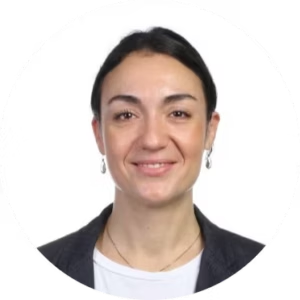
At the 7th SIOP Europe Annual Meeting, emerging therapies, biological precision, and workforce development are all under the spotlight. Dr Daniela Di Carlo (Chair, Young SIOPE), reflects on where the field is heading, particularly CAR T-cell therapy and artificial intelligence, and what is needed to ensure that progress translates into real-world benefit for children with cancer.
touchONCOLOGY coverage of SIOP Europe 2026
What are the most promising advances you’re seeing in current research and treatment options for high-risk pediatric cancers?
A growing area of interest is tumour metabolism, which remains relatively underexplored both in terms of biological understanding and therapeutic opportunities. At the same time, the field is rapidly evolving through the development of innovative therapeutic strategies. CAR T-cell therapies are a clear example: after demonstrating remarkable results in some leukaemias, they are now being explored increasingly also in solid tumours. Alongside this, immunotherapy approaches and antibody–drug conjugates (ADCs) are continuing to expand and reshape the treatment landscape.
While advancing knowledge specifically in paediatric oncology remains essential, it is equally important to keep looking at what is happening in adult oncology, where many innovative approaches first emerge. At the same time, however, we must always take into account the profound biological differences between cancers in children and adults, rather than assuming that strategies developed for adult patients can simply be translated into the paediatric setting.
Despite scientific progress, outcomes remain poor for many high-risk paediatric malignancies. What do you see as the biggest barriers to improving survival today?
One key issue is that we may have over-focused on precision oncology defined by mutations alone. We assumed that targeting genomic alterations would automatically translate into better outcomes. But in reality, many of these alterations are passenger events rather than true drivers of disease. So we need to refocus our efforts. The challenge is not just finding mutations; it is understanding biology at a deeper level and identifying what actually sustains the cancer.
Novel agents and innovative therapies are expanding rapidly. How can we ensure equitable access for children across different European healthcare systems?
This cannot be solved by one group alone. It requires a true network involving clinicians, pharmaceutical companies, institutions like the European Commission, and importantly, patient and parent advocates. Each stakeholder plays a role. Industry must understand the specific needs of paediatric oncology, and policymakers must support frameworks that allow equitable implementation. Patient voices are especially powerful; they can strongly influence how access evolves across different healthcare systems.
As Chair of Young SIOPE, what are your key priorities for supporting the next generation of paediatric oncology researchers?
Education and networking are central. Within Young SIOPE, we work closely with the broader education committee to develop structured opportunities for training and collaboration.
Moreover, as Young SIOPE we lead the Mentorship Programme, which is a cornerstone initiative. We pair early-career researchers with senior experts to develop long-term projects over three to five years. This is especially valuable for colleagues in smaller centres or countries with limited access to expertise. Equally important is peer networking. Your peers are your future collaborators, and often your best source of ideas and support.
How is AI shaping the field for early-career investigators?
AI is one of the most discussed topics at this meeting. It is already influencing how we write, review, and design research. But we need to use it responsibly. There are now AI tools developed by journals that may be more reliable than general platforms, and we should learn how to use these appropriately. The key is education; understanding both the potential and the limitations. AI is not something to fear, but it does require training, ethical awareness, and collaboration with experts such as editors and publishers to ensure its safe and effective use in science.
This content has been developed independently by Touch Medical Media for touchONCOLOGY in collaboration with SIOP Europe and Daniela Di Carlo. Views expressed are the speaker’s own and do not necessarily reflect the views of Touch Medical Media.
Disclosure: Daniela Di Carlo has no financial or non-financial conflicts of interest to declare in relation to this interview.
Cite: Young SIOPE perspective: Harnessing immunotherapy and digital tools in paediatric oncology. touchONCOLOGY. 14th May 2026.
Interviewer: Caroline Markham