“Change is happening, but we need policies, not just good intentions, to truly support women in leadership”
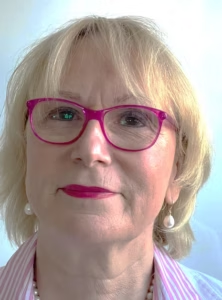
Prof Beate Rau (Senior Consultant Surgeon – Head of the Section Special Surgical Oncology, Berlin School of Integrative Oncology, Berlin, Germany) has spent her career challenging clinical and cultural frontiers. In this conversation she reflects on her experience navigating a male-dominated field, the evolving landscape for women in oncologic surgery and what still needs to change to ensure genuine gender equity. Drawing from her clinical leadership and commitment to mentorship, Prof Rau shares practical advice for young female trainees and calls for systemic reform across institutions. Her message is clear: inclusion must be intentional, and the next phase of progress will depend on structural change, strong networks and both women and men championing equity in surgery.
Q1. What were some of the biggest challenges you faced as a woman in a traditionally male-dominated field? How did you overcome them?
Entering surgical oncology, a field historically dominated by men, presented several challenges along the way. Actually, when I look back, I was mostly focusing on my work with my patients, looking after them and trying to support them during their hospital journey. With growing surgical responsibility, my attitude was the same. I guess, the male colleagues did the same, but I had no time to consider other people’s careers. This does not mean that I was not fighting for my personal career. Instead of overcoming dominant males, I tried to learn as much as possible from them. Now, I am recognized as a female surgeon who performs end-stage surgery – even when male surgeons where not able to do so. That makes me proud and happy to serve our patients safely.
Q2. What advice would you give to a young female surgical trainee who aspires to a leadership role but is daunted by the current landscape?
My advice would be to believe deeply in your abilities and the unique perspective you bring to the field. Learn from your colleagues: interdisciplinary and interprofessional. The landscape may seem difficult, but remember that change is happening, and your voice and leadership are essential to driving that progress. Seek out mentors and role models who inspire you, and don’t hesitate to build your own support network – these relationships will be invaluable throughout your career. Embrace challenges as opportunities to grow, and maintain a clear vision of the impact you want to have, both for your patients and the profession. Most importantly, be patient with yourself, stay resilient and lead with both confidence and compassion. Your dedication and leadership will help shape a more inclusive and innovative future for surgical oncology.
Q3. How would you describe the current landscape for women in oncologic surgery across Europe – and how has it evolved since you began your career?
The landscape for women in oncologic surgery across Europe has undergone significant changes over the past few decades, though challenges remain. Here’s a comprehensive view of the current state and its evolution:
Current Landscape
- Responsibilities and opportunities for women in surgical oncology is increasing, but still unequal.
- More women are entering surgical specialties, including oncologic surgery, than ever before. Medical schools across Europe often have equal or majority-female cohorts. However, after medical school most of them disappear.
- Women still remain underrepresented in senior and leadership positions – department chairs, heads of surgical oncology units or professors in academic institutions.
- Growing networks and support systems are available, but difficult to find and join.
- Organizations such as Women in Surgery (the UK’s Royal College of Surgeons initiative), ESMO Women for Oncology, Interdisciplinary Working Group on Women in Oncology of the German Cancer Society (IAG-FIO), SSO (Women in Cancer Surgery) and national bodies across Europe have created mentorship programs, networking events and advocacy efforts. This increases at least visibility.
- These initiatives provide role models, support career development and help address systemic barriers.
- Focus on work-life balance and flexibility
- Disparities still exist between countries and even within institutions.
How the landscape has evolved?
The landscape for women in oncologic surgery in Europe is improving, driven by cultural shifts, advocacy and increased representation. Still, systemic barriers remain – especially regarding leadership, mentorship and structural biases. The next phase of progress likely hinges on institutional commitment to equity, better work-life integration and male allyship within the field. We are on a good way. Some points:
- Changing culture, next generation
- The culture of surgery has become more inclusive. When many senior female surgeons began their careers, they were often the only woman in the room.
- Today, trainees are more likely to see female consultants and professors, signaling progress and opportunity.
- Gender equity is now a formal consideration in hiring, promotions, and research grants in many European academic institutions.
- Some countries have implemented quotas or targets for women in leadership or research panels.
- More female leaders and role models
- The visibility of successful women in oncologic surgery – through publications, conference keynotes and leadership roles – has significantly improved.
- This visibility encourages younger women to pursue the field and believe in upward mobility.
- Childcare nowadays is more often equally between female and male and generates equal opportunities for career
Q4. Despite growing awareness, leadership positions in surgical oncology are still disproportionately held by men. What systemic or cultural barriers persist?
The barriers to leadership for women in surgical oncology are not about individual capability, but about structural inequity, cultural items and institutional practices that continue to favour men. Tackling these requires more than awareness – it demands intentional policy change, gender-responsive leadership development and active efforts to dismantle systemic bias. However, despite progress, several systemic and cultural barriers continue to hinder women from advancing into leadership roles in surgical oncology across Europe. These barriers are often deeply embedded in medical institutions, training structures, and professional cultures. Here are some points of the key issues:
- Lack of mentorship and sponsorship
- Gender bias in evaluations and promotions
- Work–life integration challenges
- Structural gaps in training and promotion policies
- Limited visibility and recognition
- Cultural expectations and stereotypes
Q5. Are the European Society of Surgical Oncology (ESSO) actively encouraging and supporting women into leadership roles in surgery?
Yes, ESSO has taken meaningful steps to support women and is actively encouraging women into leadership roles, and progress is visible – especially through education, mentorship and increasing representation (last president Dr Isabel-Teresa Rubio and 31% female representatives in the board of directors, equal female chairs of sessions). While there’s still room for progress, the society has become increasingly aware of gender disparities and has begun implementing strategies to address them.
- Women in surgical oncology initiatives
- Commitment to gender diversity in leadership
- Mentorship and educational support
- Policy and advocacy work
- Conference and faculty representation
Q6. What practical steps can institutions take to better support and promote female leadership in surgical oncology?
Institutional support for female leadership must go beyond intentions. It requires concrete actions, policy reform and cultural shifts. Institutions that succeed in promoting women in surgical oncology build inclusive environments where leadership potential is cultivated – not constrained. These steps should be proactive, measurable and embedded into institutional strategy – not just gestures. However, I would not exclusively support women – rather implement measurable items like duration of childcare, work traditionally performed by women or to activities associated with women.
- Establish formal mentorship and sponsorship programs
- Ensure transparent and equitable promotion criteria
- Set targets and monitor gender representation
- Improve work–life integration policies
- Address unconscious bias through training and policy
- Prioritize female representation in high-visibility roles
- Invest in leadership development programs for women
- Celebrate and promote female role models
- Engage male allies
 About the European Society of Surgical Oncology (ESSO)
The European Society of Surgical Oncology (ESSO) is the leading professional organization for surgical oncologists in Europe, dedicated to advancing the science and practice of cancer surgery. ESSO fosters high standards in surgical oncology through education, research and multidisciplinary collaboration. It offers specialized training courses, fellowships and guidelines to support continuous professional development and improve patient outcomes. By connecting surgeons across Europe and beyond, ESSO promotes innovation, knowledge exchange, and leadership in oncologic surgery. The society also advocates for the integration of surgical oncology into comprehensive cancer care and plays a vital role in shaping European cancer policy and practice.
Disclosure: This short article was prepared by touchONCOLOGY in collaboration with the European Society of Surgical Oncology (ESSO). No fees or funding were associated with its publication.
Cite: Cutting through bias: Prof. Beate Rau’s vision for women in surgical leadership. touchONCOLOGY. July 22nd, 2025
SIGN UP to touchONCOLOGY!
Join our global community today for access to thousands of peer-reviewed articles, expert insights, and learn-on-the-go education across 150+ specialties, plus concise email updates and newsletters so you never miss out.