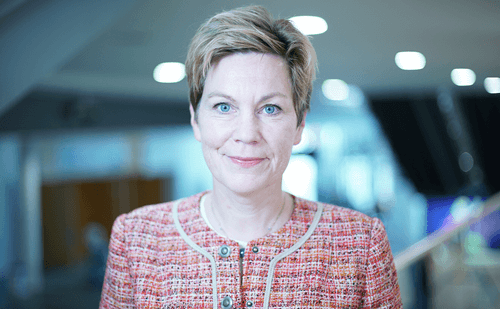
Translating scientific advances into meaningful improvements in cancer care requires more than innovation alone. Ebba Hallersjö Hult explores the importance of cross-sector collaboration, sustainable implementation and equitable access to precision cancer medicine.

At the recent European Cancer Summit 2026, Ebba Hallersjö Hult (Co-founder of Vision Zero Cancer) discusses how collaborative innovation can accelerate improvements in cancer care. She reflects on the initiative’s achievements, the importance of translating research into routine clinical practice and the need for sustainable investment and implementation to ensure that advances in cancer care benefit patients and society across Europe.
Q. Since Vision Zero Cancer was established, what have been its most significant achievements, and which initiatives are now making the greatest contribution to transforming cancer care?
Vision Zero Cancer was established in 2019 to create an innovation ecosystem that could accelerate the integration of research and innovation into routine clinical practice. I co-founded the initiative with Sweden’s former National Cancer Coordinator and stakeholders from industry, research, academia, healthcare and civil society.
Building on Sweden’s tradition of triple-helix collaboration, we wanted to take this further through what we call a penta-helix approach. A major achievement has been demonstrating how different stakeholders can work together and, importantly, how we can govern and lead these collaborations collectively.
Vision Zero Cancer ran from 2019–2024 and served as a prototype for SweCan – Sweden’s Cancer Mission Hub, launched in April 2026. It also helped inspire the development of Cancer Mission Hubs across Europe through the ECHoS initiative.
We initially focused on lung cancer, recognizing the significant unmet needs associated with inequalities, late diagnosis and stigma, alongside the opportunities emerging through new treatments and diagnostic approaches. We have since seen progress in implementing early detection initiatives and precision cancer medicine.
From the outset, we sought to connect Sweden’s three national strategies for cancer, life sciences, and export and investment. Ultimately, one of our greatest contributions has been demonstrating how a comprehensive approach to the cancer pathway can connect research, innovation and the life sciences with improvements in cancer care and European competitiveness.
Q. Vision Zero Cancer aimed to accelerate the equitable implementation of precision health in cancer. How are you building on this work to translate research and innovation into routine clinical practice, and what progress has been made in improving patient access?
Through Testbed Sweden Precision Health Cancer, a spin-off from Vision Zero Cancer established in 2021, together with Genomic Medicine Sweden and SciLifeLab we have been working across several levels simultaneously, including building a clinical trial ecosystem. We believe that sustainable implementation of precision cancer medicine requires us to combine research and innovation with implementation science. By embedding clinical trials within learning health systems, we can drive change while ensuring that patients are involved from the very beginning.
In Sweden, for example, we established a trial network connecting all seven university hospitals, with the ambition of enabling patient access across all regions, with patients involved in designing national clinical trials. They contributed to decisions about outcomes and endpoints, alongside health economists and other stakeholders, allowing us to consider sustainability from the outset. A major milestone is the establishment of FOCU.SE, Sweden’s nationwide precision oncology platform study, which opened for patient recruitment on 12 November 2026. Our national work, together with European collaborations such as PCM4EU and PRIME-ROSE, has helped lay the foundations for further work through European projects, including the Joint Action on Personalised Cancer Medicine.
For me, two particularly important achievements are the progress through the ECHoS initiative, establishing European Cancer Mission Hubs, and the European collaborations on personalized cancer medicine. These collaborations are helping us build the infrastructure and health system capabilities needed to translate innovation into more equitable cancer care.
Q. Are there any particularly exciting initiatives or collaborations on the horizon that you believe could have a significant impact on the future of cancer care?
From my perspective, the implementation of Europe’s Beating Cancer Plan, aligned with the EU Cancer Mission, the EU Life Sciences Strategy – Choose Europe for Life – and Europe’s broader competitiveness agenda, represents a significant opportunity. These are precisely the ambitions we set out to address when we established Vision Zero Cancer seven years ago in 2019. We need to bring together priorities from different strategies to build healthier, more resilient and thriving societies. With initiatives such as the forthcoming EU Biotech Act and growing recognition of the urgency of strengthening Europe’s resilience and competitiveness, there is an opportunity to bring new treatments and possibilities to patients more quickly.
We can also learn from one another in new ways through these collaborations. Europe has established many of the necessary building blocks, and now it is up to all of us to ensure that we deliver on these ambitions and implement them sustainably.
Q. What is the key takeaway for the cancer community from your session today on placing cancer above political cycles?
In my session, we discussed how to ensure that cancer control plans extend beyond individual political cycles. It is encouraging to see the progress made in developing national cancer control plans across Europe. I am particularly impressed by those developed more recently, which increasingly take a comprehensive approach to the cancer pathway and integrate research and innovation.
However, strategies alone do not deliver change. We also need the collective capacity to act. We must ensure that Europe’s research excellence is matched by implementation excellence. Strategies must be supported by appropriate costing and sustainable funding mechanisms. We need to invest in our plans, our people, leadership, implementation capabilities and our healthcare workforce, while also addressing existing inequalities.
We also need to ensure continuity while retaining the ability to adapt, and to make better use of the networks, research infrastructures and partnerships we have established across Europe.
We must also consider how we manage societal expectations and ensure that we create meaningful value for patients and for society as a whole.
Vision Zero Cancer (2019–2024) was a Swedish mission-oriented innovation initiative with the ambition that no one should die from cancer. Bringing together healthcare, academia, industry, public authorities, patients and civil society, it pioneered new approaches to cross-sector collaboration and the equitable implementation of innovation. The initiative served as a prototype for SweCan – Sweden’s Cancer Mission Hub, launched in 2026 – and helped inspire the development of Cancer Mission Hubs across Europe. Its legacy also continues through Testbed Sweden Precision Health Cancer (2021–2027), a spin-off established together with Genomic Medicine Sweden and SciLifeLab to accelerate the sustainable and equitable implementation of precision cancer medicine.
Note: This transcript has been lightly edited to ensure clarity.
Cite: Vision Zero Cancer: Accelerating the implementation of precision cancer medicine. touchONCOLOGY. 26th November, 2026.
Disclosure: Enna Hallersjö Hult is a Consultant for Swedfund and has received grant/research support from EU4Health, Horizon Europe, Vinnova. She is a member of the Advisory Board for SPRINTR and PRECISEU.
Interviewer: Caroline Markham
touchONCOLOGY coverage of the European Cancer Summit 2026. This content has been developed independently by Touch Medical Media for touchONCOLOGY. touchONCOLOGY was an official supporter of the European Cancer Summit 2026. Views expressed are the speaker’s own and do not necessarily reflect the views of Touch Medical Media.