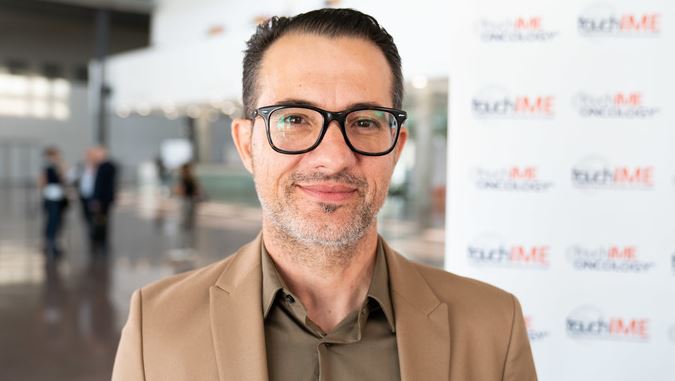
Anxiety can change at every stage of the cancer journey, from diagnosis and treatment to surveillance and survivorship. Dr Chirag B Jain discusses why a longitudinal approach to anxiety assessment and management is needed and how personalized supportive care could help address patients’ evolving needs.

Anxiety can fluctuate throughout the cancer journey, influenced by treatment decisions, side effects, surveillance and uncertainty about the future. However, a single assessment may not capture patients’ changing concerns or ensure they receive appropriate support. At the European Society for Medical Oncology (ESMO) Congress 2026 , Dr Chirag B. Jain (Onco-Anxiology Researcher, Frontiers in Psychology) discusses the key points from his poster entitled ‘HRV-adaptive music therapy for anxiety in head and neck cancer patients: protocol for a randomized controlled trial’. He discusses the proposed framework of Onco-Anxiology, the challenges of identifying cancer-related anxiety and the importance of longitudinal assessment. He also explores research into heart-rate-variability-adaptive music therapy and the practical considerations involved in integrating personalized supportive-care interventions into routine oncology practice.
“As cancer treatment becomes more personalized, psychological supportive care must also become more responsive to patients’ changing needs… Anxiety care must evolve with the patient, reflecting changing concerns, treatment experiences and support needs throughout the cancer journey.”
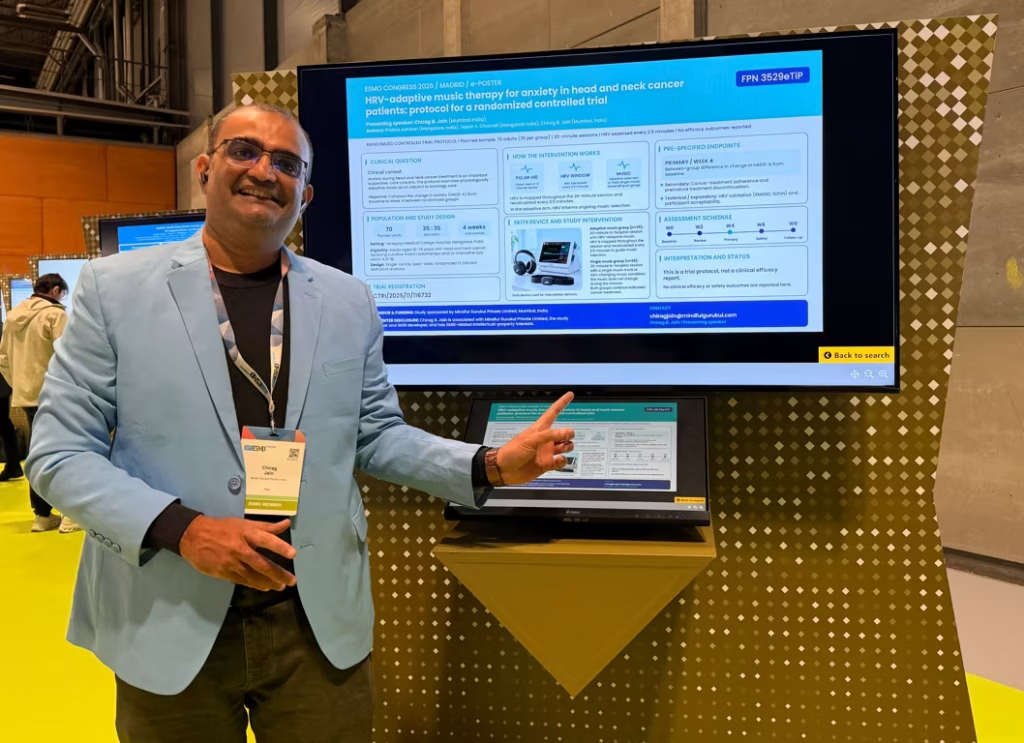
Dr Chirag B. Jain alongside ePoster 3529eTiP at ESMO Congress 2026. The poster presents a protocol for a randomized controlled trial investigating HRV-adaptive music therapy for anxiety in patients with head and neck cancer. Image courtesy of Dr Chirag B. Jain.
How would you define Onco-Anxiology, and what is its rationale within cancer care?
Onco-Anxiology is a proposed framework for looking specifically at anxiety across the cancer-care continuum. It is not intended to replace psycho-oncology. Rather, it asks us to look more closely at one symptom that can change substantially as the patient moves from diagnosis to treatment, surveillance, survivorship, recurrence or palliative care.
At diagnosis, anxiety may center on survival and treatment choices. During chemotherapy, the same patient may become preoccupied with side effects or whether treatment is working. After treatment, fear of recurrence or the anxiety surrounding surveillance scans may become dominant. That is why I do not think one assessment at diagnosis can describe the whole journey.
The discussions I had at ESMO Congress 2026 strengthened this view. Across conversations with psycho-oncology specialists, supportive-care leaders, oncologists and cancer nurses, the recurring question was not simply whether anxiety exists. It was: when does it become clinically meaningful, and how do we respond without creating another burden for patients or clinical teams?
A scan can tell us what is happening to the tumor. It cannot tell us what the patient is afraid of now.
How is cancer-related anxiety different from general distress or depression?
Distress screening is valuable, but distress is an umbrella term. A high score may reflect anxiety, depression, pain, financial difficulty, family problems or several issues at once. Anxiety also does not always sound like ‘I am anxious’. Patients may describe poor sleep, restlessness, difficulty concentrating, palpitations or an inability to stop thinking about what might happen next.
In oncology this is particularly challenging because some physical symptoms overlap with cancer, treatment toxicity and medication effects. Palpitations during chemotherapy may be associated with anxiety, but anemia, dehydration, arrhythmia or drug effects also need consideration. We therefore need to avoid two errors: dismissing anxiety because it seems understandable in someone with cancer, and attributing a physical symptom to anxiety before appropriate medical causes have been considered.
Validated tools such as the GAD-7 or HADS-A can help, but a score is not the whole story. Two simple questions can be revealing: “What worries you most right now?” and “How much is that worry affecting your sleep, daily life or ability to cope?”
What did your conversations at ESMO 2026 add to this framework?
They made the implementation question much more important. My discussion with Professor Gary Rodin from Canada reinforced the need to understand anxiety within the wider psychosocial reality of cancer. Psychological distress is shaped by the stage of illness, relationships, uncertainty, meaning and changing goals of care. Anxiety therefore has to be interpreted in context, not simply recorded as a score.
With Professor Florian Scotté from France, the discussion moved toward supportive-care research and the possibility of studying music-based interventions in oncology. What mattered most was not the technology itself, but the study question: where would an intervention fit, which patients should receive it, how often should it be delivered and what outcome would be meaningful?
The nursing perspective was equally important. My conversations with Stavroula Chante, a cancer nurse from the UK, and Constantina Cloconi from Cyprus reinforced that nurses often see anxiety at moments when it becomes most visible—during treatment, symptom management, education and follow-up. If an intervention is difficult to integrate into the clinical workflow, it will struggle no matter how promising the science appears.
I also discussed feasibility studies, assessment and future collaborations with Dr Diego Signorelli from Italy, Dr Remziye Semerci Åžahin, a staff nurse from Turkey, and other clinicians at the congress.
The message was consistent: supportive care has to fit the patient journey, not sit beside it.
What research are you pursuing in this area?
At ESMO 2026 we presented a protocol examining heart-rate-variability-adaptive music therapy for anxiety in patients with head and neck cancer. The intention is not to replace patient-reported anxiety with a physiological signal. Rather, we are asking whether autonomic measures such as heart rate variability can complement validated clinical outcomes and help us understand response to a non-pharmacological intervention over time. The system adapts instrumental music according to physiological response. But the larger research question is more important than the technology.
Can supportive interventions become more personalized while remaining simple enough to use in a real oncology environment?
The ESMO discussions convinced me that the next step should not necessarily be one very large trial trying to answer everything. A feasibility study should first tell us whether patients accept the intervention, whether staff can deliver it consistently, whether it fits into chemotherapy or radiotherapy workflows, and whether the chosen outcomes matter to patients. Only then should a larger controlled study ask whether the intervention produces clinically meaningful benefit.
We also need to study different moments separately. Anxiety during chemotherapy may not behave like anxiety after surgery, during radiotherapy or in survivorship.
What should change in routine cancer care?
We do not need every oncologist to become a mental health specialist. We do need a pathway in which anxiety is noticed, explored, documented, reassessed and referred when necessary. For some patients, better information, symptom control and knowing whom to contact may be enough. Others may benefit from structured psychological care, selected integrative approaches or medication. Severe anxiety, major functional impairment, suicidal thoughts or complex psychiatric presentations require specialist input.
The important point is continuity. Anxiety identified during chemotherapy should not disappear when treatment ends or when the patient moves to another team. My strongest takeaway from ESMO was that the future of anxiety care will not depend on one questionnaire or one intervention. It will depend on repeatedly asking three questions:
- What is this patient anxious about now?
- Has that changed since the last time we asked?
- What level of support is appropriate at this stage?
Cancer treatment has become increasingly precise in how we classify disease and tailor therapy. Psychological supportive care can also become more longitudinal, context-specific and responsive.
That is ultimately what I hope Onco-Anxiology contributes: not another silo, but a way of making anxiety visible throughout the cancer journey, and ensuring that when we identify it, there is somewhere for the patient to go.
Connect with Dr Jain: www.drchiragonco.com

This content has been developed independently by Touch Medical Media for touchONCOLOGY. It is not affiliated with the European Society for Medical Oncology (ESMO). Views expressed are the speaker’s own and do not necessarily reflect the views of Touch Medical Media. This article was created by the editorial team utilizing AI as an editorial tool (Claude.AI and ChatGPT 5.5). The content was developed and edited by human editors. No funding was received in the publication of this article.
Disclosures: Dr Jain is a consultant for, has received grant/research support from and is a major stockholder for Mindful Gurukul Private Limited.
Cite: Beyond tumour control: Why anxiety needs a longitudinal approach in cancer care. touchONCOLOGY. 28th October 2026.
Editor: Sophie Nickelson