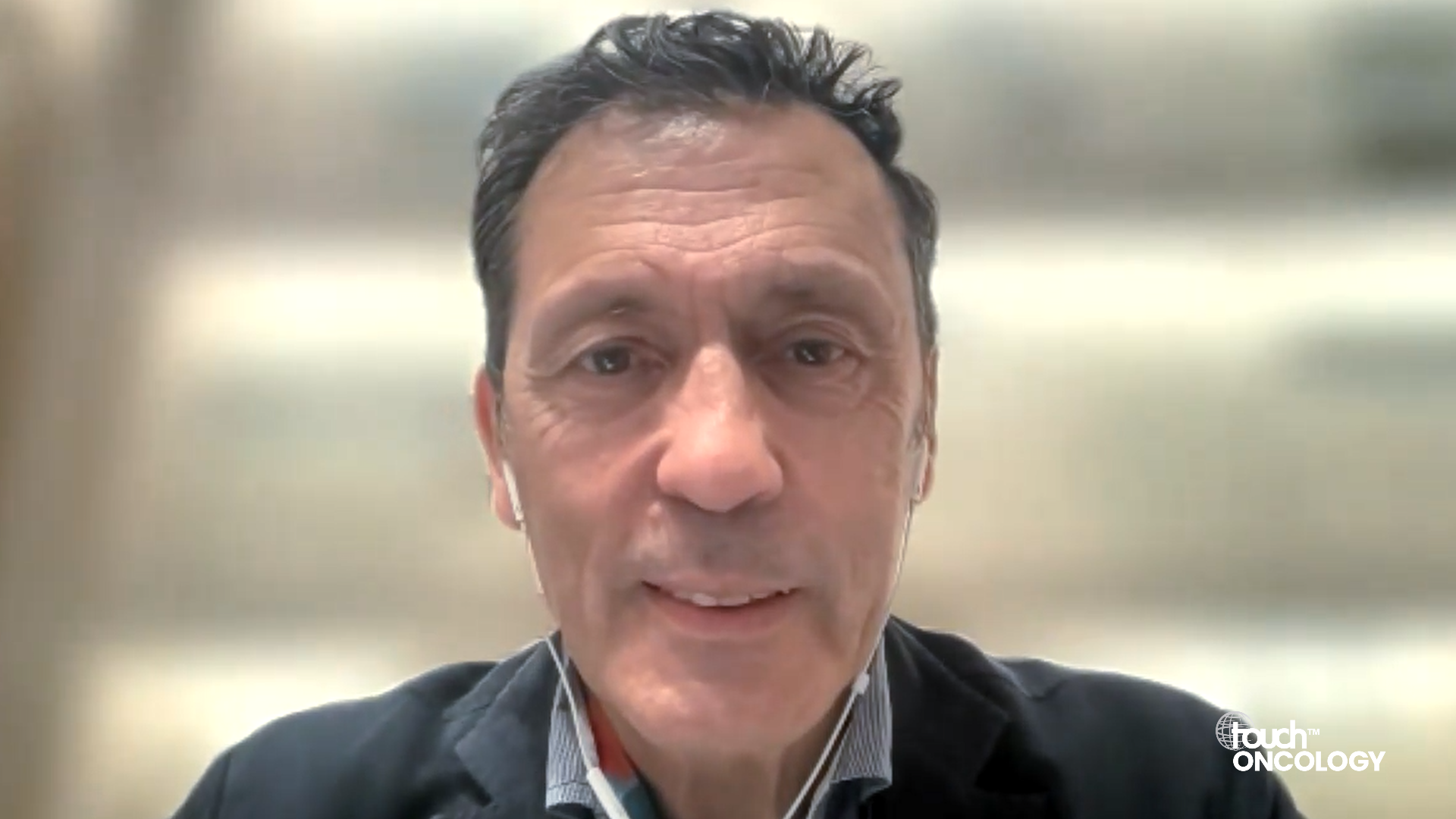

The European Society for Medical Oncology (ESMO) 2025 congress delivered an impressive breadth of lung-cancer data, spanning targeted therapy, antibody-drug conjugates, local ablative approaches and adjuvant strategies. Here, Dr Federico Monaca (The Christie NHS Foundation Trust, UK) breaks down six major abstracts from ESMO25, highlighting their take-aways and considering their potential relevance for clinical practice.
FLAURA2 (LBA77)
An exploratory overall-survival (OS) analysis from the phase III FLAURA2 trial confirmed that adding platinum–pemetrexed chemotherapy to osimertinib prolongs OS in EGFR-mutated advanced NSCLC — 47.5 months versus 37.6 months for osimertinib alone (HR ≈ 0.77). The benefit held across difficult subgroups, including patients with baseline CNS metastases, TP53 co-mutation, or plasma-detectable EGFR alterations. The data reinforce early intensification as a potential new standard of care, rather than sequential therapy, even in high-risk disease.
NorthStar (LBA72)
In the phase II NorthStar study, patients with metastatic EGFR-mutant NSCLC who received local consolidative therapy (LCT) — surgery or radiation — alongside osimertinib achieved a median progression-free survival (PFS) of 25.4 months, compared with 17 months for osimertinib alone (HR 0.60). Benefit was seen even in patients with multiple metastases, not just oligometastatic disease. The data confirm that integrating LCT into systemic TKI therapy meaningfully extends disease control with manageable toxicity, supporting earlier multidisciplinary evaluation in EGFR-mutant metastases.
HARMONi‑6 (LBA4)
The phase III HARMONi-6 trial tested the bispecific antibody ivonescimab — targeting both PD-1 and VEGF — plus chemotherapy versus tislelizumab plus chemotherapy in untreated advanced squamous NSCLC. Median PFS was 11.1 months with ivonescimab versus 6.9 months with tislelizumab (HR 0.60; P<0.0001), with benefit across PD-L1 subgroups. This dual-target immunotherapy achieved an unprecedented PFS improvement in squamous NSCLC, signalling a potential new standard once OS data mature and global approvals follow.
IDeate‑Lung01 (2760MO)
In the IDeate-Lung01 phase II trial, ifinatamab deruxtecan (I-DXd), a B7-H3–directed ADC, demonstrated unprecedented intracranial efficacy in SCLC, a setting with limited therapeutic options. The study achieved a 46% intracranial response rate in previously treated extensive-stage SCLC with brain metastases — rising to 58% among patients without prior brain radiotherapy. Disease control reached 91%, with median response duration of about six months. The data suggest I-DXd could become a new benchmark for post-platinum patients with brain disease.
OptiTROP‑Lung04 (LBA5)
In the phase III OptiTROP-Lung04 trial, patients with EGFR-mutated NSCLC who had progressed on EGFR tyrosine kinase inhibitors were randomised to receive sacituzumab tirumotecan (sac-TMT) or platinum-based chemotherapy. The study demonstrated a median progression-free survival of 8.3 months with sac-TMT versus 4.3 months with chemotherapy (HR 0.49; P < 0.0001). Interim overall survival data also favoured sac-TMT (HR 0.60), though results remain immature. These findings indicate that the TROP2-directed antibody–drug conjugate may provide a clinically meaningful alternative to standard chemotherapy in patients with EGFR-mutated NSCLC following TKI resistance, pending confirmatory data and regulatory review.
ALINA (1787MO)
The four-year follow-up results from the phase III ALINA study confirmed a sustained disease-free survival (DFS) advantage for adjuvant alectinib compared with platinum-based chemotherapy in patients with completely resected ALK-positive NSCLC. Alectinib reduced the risk of recurrence or death by about 65% (HR 0.35), with four-year DFS rates of 76% versus 47%. Central nervous system relapse was also less frequent (HR 0.37). The data support adjuvant alectinib as the preferred post-surgical therapy for ALK-positive early-stage NSCLC, offering durable protection against both systemic and CNS recurrence.
Conclusion
From upfront combination therapy and local consolidation in EGFR-mutant disease, to antibody–drug conjugates for resistant disease and long-term adjuvant ALK inhibition, the data presented at ASCO25 reinforce the shift toward more personalized, precision-based approaches. Clinicians will need to integrate molecular profiling, multidisciplinary planning and careful treatment sequencing to translate these findings into practice.
Disclosure: Federico Monaca has nothing to disclose in relation to this interview. This short article was prepared by touchONCOLOGY in collaboration with Dr Federico Monaca. touchONCOLOGY utilize AI as an editorial tool (ChatGPT (GPT-4o) [Large language model]. https://chat.openai.com/chat). The content was developed and edited by human editors. No fees or funding were associated with its publication.
This content has been developed independently by Touch Medical Media for touchONCOLOGY. It is not affiliated with the European Society for Medical Oncology (ESMO). Views expressed are the speaker’s own and do not necessarily reflect the views of Touch Medical Media.
Cite: Lung cancer round-up: What ESMO25 told us. touchONCOLOGY. November 13th, 2025
Related content
- WCLC 2025 highlights: Consolidative thoracic radiotherapy in ES-SCLC
- WCLC 2025 highlights: Practice-changing FLAURA2 sets new survival benchmark in NSCLC
- Think Horses, But Do Not Forget the Zebras: Early-onset Lung Cancer