
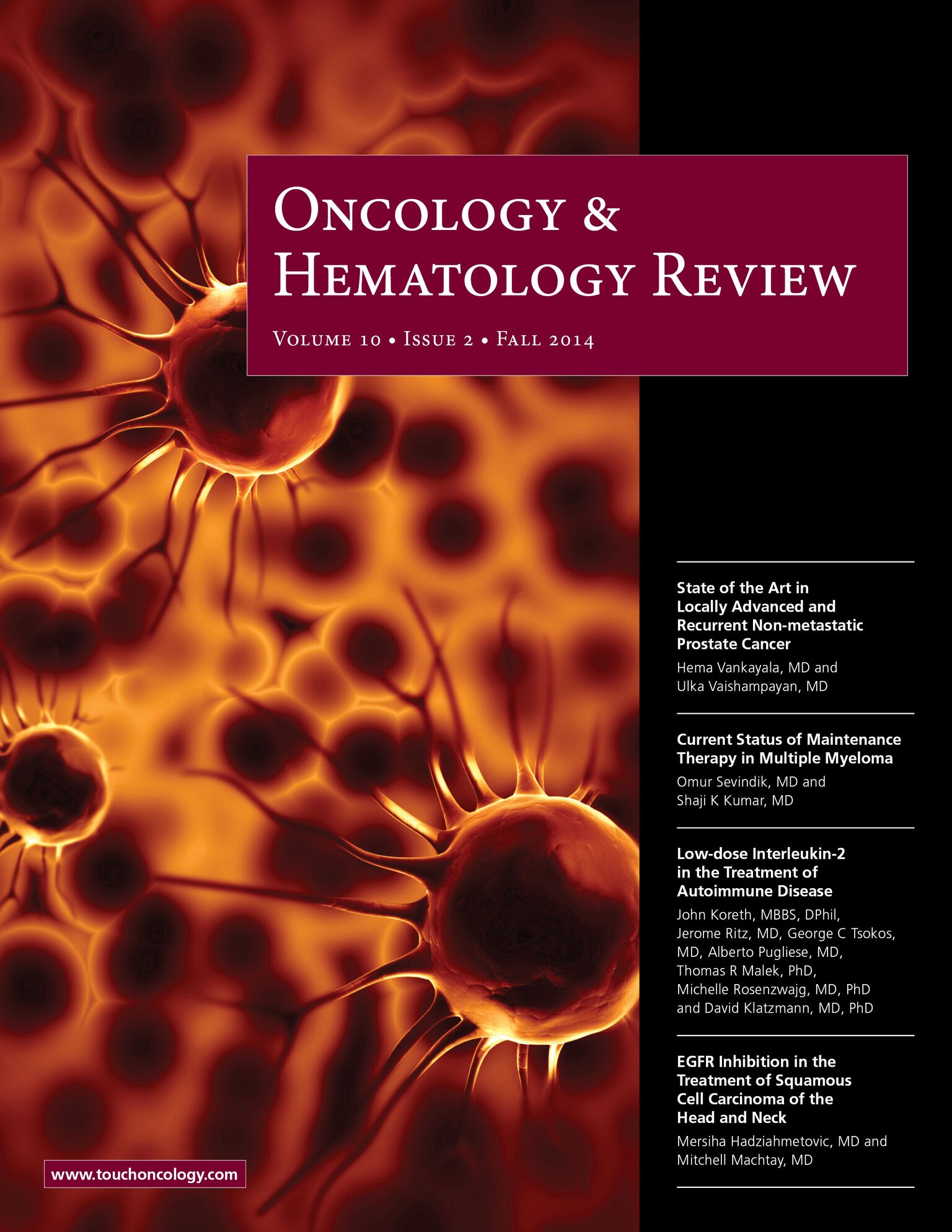
ONCOLOGY & HEMATOLOGY (US) – VOLUME 10 ISSUE 2 – FALL 2014
Welcome to the Fall edition of Oncology and Hematology Review (US) featuring a wide range of timely and concise review articles on some of the most important topics in the field. Kumar et al. explore maintenance therapy in multiple myeloma, whilst Davies et al. look at the causes and risks of thyroid cancer. Koreth and Tsokos et al. review low-dose IL-2 in automimmune disease, and Palta et al. explore US and European approaches to radiotherapy in the treatment of rectal cancer. This edition also features articles on thrombocytopenia, chronic myeloid leukemia, breast cancer, head and neck cancer, gastrointestinal stromal tumors and supportive care. We hope you enjoy this issue, and that it provides useful information relevant to your practice and interests.
I n 1941, Huggins and Hodges reported the results of their research into castration and diethylstilbestrol (DES), which established that prostate cancer is an androgen-driven/dependent disease. Androgen receptor (AR) is highly expressed on prostate cancer cells and directly stimulates its growth and survival. The vast majority of patients with prostate cancer, including those with metastatic […]
Hematology
Classification The two basic forms of thrombotic microangiopathies, excluding disseminated intravascular coagulation (DIC), include thrombotic thrombocytopenic purpura (TTP), and hemolytic uremic syndrome (HUS). Early historic reports noted the presence of hemolytic anemia and thrombocytopenia in both disorders and suggested differentiation of these two entities based on the presence of clinical symptoms. Predominant kidney failure, often […]
Hematologic Malignancies
Multiple myeloma (MM) is manifested by abnormal clonal plasma cell proliferation and accounts for approximately 1 % of all cancers and nearly 10 % of hematologic malignancies in the US.1,2 It is considered to be incurable, probably as a consequence of the ongoing clonal evolution over the course of disease. Although the disease remains incurable, […]
Chronic myelogenous (or myeloid) leukemia (CML) is a myeloproliferative disorder characterized by increased and unregulated growth of granulocytes, leading to high white blood cell counts and splenomegaly. It was estimated that 5,430 adults in the US would be diagnosed with CML in 2012 and 610 would die of the disease.1 In the absence of intervention, […]
Breast Cancer
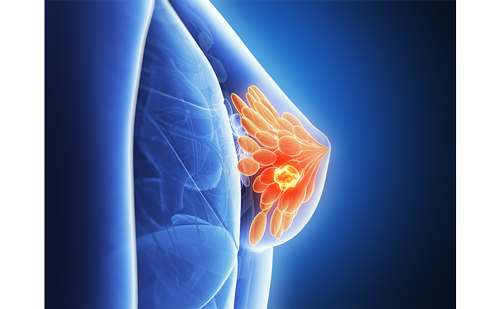
Breast cancer is the most common malignant disease in women: according to US statistics, one in eight women will be diagnosed with breast cancer in her lifetime.1 It was estimated that approximately 232,340 new cases of invasive breast cancer and 39,620 deaths were expected among US women in 2013.2 Early detection and diagnosis of breast […]
Gastrointestinal Oncology
Gastrointestinal stromal tumors (GISTs) are the most common mesenchymal tumor of the gastrointestinal tract. They are thought to be derived from the interstitial cells of Cajal, the so-called pacemaker cells that regulate gastrointestinal peristaltic function. The annual incidence of GIST is approximately 10–15 per million population with some regional variation,1 making them the most common […]
Prostate Cancer
Prostate cancer (PC) is the second most common malignancy in American men and the second leading cause of cancer-related death in men in the US. It is estimated that in 2014 nearly 233,000 men will be diagnosed with PC, with 29,480 dying from the disease.1,2 The majority of them are diagnosed as a result of […]
Prostate cancer is the most commonly diagnosed noncutaneous cancer and second leading cause of cancer mortality in American men. The lifetime risk for prostate cancer is estimated at one in six; 30,000 men die of the disease annually in the US.1 Prostate cancer is driven by the hormonally responsive transcription factor androgen receptor (AR) and […]
Rectal Cancer
Over the past several decades, two paradigms have emerged in the preoperative treatment of rectal cancer: a short course of radiation therapy (RT) often utilized in centers across Northern Europe and longcourse chemoradiation (CRT) in other parts of Europe and the US. The short-course technique was validated by randomized trials comparing this technique to surgery […]
Thyroid Cancer
Thyroid cancer is the most common endocrine cancer, representing about 1 % of all malignancies diagnosed worldwide, with approximately 600,000 men and women alive in the US who have a history of cancer of the thyroid (http://seer.cancer.gov/statfa cts/html/thyro.html). Despite its prevalence, the mortality from thyroid cancer remains relatively low at ~0.5 per 100,000 population per […]
Head and Neck Cancer
Head and neck cancer (HNC) will affect more than an estimated 55,000 individuals in the US in 2014, the vast majority of these being squamous cell carcinoma (SCC), with 12,000 estimated deaths.1 Worldwide, the figures for incidence and mortality are approximately 560,000 and 300,000, respectively.2 The current standard of care for local-regionally advanced SCC of […]
Immunotherapy
Autoimmune diseases comprise more than 80 chronic conditions that collectively affect approximately 5 to 8 % of the US population and are a leading cause of death in young and middle-aged women.1 Moreover, the incidence and prevalence of autoimmune diseases are rising. The age of onset of autoimmune diseases varies widely but many start during […]
Supportive Care
Up to 90 % of cancer patients report symptoms of insomnia during and post-treatment, such as excessive daytime napping, difficulty falling asleep, difficulty staying asleep, and waking up too early.1–10 A diagnosis of insomnia is made when one or more of these symptoms (e.g. difficulty falling asleep or difficulty staying asleep) is present in a […]
Trending Topic
Chemotherapy-induced myelosuppression has long been considered a toxicity that limits the dose of cytotoxic agents, which contributes to significant morbidity and mortality.1 Sub-optimal dose intensity may decrease the efficacy of therapy, thereby compromising progression-free survival (PFS) and overall survival (OS) benefits.2 Chemotherapy-induced myelosuppression is often managed with granulocyte-colony stimulating factors (G-CSFs) and erythropoiesis-stimulating agents (ESAs) […]
Journal Archive



Log into your Touch Account
Keep track of your clinical interests and newsletter subscriptions.
Sign up with an Email
Or use a .
Register now for FREE access
Already registered? Login below.