
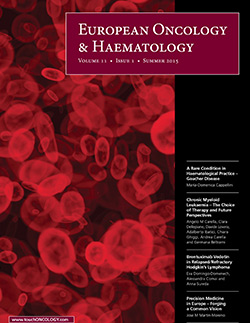
Welcome to the summer edition of European Oncology & Haematology, expertly introduced by Editorial Board member Prof. Baccarani. This edition features a wide range of timely and concise review articles on some of the most important topics in the field including breast cancer, lung cancer and precision medicine. Anna Sureda et al discuss the place of brentuximab vedotin in the treatment of relapsed/refractory Hodgkin’s lymphoma and Angelo Carella explores current and future treatment options in chronic myeloid leukaemia. We hope you enjoy this collection of topical articles, and that they provide useful information relevant to your practice and interests.
Areader of 20 years ago could have hardly imagined many of the contents of this issue of European Oncology & Haematology. Twenty years ago, chronic myeloid leukemia (CML) was still treated with hydroxyurea, interferon and allogeneic stem cell transplantation, and multiple myeloma with oral low-dose melphalan and prednisone, and autologous stem cell transplantation. Veno-occlusive disease […]
2
Haematology
Haematopoietic stem cell transplantation (HSCT) has become the standard of care for many haematological malignancies, selected solid tumours and some non-malignant disorders.1 However, it can be associated with serious complications, in particular, veno-occlusive disease (VOD). Approximately 14 % of HSCT patients develop VOD, although incidences of up to 60 % have been reported.2,3 Incidence is […]
3
Metabolic Disorders
Gaucher disease (OMIM #230800) is an inherited deficiency of lysosomal enzyme acid ß-glucosidase (glucocerbrosidase, GBA1; EC 3.2.1.45) due to mutations in the glucocerebrosidase gene, GBA1.1 Genetic mutations affect the enzyme’s catalytic function, intracellular stability or subcellulartrafficking.2–4 Such enzyme deficiency results in the accumulation of glucocerebroside in lysosomes of macrophages (known as Gaucher cells, Figure 1), […]
4
Haematological Malignancies
Hodgkin’s lymphoma (HL) is a highly curable haematological malignancy with an overall survival (OS) in the early stages of around 90 % with modern first-line therapies.1 In patients being diagnosed in advanced stages, the survival rate for 10-year OS is only above 50 %.2 Despite advances in the treatment of HL, patients having refractory or […]
The overwhelming majority of patients diagnosed with chronic phase chronic myeloid leukaemia (CP-CML) can achieve long-term survival with a good quality of life. In a recent review, it has been suggested that CML patients responsive to tyrosine kinase inhibitors (TKIs) might become a chronic disease, such as diabetes or hypertension, requiring maintenance treatment.1 If we […]
As the development of BCR-ABL1 targeting treatments has continued, patients with chronic phase chronic myeloid leukaemia (CML‑CP) were shown to have similar survival rates in all age groups to that of general population in the era of tyrosine kinase inhibitors (TKIs).1 First, imatinib and subsequently the second-generation TKIs (2GTKIs) (nilotinib and dasatinib) revolutionised the treatment […]
5
Precision Medicine
Genomic sequencing has been compared to piecing together a giant biological jigsaw puzzle. It is an arduous, slow process, somewhat prone to error and fraught with technical, practical and ethical complications that make its widespread implementation very challenging for the time being, even in the most advanced healthcare systems. Yet genomic sequencing is simple compared […]
6
Breast Cancer
Long-term Survival after Cerebellar Metastasis Resection from Her2 3+ Locally Advanced Breast Cancer
Breast cancer brain metastases (BCBM) represent a devastating event with limited survival upon diagnosis of approximately 6 months. Incidence of symptomatic BCBM ranges from 10 to 46 % during metastatic BC course and in 3–6 % of patients who are treated for early BC.1–7 Although BM cannot be predicted, risk varies according to BC molecular […]
Every year, we receive nearly 12,000 calls to Breast Cancer Care’s Helpline from people affected by breast cancer. Their reasons for calling encompass a broad range of topics, including concerns about symptoms or treatment side effects, making decisions about treatment and how to tell their children about their diagnosis. But one noticeable theme is how […]
7
Lung Cancer
Epidermal growth factor receptor tyrosine kinase inhibitors (EGFR-TKIs), such as gefitinib, erlotinib or afatinib, are standard of care as first-line treatment for advanced non-small cell lung cancer (NSCLC) harbouring EGFR-activating mutations.1 Adverse events associated with gefitinib are well known and include rash, pruritus, diarrhoea, nausea, anorexia, fatigue, derangement of liver function tests and, rarely, interstitial […]
8
US Highlights
Over the past several decades, two paradigms have emerged in the preoperative treatment of rectal cancer: a short course of radiation therapy (RT) often utilized in centers across Northern Europe and longcourse chemoradiation (CRT) in other parts of Europe and the US. The short-course technique was validated by randomized trials comparing this technique to surgery […]
Multiple myeloma (MM) is an incurable plasma cell disease that comprises 1 % of all cancers and 10 % of hematologic malignancies. It primarily affects older individuals—the median age at the moment of diagnosis is 70 years—and two-thirds of multiple myeloma patients are over 65 years of age when they are first diagnosed. The outcome […]
Gastrointestinal stromal tumors (GIST) are the most common mesenchymal tumors of the gastrointestinal (GI) tract. Although they have been recognized as a distinct entity for several decades, it has only been over the past 10–15 years that these tumors have been truly studied and further defined by rigorous diagnostic and molecular criteria. Indeed, one might […]
Trending Topic
Developed by Touch
Mark CompleteCompleted
BookmarkBookmarked
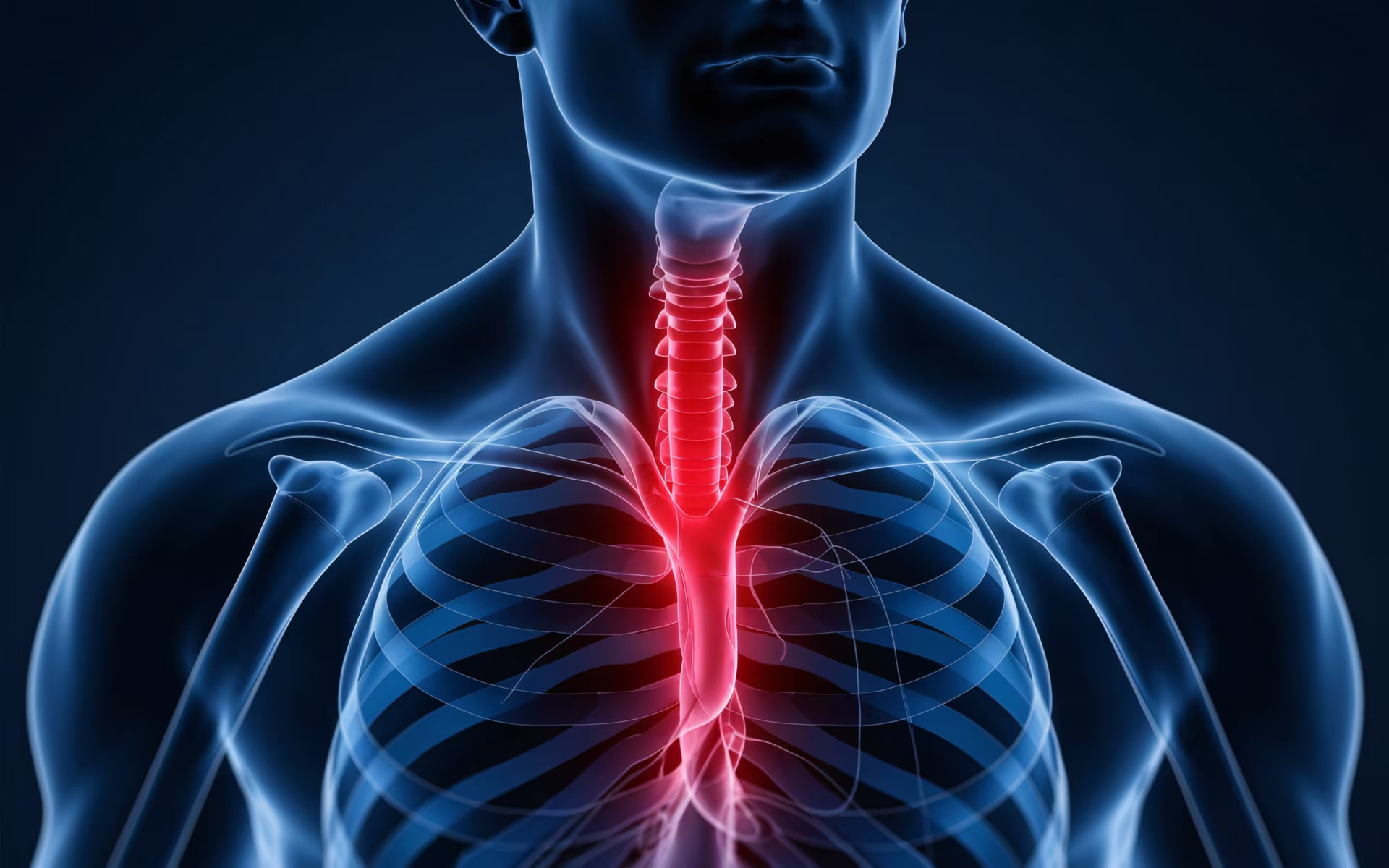
Esophageal cancer (EC) is a major global health concern, ranking as the 11th most commonly diagnosed cancer and the seventh leading cause of cancer-related deaths worldwide, with an estimated 494,320 new cases and 441,994 deaths in 2024.1 Esophageal squamous cell carcinoma (ESCC) remains the predominant subtype globally (84% of new cases), while esophageal adenocarcinoma (EAC) […]
9
Journal Archive
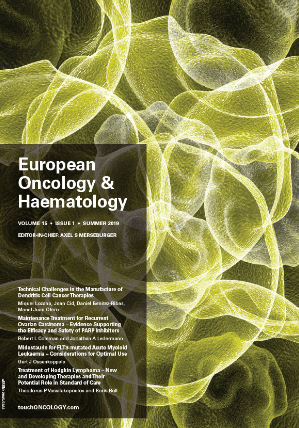
Comprising articles contributed by renowned thought leaders, European Oncology & Haematology is a peer reviewed, free-to-access, bi-annual journal that aims to disseminate best practice through review articles addressing the most important and salient developments in the Oncological & Haematology field in practical terms.
European Oncology & Haematology
Frequency: Two print issues per year (Summer & Winter); ePub ahead of print throughout the year.
Print ISSN: 2045-5275 Electronic ISSN: 2045-5283
Indexing: EMBASE, Google Scholar, Genamics JournalSeek
Log into your Touch Account
Keep track of your clinical interests and newsletter subscriptions.
Sign up with an Email
Or use a .
Register now for FREE access
Already registered? Login below.