
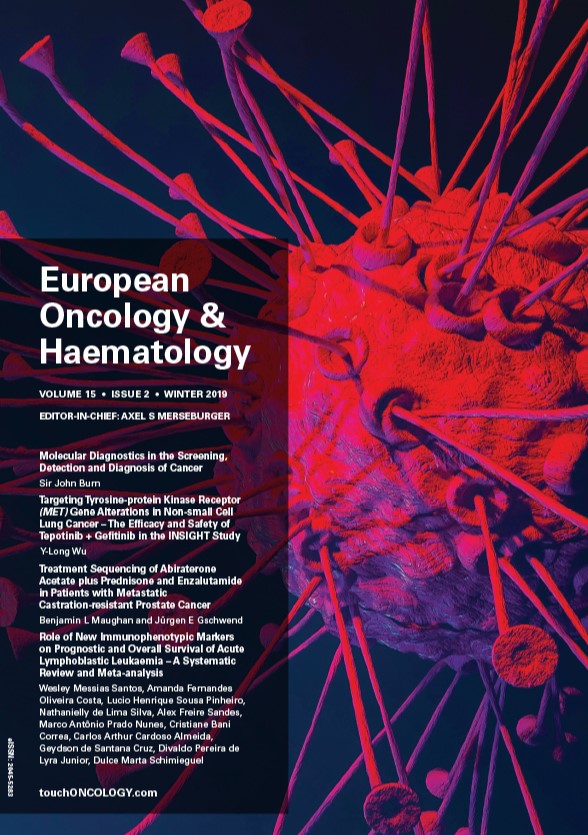
EUROPEAN ONCOLOGY & HAEMATOLOGY – VOLUME 15 – ISSUE 2 – WINTER 2019
Welcome to the winter edition of European Oncology and Haematology! This edition features a wide variety of topical articles including the evolving role of molecular diagnostic techniques in the management of cancer; the rationale for targeting MET gene alterations in non-small cell lung cancer, the key findings of the DEEP2 Trial; optimal sequencing of these agents in the treatment of patients with mCRPC and the role of new immunophenotypic markers on the prognosis and overall survival of patients with ALL.
Case studies are a valuable means of highlighting unusual manifestations of common conditions. Garcia et al. present a case of a patient with myelodysplastic syndromes (MDS) with chromosomal alteration i(7q10) and Jayawickreme et al. present a rare case of a patient with multiple myeloma complicated by immunoglobulin light chain amyloidosis.
We hope you find this edition of interest and useful.
Enjoy and happy reading!

Welcome to the winter edition of European Oncology and Haematology, a bi-annual journal that features a wide variety of topical articles of interest to oncologists and haematologists as well as the wider medical community. We begin with some of our popular expert interviews, which provide a snapshot of some of the hottest topics in oncology and haematology. […]
Expert Interviews
Molecular diagnosis and screening of cancer can be approached either in a broad, high-volume manner, or through using targeted, informed searches for specific genes. Technique selection will be critical in balancing patient benefit against healthcare resource cost, and physicians will need to consider how to prioritise their investigations in order to support accurate and efficacious […]
Non-small cell lung cancer (NSCLC) remains a world-wide health issue, accounting for 85% of all lung cancers, of which there were an estimated 2.1 million new cases and 1.76 million deaths in 2018; equivalent to 11.6% of the global cancer burden.1,2 This incidence is expected to rise in the coming years as rates of smoking increase […]
Beta-thalassaemia is a hereditary blood disorder arising from impaired synthesis of beta globin chains, and can result in a range of outcomes from asymptomatic carriers to severe anaemia.1 Symptomatic thalassaemia presents in around 1 in 100,000 people worldwide, and 1 in 10,000 in Europe.1 Transfusion-dependent beta-thalassaemia (TDT) is the most severe form of thalassaemia requiring lifelong management […]
Reviews
Prostate cancer is the most common cancer and the third leading cause of cancer-related death amongst men in Europe.1 Established treatment options for early-stage disease include surgery, radiation therapy and active surveillance,2 whereas patients presenting with advanced disease usually receive hormonal therapy using medical or surgical castration as the initial treatment.2,3 Unfortunately, most advanced prostate cancers acquire resistance […]
Case Reports

Myelodysplastic syndromes (MDS) are a group of clonal myeloid neoplasms characterised by blood cytopaenia, cellular dysplasia and predisposition to the development of acute myeloid leukaemia (AML).1,2 MDS are common in older individuals, with an incidence that varies from 2–12/100,000 inhabitants/year in the general population.3,4 The pathogenesis of MDS is due to acquired genetic changes that result in […]
Amyloidosis is a group of diseases resulting from intracellular and extracellular deposition of insoluble abnormal amyloid fibrils, which alters the normal function of tissues. Glycosaminoglycans, apolipoprotein-E and serum amyloid P component comprise 10% of deposits, while amyloid fibrils formed by misfolded proteins comprise 90% of deposits. Amyloidosis can locally target a single organ or can […]
Original Research
Acute lymphoblastic leukaemia (ALL) is a group of malignant haematological disorders characterised by accumulation of lymphoid cell precursors that replace normal bone marrow elements and inhibit the production of functional blood cells.1 ALL occurs in both children and adults, and more than one-half (56%) of those diagnosed are <20 years old, with chemotherapy required as standard […]

Trending Topic
Welcome to the latest issue of touchREVIEWS in Oncology & Haematology. We are honoured to present a series of compelling articles that reflect cutting-edge developments and diverse perspectives in this ever-evolving field. This issue includes a series of editorials and reviews from esteemed experts who provide insights into novel therapies and their potential to change […]
Journal Archive
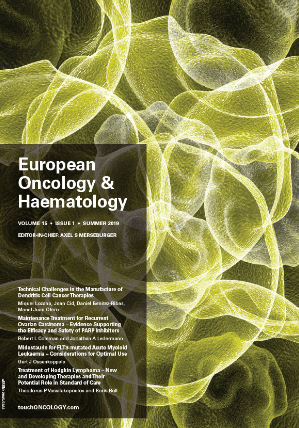
Comprising articles contributed by renowned thought leaders, European Oncology & Haematology is a peer reviewed, free-to-access, bi-annual journal that aims to disseminate best practice through review articles addressing the most important and salient developments in the Oncological & Haematology field in practical terms.
European Oncology & Haematology
Frequency: Two print issues per year (Summer & Winter); ePub ahead of print throughout the year.
Print ISSN: 2045-5275 Electronic ISSN: 2045-5283
Indexing: EMBASE, Google Scholar, Genamics JournalSeek
Log into your Touch Account
Keep track of your clinical interests and newsletter subscriptions.
Sign up with an Email
Or use a .
Register now for FREE access
Already registered? Login below.