
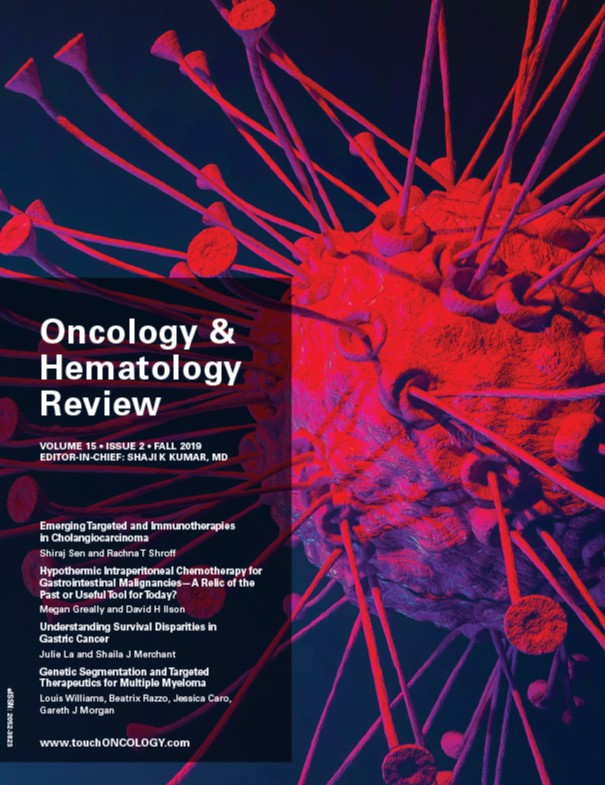
Enjoy and happy reading!
ONCOLOGY & HEMATOLOGY (US) – VOLUME 15 ISSUE 2 – FALL 2019
Welcome to the fall edition of Oncology and Hematology Review (US), which features a wide variety of articles covering topics of interest to oncologists and hematologists. Our expert interviews discuss the PhosphoSynVax™ vaccine platform, new research on the benefits of PARP inhibitors in a broader range of breast cancer patients, and immune checkpoint inhibitors for metastatic urothelial cancer. The journal also covers technical advances in targeted therapy for cholangiocarcinoma, cytoreductive surgery and hyperthermic intraperitoneal chemotherapy in peritoneal carcinomatosis related to gastrointestinal malignancies. Finally, Williams et al. review recent progress in molecular testing for multiple myeloma and the mutation-targeted therapies that are emerging as a result of molecular diagnostic panels.

Welcome to the fall edition of Oncology and Hematology Review (US), which features a wide variety of articles covering topics of interest to oncologists and hematologists, as well as the wider medical community. We begin with some expert interviews, which provide a snapshot of some of the hottest topics in oncology. In the first, Paisley Myers […]
2
Expert Interviews
Q. What are phosphopeptide tumor targets and why are they good candidates for vaccine and cell therapy development? PTTs are a novel class of neoantigen. They are portions of aberrantly phosphorylated proteins that are presented at the cell surface to the immune system in the context of human leukocyte antigen (HLA) class I molecules. These […]

Q. What is the role of PARP-1 in the pathogenesis of cancer? PARP-1 is a protein that resides in the cell nucleus where it plays a role in most, if not all, nuclear functions (e.g. DNA repair, transcription, RNA processing, RNA ribosomal transcription). PARP-1 uses these pathways to assist the cancer cell in its uncontrolled […]
Advanced (locally advanced/unresectable or metastatic) urothelial cancer (UC) is an incurable disease with a poor prognosis.1 Platinum-based chemotherapy is the first-line treatment for most patients and, until recently, patients with advanced UC that has progressed after platinum-based chemotherapy had limited treatment options.2 In recent years, improved understanding of molecular mechanisms underlying the pathogenesis of UC has enabled […]
3
Editorial
Cholangiocarcinoma is an epithelial malignancy of the biliary system characterized by cholangiocyte differentiation, and its incidence is on the rise. Currently, cholangiocarcinomas are classified by their anatomical location in the biliary system as intrahepatic cholangiocarcinoma, distal cholangiocarcinoma, or hilar cholangiocarcinoma. Since 2010, the standard of care in all advanced, inoperable biliary tract cancers has been combination […]
4
Reviews

Gastric cancer was the fifth most common cancer in 2018 with over one million new cases, 55% of which occurred in developed countries.1,2 Mortality remains high and gastric cancer is the third leading cause of cancer-related death in the world.1 Despite decreasing trends in incidence and death worldwide, high rates of gastric cancer remain throughout […]

Peritoneal carcinomatosis, defined as tumor dissemination in the peritoneal cavity, is a common manifestation of gastrointestinal malignancies. However, isolated peritoneal metastases (IPM) are relatively rare, though appendiceal tumors and peritoneal mesothelioma have a propensity to involve only the peritoneum. Cytoreductive surgery including hyperthermic intraperitoneal chemotherapy (HIPEC), are now considered standard treatment for appendiceal tumors with […]
An ever-expanding understanding of the biological basis for multiple myeloma (MM) combined with a widening array of effective therapies has dramatically improved outcomes for patients and has provided new opportunities for disease segmentation and targeted therapeutics.1 While this progress is most welcome, it has created unique challenges for clinicians because of the spatial and temporal heterogeneity, […]
Trending Topic
Developed by Touch
Mark CompleteCompleted
BookmarkBookmarked
Multiple myeloma (MM) is the second most common haematological malignancy, with upwards of 35,000 diagnoses in the USA each year.1,2 It remains a leading cause of blood cancer–related mortality worldwide, and although therapeutic advances have allowed for significant improvements in the median overall survival,3,4 the majority of patients still experience cycles of relapse that are eventually fatal.5 While patients with MM are living longer, a subgroup with high-risk disease at diagnosis still does poorly, with a median […]
5
Journal Archive



Log into your Touch Account
Keep track of your clinical interests and newsletter subscriptions.
Sign up with an Email
Or use a .
Register now for FREE access
Already registered? Login below.