This website is intended for healthcare professionals only

Trending Topic

Comprehensive Anatomical Render Of Breast Cancer In A Human Female
8 mins

Trending Topic

Developed by Touch
Mark CompleteCompleted
BookmarkBookmarked

Circulating tumor DNA (ctDNA) has emerged as an innovative and minimally invasive tool in precision oncology. With a short half-life of 30–120 min, ctDNA provides real-time insight into tumor dynamics.1 In early-stage breast cancer, there is growing evidence supporting its potential for minimal residual disease (MRD) detection and recurrence monitoring. In metastatic breast cancer (MBC), ctDNA […]

Teclistamab Monotherapy for the Treatment of Adult Patients with Relapsed and Refractory Multiple Myeloma

Beatrice M Razzo, Alfred L Garfall
8 mins
Share
Facebook
X (formerly Twitter)
LinkedIn
Via Email
Mark CompleteCompleted
BookmarkBookmarked
Copy LinkLink Copied
Download as PDF
Published Online: Apr 27th 2023 touchREVIEWS in Oncology & Haematology. 2023;19(1):46–51 DOI: https://doi.org/10.17925/OHR.2023.19.1.46
Select a Section…
1

Abstract

Overview

Several new drugs and regimens have greatly improved outcomes in multiple myeloma, but the rapid emergence of new targets and immune-based modalities has added significant complexity to the management of relapsed and refractory multiple myeloma (RRMM). Teclistamab is a T cell-redirecting anti-CD3 × anti-B cell maturation antigen bispecific antibody recently approved as monotherapy against RRMM. The drug is now the fourth B cell maturation antigen-targeting agent commercially used in RRMM and the third different drug class and mechanism of action doing so. Although approved as a single agent in relapsed and refractory disease, preclinical and clinical evidence has supported teclistamab-based regimens for use in earlier lines or in combination strategies. The identification of novel suitable cell-surface targets in multiple myeloma and the promising efficacy seen in early–phase studies represent additional innovations to the treatment paradigms for RRMM.

Keywords
2

Article

Multiple myeloma (MM) is the second most common haematological malignancy, with upwards of 35,000 diagnoses in the USA each year.1,2 It remains a leading cause of blood cancer–related mortality worldwide, and although therapeutic advances have allowed for significant improvements in the median overall survival,3,4 the majority of patients still experience cycles of relapse that are eventually fatal.5 While patients with MM are living longer, a subgroup with high-risk disease at diagnosis still does poorly, with a median overall survival of nearly 3 years.6 Outcomes are also dismal in patients with disease that is refractory to the major modern therapies including thalidomide analogues, proteosome inhibitors and anti-CD38 monoclonal antibodies.7 Together, these unmet needs have driven the development of immunotherapy for relapsed and refractory multiple myeloma (RRMM).

Toward this end, immune cell redirecting therapies were developed following the discovery of suitable MM cell-surface markers and novel drug engineering technologies. Chimeric antigen receptor (CAR)-T cells showed robust responses in RRMM compared with B cell maturation antigen (BCMA), leading to the approval of cellular therapies for MM – idecabtagene vicleucel in 2021 and ciltacabtagene autoleucel in 2022.8–11 Available data on idecabtagene vicleucel and ciltacabtagene autoleucel in RRMM, however, suggest that most patients will experience disease progression after initial response.9,11 Moreover, the need for patient-specific manufacturing and access to specialized cellular therapy centres continue to limit CAR T cell access for patients with rapid disease progression or in under-served areas.

Successful adaptive immune redirection has also been shown with bispecific antibodies (BsAbs) against various established and emerging MM cell targets. This review follows the US Food and Drug Administration (FDA) approval of teclistamab – the first-in-kind commercially available BsAb for RRMM.12 Teclistamab is a T cell-redirecting antibody that targets CD3 on the surface of T cells and BCMA expressed on the surface of myeloma cells (BCMA×CD3). It was approved for use as monotherapy in 2022 based on data from the MajesTEC-1 trial published in June 2022.13 Teclistamab and similar agents in development enable T cell redirection with similar potency to CAR T cells but without the delay required for patient-specific manufacturing.

In this article, we review the mechanism of action of this BCMA×CD3 antibody, the clinical data supporting the approval of teclistamab and its impact on the treatment paradigms for RRMM.

Mechanisms of action

Overview of B cell maturation antigen as a target

BCMA, also known as TNFRSF-17 or CD269, is a small transmembrane protein member of the tumour necrosis factor (TNF) receptor superfamily. It is selectively induced during plasma cell (PC) differentiation,14 with transcription and cell-surface expression concentrated in subsets of mature B cells, PCs and plasmacytoid dendritic cells.15,16 Select datasets have also suggested low-level transcription on neurons and astrocytes,17 though other studies have not supported this association.18,19

BCMA has two ligands, BAFF/BLys and APRIL, which are integral to maintaining bone marrow PC survival and homeostasis (as reviewed in Eckhert et al. and Romano et al.).20,21 Stimulation with APRIL or BAFF activates the NF-κB, AKT and mitogen-activated protein kinase (MAPK)8/c-Jun N-terminal kinase (JNK) signalling cascades, resulting in the upregulation of anti-apoptotic proteins,22 adhesion molecules, cell-cycle regulators, angiogenesis factors, immunosuppressive molecules and inflammatory cytokines (Figure 1A).23–26 Both ligands also bind to transmembrane activator calcium modulator and cyclophilin ligand interactor (TACI), a larger homologue receptor of the TNF receptor superfamily, and mediate PC differentiation and T cell-independent immunoglobulin (Ig) isotype switching.27 The role of BCMA activation, however, is restricted to maintaining PCs and antigen presentation by B cells.26 BCMA has a soluble form derived from the cleavage of the membrane BCMA mediated by γ-secretase.28 This soluble form has shown to sequester BAFF and mediate immunosuppression by preventing normal B cell and PC development.29
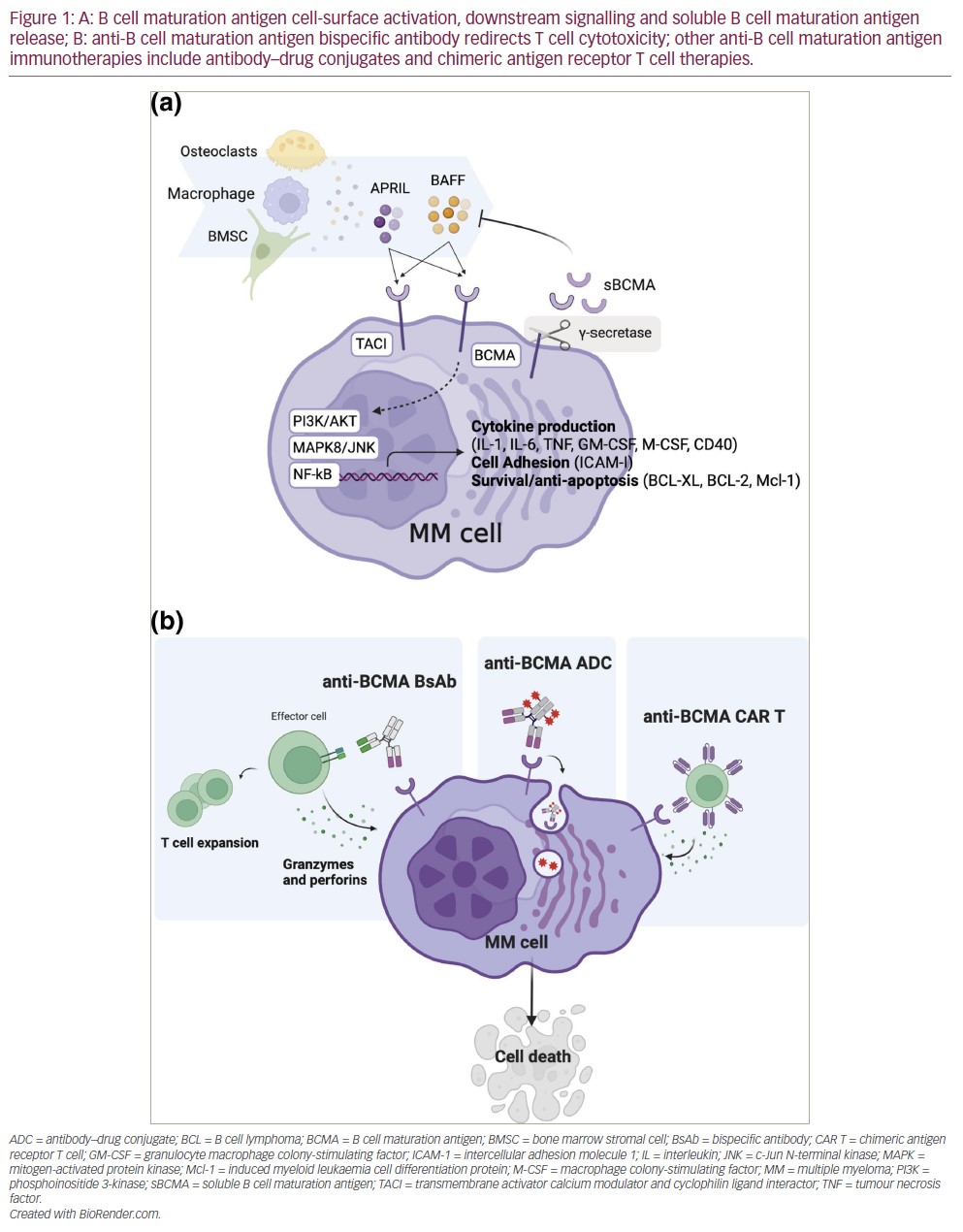
 

BCMA is overexpressed in MM,30 and NF-κB overactivation is a hallmark of MM tumourigenesis.31 In patients with MM, soluble BCMA is also significantly elevated compared with healthy individuals, and higher soluble BCMA (sBCMA) levels correlate with immune paresis, disease burden and adverse outcomes.28,32 Preclinical studies demonstrated that antibodies with ligand–blocking activity could promote cytotoxicity in MM cell lines as naked antibodies or as antibody–drug conjugates by inhibiting APRIL-dependent activation of NF-κB in a dose-dependent manner in vitro.33 BCMA was later validated as a suitable CAR T target.15 Altogether, these studies paved the way for the development and clinical investigation of anti-BCMA antibody–drug conjugates, CAR T and now BsAb therapies against RRMM (Figure 1B).

Bispecific antibody therapy development for relapsed and refractory multiple myeloma

BsAbs are T cell–engaging (TCE) therapies designed to redirect T cell cytotoxicity towards cell-surface tumour antigens (Figure 1B). TCE therapies have been developed in various formats, including bispecific IgG-like antibodies or shorter molecules comprising two linked antigen-binding domains configured as single-chain variable fragments, such as bispecific T cell engagers (BiTEs).34 BsAbs were originally proposed in the early 1960s but only developed35 and studied clinically36 years later. The favourable clinical efficacy of the blinatumomab (CD19×CD3 BiTE in relapsed B-cell acute lymphoblastic leukaemia) published in 201737 generated interest in BsAb development for other haematologic malignancies.34

An anti-BCMA BiTE construct, the BCMA×CD3 AMG420, yielded encouraging preclinical38 and clinical activity against RRMM.39 The need for a 4–week continuous infusion due to the short half-life of BiTEs shifted the focus onto longer half-life, full-length IgG molecules.40 Several BCMA-targeting BsAbs have since been developed and tested in various clinical settings and combinations, and are reviewed by Moreau and Touzeau.41 Of these, teclistamab has been studied in the MajesTEC trial series and will be further described in the following section.

BsAbs against other emerging targets in RRMM are also being investigated. Talquetamab, a G protein-coupled receptor class C, group 5, member D (GPRC5D)×CD3 BsAb, showed promising tolerability and efficacy in a phase 1 trial (MonumenTAL-1)42,43 and is also being studied in combination with daratumumab (TRIMM-2,44 MonumenTAL-345) and several other agents (MonumenTAL-2).46 Cevostamab, an Fc receptor-homologue 5 (FCHR5)×CD3 BsAb, has also demonstrated safety and promising efficacy in an on–going phase 1 study (ClinicalTrials.gov identifier: NCT03275103).47 This emergence of non-BCMA TCE targets is likely to introduce additional options and complexity in the care of heavily refractory patients.

Teclistamab in relapsed and refractory multiple myeloma

Clinical investigation

Teclistamab (also known as JNJ-64007957, Ab-957 and JNJ-7957) is a humanized IgG4-proline, alanine, alanine (IgG4-PAA) bispecific DuoBody® antibody (Genmab, Copenhagen, Denmark), whose in vitro efficacy was first shown in 2016.48,49 The first in–human trial with teclistamab, MajesTEC-1, was an open-label, single-arm phase 1/2 (phase 1 ClinicalTrials.gov identifier: NCT03145181; phase 2 ClinicalTrials.gov identifier: NCT03145181) trial that evaluated intravenous (phase 1) and subcutaneous (phase 1 and 2) administration.1,13,50,51 Participants were refractory to thalidomide analogues and proteosome inhibitors; most patients (93%) had also progressed on an anti-CD38 agent.51 Doses ranging from 0.3 µg/kg to 3000 µg/kg were evaluated.51 At most levels, a step-up dosing approach was used, in which 1–3 smaller quantities were administered over several days prior to the first full dose, with the intent of more gradually activating T cells and reducing the risk of severe cytokine release syndrome (CRS). Clinical responses were observed beginning at 38.4 µg/kg. No maximum tolerated dose was identified, and a recommended phase 2 dose of 1.5 mg/kg weekly, administered as a subcutaneous injection, was determined based on the combined safety, efficacy, pharmacokinetic and pharmacodynamic profiles of teclistamab. In total, 165 patients enrolled in phase 1 and 2 of the MajesTEC-1 trial received teclistamab at the recommended phase 2 dose. Patients received two step-up doses of 0.06 mg/kg and 0.3 mg/kg, which were separated by 2–4 days and were completed 2–4 days before the first full teclistamab dose was administered. Patients with confirmed partial response or better were permitted to switch to 2-weekly dosing.13,52

With a median follow-up of 14.1 months, the overall response rate was 63.0%, with 65 patients (39.4%) having a complete response or better. A total of 44 patients (26.7%) had no minimal residual disease; the negativity rate of minimal residual disease among the patients with a complete response or better was 46.0%. Responses occurred rapidly, with a median of 1.2 months until first response.

The Kaplan–Meier estimate of maintenance of response for at least 12 months was 68.5% (95% confidence interval [CI] 57.7–77.1). The median duration of response was 18.4 months (95% CI 14.9–not estimable). The median progression-free survival was 11.3 months (95% CI 8.8–17.1).

Safety and infection risk13

As with CAR T cells, CRS and immune effector cell-associated neurotoxicity syndrome (ICANS) are important adverse effects of teclistamab and occurred in 72.1% and 3.0% of patients, respectively. These risks are confined to the initial doses and typically occur 2 or 3 days following the inciting dose. Inpatient monitoring at the time of the two step-up dose and first full dose of teclistamab is recommended in the FDA prescribing information to enable the prompt management of CRS.53 Roughly half of the patients who experienced CRS, or 36% of phase 2 participants, received tocilizumab; 8.5% of subjects received corticosteroids for CRS or ICANS management, thus warranting the availability of anti-interleukin-6 agent upon therapy initiation. Patients who respond to teclistamab are not at an on–going risk of CRS or ICANS with long-term dosing. If therapy is interrupted for longer than a month, however, repeat step–up dosing is advised.54

Infections were major adverse events in the MajesTEC-1 trial and occurred throughout the therapy.50 A total of 126 patients (76.4%) reported at least one infectious event, with 74 (44.8%) experiencing grade 3 or 4 infections. Notably, coronavirus disease 2019 (COVID-19) was frequent and led to on-study mortality in 12 of the 165 participants, though many of the fatal cases occurred in the early phase of the pandemic. Other viral (cytomegalovirus, JC virus), bacterial and fungal events were also reported. Six (3.6%) patients developed Pneumocystis jirovecii pneumonia. Among the 19 on-study deaths due to adverse events, 14 were attributed to infection (12 due to COVID-19, one due to progressive multifocal leukoencephalopathy from JC virus infection, and one due to streptococcal pneumonia). Hypogammaglobulinaemia developed in 74.5% of patients (essentially all patients who responded to therapy and received long-term teclistamab), which likely contributed to the risk of infection. The FDA prescribing information recommends varicella zoster virus prophylaxis.53 Additional prophylaxis against Pneumocystis jirovecii pneumonia, and Ig replacement therapy to maintain IgG levels >400 mg/dL, should be considered.54 In our view, these measures are essential considering the magnitude of infection risk. Interventions to protect against COVID-19 are also prudent, including vaccination and proactive use of anti-virals when symptomatic infections develop. Though patients on teclistamab are not expected to mount antibody responses to vaccination, vaccine-induced T cell responses have been observed and may be clinically protective.55

Haematologic toxicity is commonly observed. Grade 3 or 4 neutropenia, anaemia and thrombocytopenia were reported in 64.2%, 37.0% and 21.2% of trial participants, respectively. Of the 117 patients in whom neutropenia developed, 91 received granulocyte colony-stimulating factor therapy at the investigator’s discretion.13,50,51 In our experience, neutropenia with teclistamab is idiosyncratic, occurring intermittently throughout treatment, and can be successfully managed with occasional dose holding and the administration of filgrastim.

Efficacy correlations and drug–drug synergy

Various baseline immune, tumour and clinical factors are associated with the clinical efficacy of teclistamab. 52 In MajesTEC-1, response rates and progression-free survival correlated positively with recipient peripheral T cell counts and a naive CD8 T cell phenotype and inversely with burden of regulatory and exhausted (PD-1-, CD38-, and TIM-3-expressing) T cells.50 These findings are consistent with preclinical predictions56 and with associations seen in other TCE therapies, including BCMA CAR T.57–59 The depletion of naïve and early–memory T cells, along with the increasing frequency of an exhausted immune phenotype, are common features of advanced MM and of heavily pretreated patients. The intrinsic reliance on host immunity raises the question of whether TCE therapies should be used in early lines of MM therapy rather than in the relapsed refractory setting, where their use is currently approved.

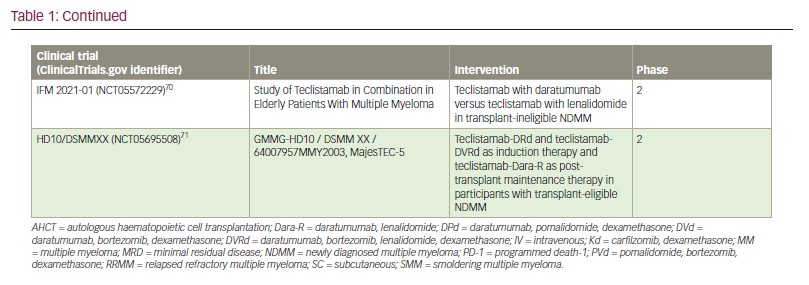
Teclistamab responders also had lower sBCMA concentrations, and elevated sBCMA (but not surface BCMA) was associated with worse disease (high-risk International Staging System scores and extramedullary involvement) and with a greater bone marrow PC cellularity.52 These features were associated with more baseline T cell dysfunction, and likely account for the lower response rates in patients with high tumour burden. Again, these findings challenge the current treatment paradigm and suggest the use of teclistamab in maintenance or other low-disease-burden setting, as investigated in the MajesTEC-4, MASTER-2 and Immuno-PRISM trials, may allow for long-lasting anti-tumour immunity (Table 1).1,51,60–71
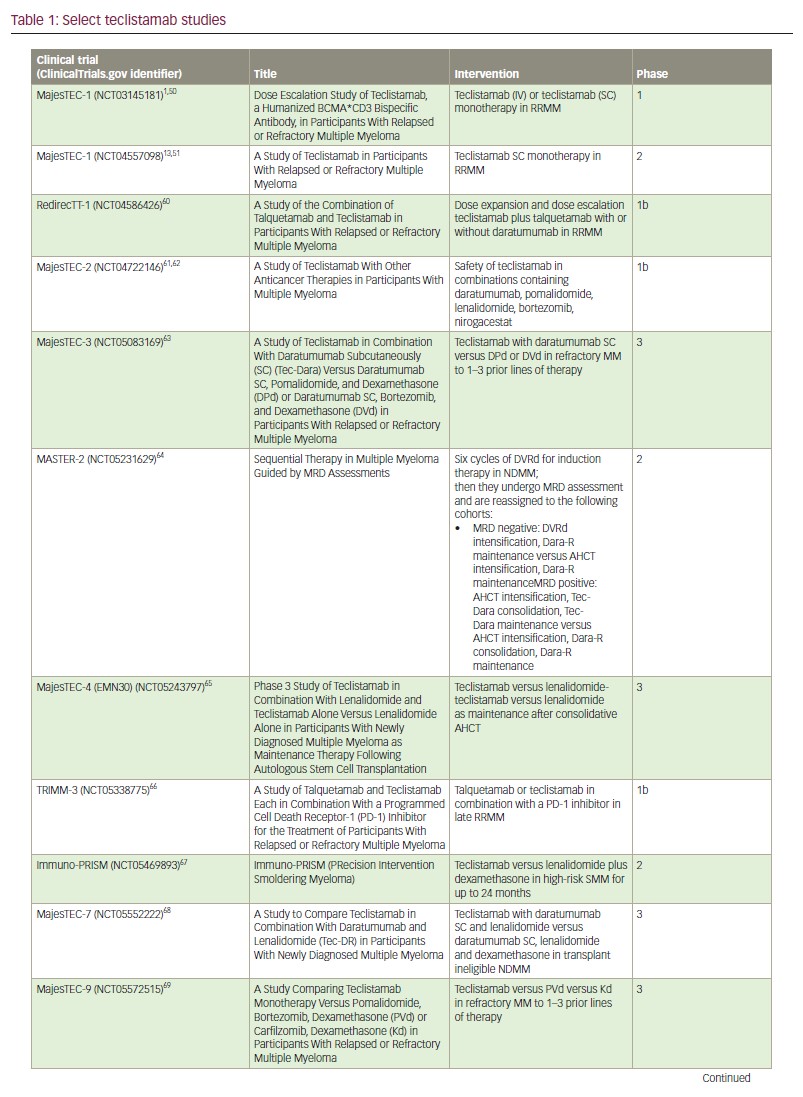
Lastly, a preclinical study found that pretreatment with CD38 inhibition enhanced teclistamab activity in a synergistic manner, possibly due to the immunomodulatory effect of daratumumab in the tumour microenvironment,72–76 and its inhibition of nicotinamide adenine dinucleotidase activity, which, in turn, may avert T cell exhaustion.40,77 Daratumumab-lenalidomide synergism has been previously demonstrated.78 As such, various teclistamab-containing multi–drug regimens are currently under investigation in newly diagnosed (MajesTEC-4,65 MajesTEC-7 [ClinicalTrials.gov identifier: NCT0555222268] and MASTER-2 [ClinicalTrials.gov identifier: NCT05231629]64), early (MajesTEC-3 [ClinicalTrials.gov identifier: NCT05083169]63 and MajesTEC-9 [ClinicalTrials.gov identifier: NCT05572515]69) and late relapsed settings (TRIMM-3 [ClinicalTrials.gov identifier: NCT05338775]66 and RedirecTT-1 [ClinicalTrials.gov identifier: NCT04586426]60) (Table 1). How and when these combinations are adopted will largely depend on the safety of the regimen and whether the progression-free and overall survival advantages outweigh the risk of incremental toxicity. For example, recently presented early results from MajesTEC-2 combining teclistamab with lenalidomide and daratumumab in patients with RRMM who had received 1–3 prior lines of therapy was highly efficacious but again associated with a high rate of infectious complications.61 In these early lines of therapy, responses are expected to be very durable, which would expose patients to cumulative immune suppression. Alternative dosing strategies in which teclistamab is administered for fixed durations, with intermittent re-dosing upon disease progression, may be important for safe use in early lines of therapy. Such intermittent dosing may also improve efficacy by alleviating T cell exhaustion associated with continuous administration.79

Treatment paradigms and discussion

TCE therapies for MM have evolved rapidly. Though CAR T cells demonstrated the most impressive single-agent response rates ever reported in RRMM just a couple of years ago, teclistamab now enables similar efficacy but with off-the-shelf availability and subcutaneous administration.9,11 Both CAR T cells and BsAb therapy continue to innovate. For example, abbreviated manufacturing protocols may improve both the efficacy and accessibility of CAR T cell therapy,80 and trispecific antibodies that enable dual-antigen specificity or that incorporate costimulatory or checkpoint-blocking domains are in development.81 Collectively, these are paradigm-shifting advances with the potential to add years to the survival of the typical patient with MM.

We do not yet know how best to use these agents in practice. Both CAR T cells and teclistamab are currently approved for patients with at least four prior lines of MM therapy; however, all these agents are being evaluated in earlier lines of MM therapy (Table 1).8,10,12 Meanwhile, non-TCE therapies continue to progress, notably with molecules such as iberdomide82 and mezigdomide,83 which build on lenalidomide’s mechanism of action, and novel immunotherapies such as modakafusp alfa, an anti-CD38 antibody-cytokine fusion protein.84 Extensive clinical investigation will be required to determine how to best sequence and combine these agents with current therapies; such studies will hopefully incorporate correlative studies to inform personalized treatment approaches.

Though it is tempting to contrast different TCE therapies, patients can receive both BsAb and CAR T cells sequentially. Teclistamab has been prospectively evaluated in a small cohort of patients previously treated with anti-BCMA CAR T cells or the anti-BCMA antibody–drug conjugate belantamab mafadotin; the response rate in these patients was only slightly lower than in patients who were naive to BCMA-directed therapy.85 Similarly, ciltacabtagene autoleucel has been prospectively studied after prior BCMA-directed therapy with promising results,86 and several retrospective reports have demonstrated efficacy with sequential BCMA-directed therapies.87–89

Although BCMA-negative relapses have been reported,90 most cases of progression after anti-BCMA CAR T cells do not appear related to antigenic escape.91 Continuously dosed BsAbs likely exert more durable target-directed immune surveillance than CAR T cells, which wane after several months in most RRMM patients.9,11 Target-negative relapse may, therefore, be more likely after BsAb therapy than CAR T cell therapy; however, this has not yet been evaluated. Patients progressing after BCMA-directed TCE therapy have been shown to respond to both BsAb and CAR T cells directed against GPRC5D.43,92,93

Our current approach to sequencing teclistamab and CAR T cells is driven by patient-specific factors, including patient preference either for a single–dose, but more complex, CAR T cell approach or for the simpler, but continuously dosed, teclistamab. Patients with rapidly progressive RRMM now have teclistamab as a readily available option. However, teclistamab may still be preferred for patients with gradual and uncomplicated progression, depending on the accessibility of a cellular therapy centre and patient tolerance of CAR T cell toxicities and logistical requirements.

Finally, with all this exciting progress, we must not lose sight of the stubbornly high propensity for relapse that remains even after treatment with these potent novel therapies and of the high cost required to sustain years of sophisticated therapy in patients with MM. More focused research is required on the specific mechanisms of relapse and the biology of resistant disease that persists, often below detectable limits, and that presumably seeds future relapses. In addition, a nuanced clinical and translational investigation is required to understand when and for whom continuous therapy promotes long-term survival compared with more intermittent therapy.

3

References

List View
Grid View
1
Copy URLURL Copied
Visit URL

 Clinicaltrials.gov. Dose escalation study of teclistamab, a humanized BCMA*CD3 bispecific antibody, in participants with relapsed or refractory multiple myeloma (majesTEC-1). ClinicalTrials.gov identifier: NCT03145181. Available at: https://clinicaltrials.gov/ct2/show/NCT03145181 (Date last accessed: 12 April 2023)

2
Copy URLURL Copied
Visit URL

 American Cancer Society. Key statistics about multiple myeloma. Available at: www.cancer.org/cancer/multiple-myeloma/about/key-statistics.html (Date last accessed: 21 April 2023)

3
Copy DOIDOI Copied
Visit DOI Link

 Kumar SK, Dispenzieri A, Lacy MQ, et al. Continued improvement in survival in multiple myeloma: Changes in early mortality and outcomes in older patients. Leukemia. 2014;28:1122–8. DOI: 10.1038/leu.2013.313

4
Copy DOIDOI Copied
Visit DOI Link

 Turesson I, Bjorkholm M, Blimark CH, et al. Rapidly changing myeloma epidemiology in the general population: Increased incidence, older patients, and longer survival. Eur J Haematol. 2018;101:237–44. DOI: 10.1111/ejh.13083

5
Copy DOIDOI Copied
Visit DOI Link

 Ludwig H, Novis Durie S, Meckl A, et al. Multiple myeloma incidence and mortality around the globe; interrelations between health access and quality, economic resources, and patient empowerment. Oncologist. 2020;25:e1406–13. DOI: 10.1634/theoncologist.2020-0141

6
Copy DOIDOI Copied
Visit DOI Link

 D’Agostino M, Cairns DA, Lahuerta JJ, et al. Second revision of the international staging system (R2-ISS) for overall survival in multiple myeloma: A European Myeloma Network (EMN) report within the Harmony project. J Clin Oncol. 2022;40:3406–18. DOI: 10.1200/JCO.21.02614

7
Copy DOIDOI Copied
Visit DOI Link

 Gandhi UH, Cornell RF, Lakshman A, et al. Outcomes of patients with multiple myeloma refractory to CD38-targeted monoclonal antibody therapy. Leukemia. 2019;33:2266–75. DOI: 10.1038/s41375-019-0435-7

8
Copy DOIDOI Copied
Visit DOI Link

 US Food and Drug Administration. FDA APPROVES Idecabtagene Vicleucel for multiple myeloma. Available at: www.fda.gov/drugs/resources-information-approved-drugs/fda-approves-idecabtagene-vicleucel-multiple-myeloma (Date last accessed: 21 April 2023)

9
Copy DOIDOI Copied
Visit DOI Link

 Munshi NC, Anderson LD Jr Shah N, et al. Idecabtagene vicleucel in relapsed and refractory multiple myeloma. N Engl J Med. 2021;384:705–16. DOI: 10.1056/NEJMoa2024850

10
Copy DOIDOI Copied
Visit DOI Link

 US Food and Drug Administration. FDA approves ciltacabtagene autoluecel for relapsed or refractory multiple myeloma . Available at: www.fda.gov/drugs/resources-information-approved-drugs/fda-approves-ciltacabtagene-autoleucel-relapsed-or-refractory-multiple-myeloma (Date last accessed: 21 April 2023)

11
Copy DOIDOI Copied
Visit DOI Link

 Berdeja JG, Madduri D, Usmani SZ, et al. Ciltacabtagene autoleucel, a B-cell maturation antigen-directed chimeric antigen receptor T-cell therapy in patients with relapsed or refractory multiple myeloma (CARTITUDE-1): A phase 1b/2 open-label study. Lancet. 2021;398:314–24. DOI: 10.1016/S0140-6736(21)00933-8

12
Copy DOIDOI Copied
Visit DOI Link

 US Food and Drug Administration. FDA approves teclistamab-cqyv for relapsed or refractory multiple myeloma. Available at: www.fda.gov/drugs/resources-information-approved-drugs/fda-approves-teclistamab-cqyv-relapsed-or-refractory-multiple-myeloma (Date last accessed: 21 April 2023)

13
Copy DOIDOI Copied
Visit DOI Link

 Moreau P, Garfall AL, van de Donk N, et al. Teclistamab in relapsed or refractory multiple myeloma. N Engl J Med. 2022;387:495–505. DOI: 10.1056/NEJMoa2203478

14
Copy DOIDOI Copied
Visit DOI Link

 Laabi Y, Gras MP, Brouet JC, et al. The BCMA gene, preferentially expressed during B lymphoid maturation, is bidirectionally transcribed. Nucleic Acids Res. 1994;22:1147–54. DOI: 10.1093/nar/22.7.1147

15
Copy DOIDOI Copied
Visit DOI Link

 Carpenter RO, Evbuomwan MO, Pittaluga S, et al. B-cell maturation antigen is a promising target for adoptive T-cell therapy of multiple myeloma. Clin Cancer Res. 2013;19:2048–60. DOI: 10.1158/1078-0432.CCR-12-2422

16
Copy DOIDOI Copied
Visit DOI Link

 Tai YT, Mayes PA, Acharya C, et al. Novel anti–B-cell maturation antigen antibody-drug conjugate (GSK2857916) selectively induces killing of multiple myeloma. Blood. 2014;123:3128–38. DOI: 10.1182/blood-2013-10-535088

17
Copy DOIDOI Copied
Visit DOI Link

 Van Oekelen O, Aleman A, Upadhyaya B, et al. Neurocognitive and hypokinetic movement disorder with features of parkinsonism after BCMA-targeting CAR-T cell therapy. Nat Med. 2021;27:2099–103. DOI: 10.1038/s41591-021-01564-7

18
Copy DOIDOI Copied
Visit DOI Link

 Bu D-X, Singh R, Choi EE, et al. Pre-clinical validation of B cell maturation antigen (BCMA) as a target for T cell immunotherapy of multiple myeloma. Oncotarget. 2018;9:25764–80. DOI: 10.18632/oncotarget.25359

19
Copy DOIDOI Copied
Visit DOI Link

 Marella M, Yao X, Carreira V, et al. Comprehensive BCMA expression profiling in adult normal human brain suggests a low risk of on-target neurotoxicity in BCMA-targeting multiple myeloma therapy. J Histochem Cytochem. 2022;70:273–87. DOI: 10.1369/00221554221079579

20
Copy DOIDOI Copied
Visit DOI Link

 Eckhert E, Hewitt R, Liedtke M. B-cell maturation antigen directed monoclonal antibody therapies for multiple myeloma. Immunotherapy. 2019;11:801–11. DOI: 10.2217/imt-2018-0199

21
Copy DOIDOI Copied
Visit DOI Link

 Romano A, Storti P, Marchica V, et al. Mechanisms of action of the new antibodies in use in multiple myeloma. Front Oncol. 2021;11:684561. DOI: 10.3389/fonc.2021.684561

22
Copy DOIDOI Copied
Visit DOI Link

 Peperzak V, Vikström I, Walker J, et al. Mcl-1 is essential for the survival of plasma cells. Nat Immunol. 2013;14:290–7. DOI: 10.1038/ni.2527

23
Copy DOIDOI Copied
Visit DOI Link

 Bossen C, Cachero TG, Tardivel A, et al. TACI, unlike BAFF-R, is solely activated by oligomeric BAFF and April to support survival of activated B cells and plasmablasts. Blood. 2008;111:1004–12. DOI: 10.1182/blood-2007-09-110874

24
Copy DOIDOI Copied
Visit DOI Link

 Hatzoglou A, Roussel J, Bourgeade MF, et al. TNF receptor family member BCMA (B cell maturation) associates with TNF receptor-associated factor (TRAF) 1, TRAF2, and TRAF3 and activates NF-kappa B, Elk-1, c-Jun N-terminal kinase, and p38 mitogen-activated protein kinase. J Immunol. 2000;165:1322–30. DOI: 10.4049/jimmunol.165.3.1322

25
Copy DOIDOI Copied
Visit DOI Link

 O’Connor BP, Raman VS, Erickson LD, et al. BCMA is essential for the survival of long-lived bone marrow plasma cells. J Exp Med. 2004;199:91–8. DOI: 10.1084/jem.20031330

26
Copy DOIDOI Copied
Visit DOI Link

 Tai Y-T, Acharya C, An G, et al. April and BCMA promote human multiple myeloma growth and immunosuppression in the bone marrow microenvironment. Blood. 2016;127:3225–36. DOI: 10.1182/blood-2016-01-691162

27
Copy DOIDOI Copied
Visit DOI Link

 Castigli E, Wilson SA, Scott S, et al. TACI and BAFF-R mediate isotype switching in B cells. J Exp Med. 2005;201:35–9. DOI: 10.1084/jem.20032000

28
Copy DOIDOI Copied
Visit DOI Link

 Laurent SA, Hoffmann FS, Kuhn P-H, et al. Γ-Secretase directly sheds the survival receptor BCMA from plasma cells. Nat Commun. 2015;6:7333. DOI: 10.1038/ncomms8333

29
Copy DOIDOI Copied
Visit DOI Link

 Sanchez E, Gillespie A, Tang G, et al. Soluble B-cell maturation antigen mediates tumor-induced immune deficiency in multiple myeloma. Clin Cancer Res. 2016;22:3383–97. DOI: 10.1158/1078-0432.CCR-15-2224

30
Copy DOIDOI Copied
Visit DOI Link

 Claudio JO, Masih-Khan E, Tang H, et al. A molecular compendium of genes expressed in multiple myeloma. Blood. 2002;100:2175–86. DOI: 10.1182/blood-2002-01-0008

31
Copy DOIDOI Copied
Visit DOI Link

 Annunziata CM, Davis RE, Demchenko Y, et al. Frequent engagement of the classical and alternative NF-kappaB pathways by diverse genetic abnormalities in multiple myeloma. Cancer Cell. 2007;12:115–30. DOI: 10.1016/j.ccr.2007.07.004

32
Copy DOIDOI Copied
Visit DOI Link

 Sanchez E, Li M, Kitto A, et al. Serum B-cell maturation antigen is elevated in multiple myeloma and correlates with disease status and survival. Br J Haematol. 2012;158:727–38. DOI: 10.1111/j.1365-2141.2012.09241.x

33
Copy DOIDOI Copied
Visit DOI Link

 Ryan MC, Hering M, Peckham D, et al. Antibody targeting of B-cell maturation antigen on malignant plasma cells. Mol Cancer Ther. 2007;6:3009–18. DOI: 10.1158/1535-7163.MCT-07-0464

34
Copy DOIDOI Copied
Visit DOI Link

 Lejeune M, Köse MC, Duray E, et al. Bispecific, T-cell-recruiting antibodies in B-cell malignancies. Front Immunol. 2020;11:762. DOI: 10.3389/fimmu.2020.00762

35
Copy DOIDOI Copied
Visit DOI Link

 Perez P, Hoffman RW, Shaw S, et al. Specific targeting of cytotoxic T cells by anti-T3 linked to anti-target cell antibody. Nature. 1985;316:354–6. DOI: 10.1038/316354a0

36
Copy DOIDOI Copied
Visit DOI Link

 De Gast GC, Van Houten AA, Haagen IA, et al. Clinical experience with CD3 x CD19 bispecific antibodies in patients with B cell malignancies. J Hematother. 1995;4:433–7. DOI: 10.1089/scd.1.1995.4.433

37
Copy DOIDOI Copied
Visit DOI Link

 Kantarjian H, Stein A, Gökbuget N, et al. Blinatumomab versus chemotherapy for advanced acute lymphoblastic leukemia. N Engl J Med. 2017;376:836–47. DOI: 10.1056/NEJMoa1609783

38
Copy DOIDOI Copied
Visit DOI Link

 Hipp S, Tai Y-T, Blanset D, et al. A novel BCMA/CD3 bispecific T-cell engager for the treatment of multiple myeloma induces selective lysis in vitro and in vivo. Leukemia. 2017;31:2278. DOI: 10.1038/leu.2017.219

39
Copy DOIDOI Copied
Visit DOI Link

 Topp MS, Duell J, Zugmaier G, et al. Anti-B-cell maturation antigen bite molecule AMG 420 induces responses in multiple myeloma. J Clin Oncol. 2020;38:775–83. DOI: 10.1200/JCO.19.02657

40
Copy DOIDOI Copied
Visit DOI Link

 Verkleij CPM, Frerichs KA, Broekmans M, et al. T-cell redirecting bispecific antibodies targeting BCMA for the treatment of multiple myeloma. Oncotarget. 2020;11:4076–81. DOI: 10.18632/oncotarget.27792

41
Copy DOIDOI Copied
Visit DOI Link

 Moreau P, Touzeau C. T-cell-redirecting bispecific antibodies in multiple myeloma: A revolution? Blood. 2022;139:3681–7. DOI: 10.1182/blood.2021014611

42
Copy DOIDOI Copied
Visit DOI Link

 ClinicalTrials.gov. Dose Escalation Study of Talquetamab in Participants With Relapsed or Refractory Multiple Myeloma (MonumenTAL-1). Available at: https://clinicaltrials.gov/ct2/show/NCT03399799 (Date last accessed: 21 April 2023)

43
Copy DOIDOI Copied
Visit DOI Link

 Chari A, Minnema MC, Berdeja JG, et al. Talquetamab, a T-cell–redirecting GPRC5D bispecific antibody for multiple myeloma. N Engl J Med. 2022;387:2232–44. DOI: 10.1056/NEJMoa2204591

44
Copy DOIDOI Copied
Visit DOI Link

 ClinicalTrials.gov. A Study of Subcutaneous Daratumumab Regimens in Combination With Bispecific T Cell Redirection Antibodies for the Treatment of Participants With Multiple Myeloma. Available at: https://clinicaltrials.gov/ct2/show/NCT04108195 (Date last accessed: 21 April 2023)

45
Copy DOIDOI Copied
Visit DOI Link

 Cohen YC, Moreau P, Tolbert J, et al. MonumenTAL-3: phase 3 trial of talquetamab + daratumumab ± pomalidomide versus daratumumab + pomalidomide + dexamethasone in relapsed/refractory multiple myeloma following ≥1 prior line of therapy. Blood. 2022;140:4418–9. DOI: 10.1182/blood-2022-162733

46
Copy DOIDOI Copied
Visit DOI Link

 ClinicalTrials.gov. A Study of Talquetamab With Other Anticancer Therapies in Participants With Multiple Myeloma (MonumenTAL-2). Available at: https://clinicaltrials.gov/ct2/show/NCT05050097 (Date last accessed: 21 April 2023)

47
Copy DOIDOI Copied
Visit DOI Link

 Trudel S, Cohen AD, Krishnan AY, et al. Cevostamab monotherapy continues to show clinically meaningful activity and manageable safety in patients with heavily pre-treated relapsed/refractory multiple myeloma (RRMM): Updated results from an ongoing phase I study. Blood. 2021;138:157. DOI: 10.1182/blood-2021-147983

48
Copy DOIDOI Copied
Visit DOI Link

 Pillarisetti K, Baldwin E, Babich A, et al. Development of a new BCMAxCD3 DuoBody® antibody for multiple myeloma. Blood. 2016;128:2116. DOI: 10.1182/blood.V128.22.2116.2116

49
Copy DOIDOI Copied
Visit DOI Link

 Pillarisetti K, Powers G, Luistro L, et al. Teclistamab is an active T cell-redirecting bispecific antibody against B-cell maturation antigen for multiple myeloma. Blood Adv. 2020;4:4538–49. DOI: 10.1182/bloodadvances.2020002393

50
Copy DOIDOI Copied
Visit DOI Link

 Usmani SZ, Garfall AL, van de Donk NWCJ, et al. Teclistamab, a B-cell maturation antigen × CD3 bispecific antibody, in patients with relapsed or refractory multiple myeloma (majesTEC-1): A multicentre, open-label, single-arm, phase 1 study. Lancet. 2021;398:665–74. DOI: 10.1016/S0140-6736(21)01338-6

51
Copy DOIDOI Copied
Visit DOI Link

 ClinicalTrials.gov. A Study of Teclistamab in Participants With Relapsed or Refractory Multiple Myeloma (MajesTEC-1). ClinicalTrials.gov Identifier: NCT04557098. Available at: https://clinicaltrials.gov/ct2/show/NCT04557098 (Date last accessed: 12 April 2023)

52
Copy DOIDOI Copied
Visit DOI Link

 Cortes-Selva D, Casneuf T, Vishwamitra D, et al. Teclistamab, a B-cell maturation antigen (BCMA) x CD3 bispecific antibody, in patients with relapsed/refractory multiple myeloma (RRMM): Correlative analyses from majesTEC-1. Blood. 2022;140:241–3. DOI: 10.1182/blood-2022-162709

53
Copy DOIDOI Copied
Visit DOI Link

US Food and Drug Administration TECVAYLI highlights of Prescribing information. Available at: www.accessdata.fda.gov/drugsatfda_docs/label/2022/761291s000lbl.pdf (Date last accessed: 21 April 2023)

55
Copy DOIDOI Copied
Visit DOI Link

 Aleman A, Upadhyaya B, Tuballes K, et al. Variable cellular responses to SARS-CoV-2 in fully vaccinated patients with multiple myeloma. Cancer Cell. 2021;39:1442–4. DOI: 10.1016/j.ccell.2021.09.015

56
Copy DOIDOI Copied
Visit DOI Link

 Frerichs KA, Broekmans MEC, Marin Soto JA, et al. Preclinical activity of JNJ-7957, a novel BCMA×CD3 bispecific antibody for the treatment of multiple myeloma, is potentiated by daratumumab. Clin Cancer Res. 2020;26:2203–15. DOI: 10.1158/1078-0432.CCR-19-2299

57
Copy DOIDOI Copied
Visit DOI Link

 Cohen AD, Garfall AL, Stadtmauer EA, et al. B cell maturation antigen–specific CAR T cells are clinically active in multiple myeloma. J Clin Invest. 2019;129:2210–21. DOI: 10.1172/JCI126397

58
Copy DOIDOI Copied
Visit DOI Link

 Garfall AL, Dancy EK, Cohen AD, et al. T-cell phenotypes associated with effective CAR T-cell therapy in postinduction vs relapsed multiple myeloma. Blood Adv. 2019;3:2812–5. DOI: 10.1182/bloodadvances.2019000600

59
Copy DOIDOI Copied
Visit DOI Link

 Leblay N, Maity R, Barakat E, et al. Cite-seq profiling of T cells in multiple myeloma patients undergoing BCMA targeting CAR-T or bites immunotherapy. Blood. 2020;136:11–2. DOI: 10.1182/blood-2020-137650

60
Copy DOIDOI Copied
Visit DOI Link

 ClinicalTrials.gov. A Study of the Combination of Talquetamab and Teclistamab in Participants With Relapsed or Refractory Multiple Myeloma (RedirecTT-1). ClinicalTrials.gov Identifier: NCT04586426. Available at: https://clinicaltrials.gov/ct2/show/NCT04586426 (Date last accessed: 12 April 2023)

61
Copy DOIDOI Copied
Visit DOI Link

 Searle E, Quach H, Wong SW, et al. Teclistamab in combination with subcutaneous daratumumab and lenalidomide in patients with multiple myeloma: Results from one cohort of majesTEC-2, a phase1b, multicohort study. Blood. 2022;140:394–6. DOI: 10.1182/blood-2022-159711

62
Copy DOIDOI Copied
Visit DOI Link

 ClinicalTrials.gov. A Study of the Combination of Talquetamab and Teclistamab in Participants With Relapsed or Refractory Multiple Myeloma (RedirecTT-1). ClinicalTrials.gov Identifier: NCT04722146. Available at: https://clinicaltrials.gov/ct2/show/NCT04722146 (Date last accessed: 12 April 2023)

63
Copy DOIDOI Copied
Visit DOI Link

 ClinicalTrials.gov. Study of Teclistamab in Combination With Daratumumab Subcutaneously (SC) (Tec-Dara) Versus Daratumumab SC, Pomalidomide, and Dexamethasone (DPd) or Daratumumab SC, Bortezomib, and Dexamethasone (DVd) in Participants With Relapsed or Refractory Multiple Myeloma (MajesTEC-3). ClinicalTrials.gov Identifier: NCT05083169. Available at: https://clinicaltrials.gov/ct2/show/NCT05083169 (Date last accessed: 12 April 2023)

64
Copy DOIDOI Copied
Visit DOI Link

 ClinicalTrials.gov. A Sequential Therapy in Multiple Myeloma Guided by MRD Assessments (MASTER-2). ClinicalTrials.gov Identifier: NCT05231629. Available at: https://clinicaltrials.gov/ct2/show/NCT05231629 (Date last accessed: 12 April 2023)

65
Copy DOIDOI Copied
Visit DOI Link

 ClinicalTrials.gov. Phase 3 Study of Teclistamab in Combination With Lenalidomide and Teclistamab Alone Versus Lenalidomide Alone in Participants With Newly Diagnosed Multiple Myeloma as Maintenance Therapy Following Autologous Stem Cell Transplantation (MajesTEC-4). ClinicalTrials.gov Identifier: NCT05243797. Available at: https://clinicaltrials.gov/ct2/show/NCT05243797 (Date last accessed: 12 April 2023)

66
Copy DOIDOI Copied
Visit DOI Link

 ClinicalTrials.gov. A Study of Talquetamab and Teclistamab Each in Combination With a Programmed Cell Death Receptor-1 (PD-1) Inhibitor for the Treatment of Participants With Relapsed or Refractory Multiple Myeloma (TRIMM-3). ClinicalTrials.gov Identifier: NCT05338775. Available at: https://clinicaltrials.gov/ct2/show/NCT05338775 (Date last accessed: 12 April 2023)

67
Copy DOIDOI Copied
Visit DOI Link

 ClinicalTrials.gov. Immuno-PRISM (PRecision Intervention Smoldering Myeloma). ClinicalTrials.gov Identifier: NCT05469893. Available at: https://clinicaltrials.gov/ct2/show/NCT05469893 (Date last accessed: 12 April 2023)

68
Copy DOIDOI Copied
Visit DOI Link

 ClinicalTrials.gov. A Study to Compare Teclistamab in Combination With Daratumumab and Lenalidomide (Tec-DR) in Participants With Newly Diagnosed Multiple Myeloma (MajesTEC-7). ClinicaltTials.gov Identifier: NCT05552222. Available at: https://clinicaltrials.gov/ct2/show/NCT05552222 (Date last accessed: 12 April 2023)

69
Copy DOIDOI Copied
Visit DOI Link

 ClinicalTrials.gov. A Study Comparing Teclistamab Monotherapy Versus Pomalidomide, Bortezomib, Dexamethasone (PVd) or Carfilzomib, Dexamethasone (Kd) in Participants With Relapsed or Refractory Multiple Myeloma (MajesTEC-9). ClinicalTrials.gov Identifier: NCT05572515. Available at: https://clinicaltrials.gov/ct2/show/NCT05572515 (Date last accessed: 12 April 2023)

70
Copy DOIDOI Copied
Visit DOI Link

 ClinicalTrials.gov. Study of Teclistamab in Combination in Elderly Patients With Multiple Myeloma (IFM 2021-01). ClinicalTrials.gov Identifier: NCT05572229. . Available at: https://clinicaltrials.gov/ct2/show/NCT05572229 (Date last accessed: 12 April 2023)

71
Copy DOIDOI Copied
Visit DOI Link

 ClinicalTrials.gov. GMMG-HD10 / DSMM-XX / 64007957MMY2003, MajesTEC-5 (HD10/DSMMXX). ClinicalTrials.gov Identifier: NCT05695508. Available at: https://clinicaltrials.gov/ct2/show/NCT05695508 (Date last accessed: 12 April 2023)

72
Copy DOIDOI Copied
Visit DOI Link

 Adams H, Van der Borght K, Abraham Y, et al. Effects of daratumumab on the composition and activation status of immune-cell populations in Centaurus, a phase 2 randomized study of smoldering multiple myeloma (SMM) patients. Presented at: EHA 2018, Stockholm, Sweden, 14-17 June 2018. S1577.

73
Copy DOIDOI Copied
Visit DOI Link

 Adams HC III, Stevenaert F, Krejcik J, et al. High‐parameter mass cytometry evaluation of relapsed/refractory multiple myeloma patients treated with daratumumab demonstrates immune modulation as a novel mechanism of action. Cytometry. 2019;95:279–89. DOI: 10.1002/cyto.a.23693

74
Copy DOIDOI Copied
Visit DOI Link

 Krejcik J, Casneuf T, Nijhof IS, et al. Daratumumab depletes CD38+ immune regulatory cells, promotes T-cell expansion, and skews T-cell repertoire in multiple myeloma. Blood. 2016;128:384–94. DOI: 10.1182/blood-2015-12-687749

75
Copy DOIDOI Copied
Visit DOI Link

 van de Donk NWCJ. Immunomodulatory effects of CD38-targeting antibodies. Immunol Lett. 2018;199:16–22. DOI: 10.1016/j.imlet.2018.04.005

76
Copy DOIDOI Copied
Visit DOI Link

 Van De Donk NW, Adams H, Vanhoof G, et al. Daratumumab in combination with lenalidomide plus dexamethasone results in persistent natural killer (NK) cells with a distinct phenotype and expansion of effector memory T-cells in pollux, a phase 3 randomized study. Blood. 2017;130:3124. DOI: 10.1182/blood.V130.Suppl_1.3124.3124

77
Copy DOIDOI Copied
Visit DOI Link

 Chatterjee S, Daenthanasanmak A, Chakraborty P, et al. CD38-NAD+ axis regulates immunotherapeutic anti-tumor T cell response. Cell Metab. 2018;27:85–100. DOI: 10.1016/j.cmet.2017.10.006

78
Copy DOIDOI Copied
Visit DOI Link

 van der Veer MS, de Weers M, van Kessel B, et al. Towards effective immunotherapy of myeloma: Enhanced elimination of myeloma cells by combination of lenalidomide with the human CD38 monoclonal antibody daratumumab. Haematologica. 2011;96:284–90. DOI: 10.3324/haematol.2010.030759

79
Copy DOIDOI Copied
Visit DOI Link

 Philipp N, Kazerani M, Nicholls A, et al. T-cell exhaustion induced by continuous bispecific molecule exposure is ameliorated by treatment-free intervals. Blood. 2022;140:1104–18. DOI: 10.1182/blood.2022015956

80
Copy DOIDOI Copied
Visit DOI Link

 Costa LJ, Kumar SK, Atrash S, et al. Results from the first phase 1 clinical study of the B-cell maturation antigen (BCMA) nex T chimeric antigen receptor (CAR) T cell therapy CC-98633/BMS-986354 in patients (pts) with relapsed/refractory multiple myeloma (RRMM). Blood. 2022;140:1360–2. DOI: 10.1182/blood-2022-160038

81
Copy DOIDOI Copied
Visit DOI Link

 Garfall AL, June CH. Trispecific antibodies offer a third way forward for anticancer immunotherapy. Nature. 2019;575:450–1. DOI: 10.1038/d41586-019-03495-3

82
Copy DOIDOI Copied
Visit DOI Link

 Lonial S, Popat R, Hulin C, et al. Iberdomide plus dexamethasone in heavily pretreated late-line relapsed or refractory multiple myeloma (CC-220-MM-001): A multicentre, multicohort, open-label, phase 1/2 trial. Lancet Haematol. 2022;9:e822–32. DOI: 10.1016/S2352-3026(22)00290-3

83
Copy DOIDOI Copied
Visit DOI Link

 Richardson PG, Trudel S, Quach H, et al. Mezigdomide (CC-92480), a potent, novel cereblon E3 ligase modulator (CELMoD), combined with dexamethasone (DEX) in patients (pts) with relapsed/refractory multiple myeloma (RRMM): Preliminary results from the dose-expansion phase of the CC-92480-MM-001 trial. Blood. 2022;140:1366–8. DOI: 10.1182/blood-2022-157945

84
Copy DOIDOI Copied
Visit DOI Link

 Vogl DT, Atrash S, Holstein SA, et al. Final results from the first-in-human phase 1/2 study of modakafusp alfa, an immune-targeting attenuated cytokine, in patients (pts) with relapsed/refractory multiple myeloma (RRMM). Blood. 2022;140:1357–9. DOI: 10.1182/blood-2022-162253

85
Copy DOIDOI Copied
Visit DOI Link

 Touzeau C, Krishnan AY, Moreau P, et al. Efficacy and safety of teclistamab (tec), a B-cell maturation antigen (BCMA) x CD3 bispecific antibody, in patients (pts) with relapsed/refractory multiple myeloma (RRMM) after exposure to other BCMA-targeted agents. J Clin Oncol. 2022;40:8013. DOI: 10.1200/JCO.2022.40.16_suppl.8013

86
Copy DOIDOI Copied
Visit DOI Link

 Cohen AD, Mateos M-V, Cohen YC, et al. Efficacy and safety of cilta-cel in patients with progressive multiple myeloma after exposure to other BCMA-targeting agents. Blood. 2023;141:219–30. DOI: 10.1182/blood.2022015526

87
Copy DOIDOI Copied
Visit DOI Link

 Oliver Van Oekelen KN, Tarek HM, Mouhieddine TH, et al. Interventions and outcomes of patients with multiple myeloma receiving salvage therapy after BCMA-directed CAR T therapy. Blood. 2023;141:756–65. DOI: 10.1182/blood.2022017848/1928339/blood.2022017848.pdf

88
Copy DOIDOI Copied
Visit DOI Link

 Cohen AD, Garfall AL, Dogan A, et al. Serial treatment of relapsed/refractory multiple myeloma with different BCMA-targeting therapies. Blood Adv. 2019;3:2487–90. DOI: 10.1182/bloodadvances.2019000466

89
Copy DOIDOI Copied
Visit DOI Link

 Gazeau N, Beauvais D, Yakoub-Agha I, et al. Effective anti-BCMA retreatment in multiple myeloma. Blood Adv. 2021;5:3016–20. DOI: 10.1182/bloodadvances.2021004176

90
Copy DOIDOI Copied
Visit DOI Link

 Da Vià MC, Dietrich O, Truger M, et al. Homozygous BCMA gene deletion in response to anti-BCMA CAR T cells in a patient with multiple myeloma. Nat Med. 2021;27:616–9. DOI: 10.1038/s41591-021-01245-5

91
Copy DOIDOI Copied
Visit DOI Link

 Martin N, Thompson E, Dell’Aringa J, et al. Correlation of tumor BCMA expression with response and acquired resistance to idecabtagene vicleucel in the karMMa study in relapsed and refractory multiple myeloma. Presented at: EHA 2020, virtual, 11-21 June 2020. EP985.

92
Copy DOIDOI Copied
Visit DOI Link

 Mailankody S, Delvin SM, Landa J. GPRC5D-targeted CAR T cells for myeloma. N Engl J Med. 2022;387:1196–206. DOI: 10.1056/NEJMc2213985

93
Copy DOIDOI Copied
Visit DOI Link

 Mouhieddine TH, Van Oekelen O, Melnekoff DT, et al. Sequencing T-cell redirection therapies leads to deep and durable responses in relapsed/refractory myeloma patients. Blood Adv. 2022;7:1056–64. DOI: 10.1182/bloodadvances.2022007923

4

Article Information

Disclosure

Alfred L Garfall receives research funding from Novartis, Janssen, CRISPR Therapeutics and Tmunity; consulting/honoraria from Janssen, BMS, Legend Biotech and GSK; and IDMC membership for Janssen. Beatrice M Razzo has no financial or non-financial relationships or activities to declare in relation to this article.

Compliance With Ethics

This article involves a review of the literature and did not involve any studies with human or animal subjects performed by any of the authors.

Review Process

Double-blind peer review.

Authorship

The named authors meet the International Committee of Medical Journal Editors (ICMJE) criteria for authorship of this manuscript, take responsibility for the integrity of the work as a whole, and have given final approval for the version to be published.

Correspondence

Dr Alfred L Garfall, Perelman Center for Advanced Medicine, 12-173 South Pavilion Extension, 3400 Civic Center Blvd., Philadelphia, PA 19104, USA; Alfred.Garfall@pennmedicine.upenn.edu

Support

No funding was received in the publication of this article.

Access

This article is freely accessible at touchONCOLOGY.com. © Touch Medical Media 2023

Data Availability

Data sharing is not applicable to this article as no datasets were generated or analysed during the writing of this study.

Received

2023-03-27

5

Further Resources

Share
Facebook
X (formerly Twitter)
LinkedIn
Via Email
Mark CompleteCompleted
BookmarkBookmarked
Copy LinkLink Copied
Download as PDF
Close Popup