
Welcome to this edition of European Haematology. This publication strives to address important advances and issues in the field of haematology, and the articles included have been selected for their significance and substance. The result is a collection of outstanding articles that discuss and review many of the important issues that haematologists throughout Europe, and […]
Anaemia
Cancer-related anaemia (CRA) is a common problem that is reported in up to 75% of patients receiving chemotherapy.1,2 Randomised trials of erythropoiesis-stimulating agents (ESAs) report an improvement in the haemoglobin concentration by >2g/dl in 50–70% of patients, which results in a reduction in the need for transfusion and an improvement in quality of life. However, […]
Immune-mediated haematological disorders are a heterogeneous group of disorders characterised by immune-mediated destruction of blood cells, leading to anaemia, neutropenia or thrombocytopenia or to a combination of two or all of them. Immune-mediated anaemia can be caused directly by destruction of red blood cells (autoimmune haemolytic anaemia), by auto-antibodies against red blood cell precursors in […]
Thrombosis
There has been renewed interest in the last decade in terms of laboratory measurement and clinical application of thrombin-generation assays. While these methods have found their place as a useful research tool, the question remains whether they will be routinely applied to the diagnosis of haemostatic disorders and/or the monitoring of anticoagulant therapy. Indeed, the […]
Haemoglobinopathies
Free cholesterol is a constituent of cell membranes. Apart from nucleus-free erythrocytes, all cells of the human body are able to synthesise cholesterol de novo. More than 100 enzymatic processes are involved in the complete biosynthesis of cholesterol, which is a complex and energy-consuming process.
Transplantation
Autologous haematopoietic stem cell transplantation (auto-HSCT) has been used successfully in certain forms of haematological cancer and is now the standard of care for relapsed non-Hodgkin’s lymphoma (NHL) and for subgroups of patients with multiple myeloma (MM).1–3 Auto-HSCT also provides haematopoietic support after the administration of high-dose chemotherapy in relapsed NHL and MM. Several clinical […]
Myelodysplastic Syndromes
Myelodysplastic syndromes (MDS) are clearly a disease of the elderly, the median age of patients being 70 years. Almost one-third of patients will progress to acute myeloid leukaemia (AML). These clonal heterogeneous stem cell disorders are characterised by the clinical presentation of variable cytopenias despite a generally cellular and dysplastic marrow. Cytogenetic abnormalities most commonly […]
Myelodysplastic syndromes (MDS) are clonal diseases of haematopoiesis, i.e. they are conditions where haematopoiesis is maintained by one or a few abnormal clones of haematopoietic cells. During the evolution of the disease normal stem cells tend to decrease in number and to disappear progressively. Disease progression is multistep, with a series of genetic events that […]
Haematological Malignancies
The opportunity for implementation of new technologies in healthcare is expanding with new findings in the areas of biotechnology and genetic research. A health technology assessment (HTA) can be used to answer questions related to implementation in clinical practice. However, the results of HTAs have limited impact on practical implementation decisions, especially in technologies introduced […]
Although the outcome of patients with acute myeloid leukaemia (AML) has improved with cytarabine and anthracycline-based chemotherapy regimens in addition to advances in supportive care, relapse remains frequent and constitutes the leading cause of mortality.
Although some haematological malignancies such as Hodgkin’s lymphoma (HL) or acute myeloiud leukaemia (AML) are curable with conventional treatments, many patients still relapse, and these relapses are more resistant to therapy than the original disease. Moreover, other diseases, such as multiple myeloma (MM) or myelodysplastic syndrome (MDS), are considered incurable with the currently available therapeutic […]
Polycythaemia vera (PV), essential thrombocythaemia (ET) and primary myelofibrosis (PMF) are classified as Philadelphia-negative chronic myeloproliferative disorders (Ph-MPDs), clonal haematopoietic disorders1,2 that result in overproduction of mature myeloid cells and that are characterised by an increased risk of thrombotic and/or haemorrhagic complications3 and a possible evolution into MF and/or acute leukaemia.4 In PV there is […]
Red cells constitute the vast majority of the cells in circulation in the human body. The amount of red cells has an influence on the viscosity of the blood. Red cell production is under exquisitely sensitive control. Any disruption of this system can lead to an increase in red cell production – erythrocytosis – leading […]
Imatinib is a 2-phenylaminopyrimidine derivative that selectively inhibits BCR-ABL, a constitutively active tyrosine kinase arising from the Philadelphia chromosome translocation that occurs in nearly all patients with CML.1,2 Imatinib is the current standard of care in patients with CML, inducing durable responses and prolonging event-free and progression-free survival.3,4 Imatinib has a favourable pharmacokinetic profile, with […]
Large granular lymphocytic (LGL) proliferations comprise a spectrum of conditions ranging from reactive non-clonal and self-limited LGL expansions to asymptomatic or frank leukaemic clonal LGL disease. They are defined by the polyclonal, oligoclonal and/or clonal expansion in the blood and bone marrow or, rarely, in other tissues of a lymphocyte with a distinct morphology for […]
Multiple myeloma (MM) is a malignancy originating from a post-germinal centre lymphocyte, the antibody-secreting plasma cell. It remains incurable despite the fact that numerous pre-clinical and clinical investigations have been conducted. Therapeutic milestones allowed for the extension of survival times in affected subjects during a 35-year period, as reported recently.1 By nature, MM requires systemic […]
Diffuse large B-cell lymphoma (DLBCL) is the most common type of non-Hodgkin’s lymphoma (NHL), accounting for 30% of all newly diagnosed cases and >80% of aggressive lymphomas.
Progress in culturing techniques, including the use of B-cell mitogens in combination with conventional cytogenetics, led to the discovery of non-random chromosomal abnormalities in chronic lymphocytic leukaemia (CLL), initially reported in 1980.1–3 Due to the low in vitro mitotic activity of CLL cells, chromosomal banding had previously proved difficult. One decade later, in 1990, a […]
Multiple myeloma (MM) accounts for 10% of haematological malignancies.1,2 Its frequency is constantly increasing with the age of the general population. Currently, <40% of myeloma patients are <65 years of age, while the incidence of elderly MM patients (>65 years of age) will increase in the near future, in part due to the increased lifespan […]
Clinical Features of Multiple Myeloma
Trending Topic
Multiple myeloma (MM) is the second most common haematological malignancy, with upwards of 35,000 diagnoses in the USA each year.1,2 It remains a leading cause of blood cancer–related mortality worldwide, and although therapeutic advances have allowed for significant improvements in the median overall survival,3,4 the majority of patients still experience cycles of relapse that are eventually fatal.5 While patients with MM are living longer, a subgroup with high-risk disease at diagnosis still does poorly, with a median […]
Journal Archive
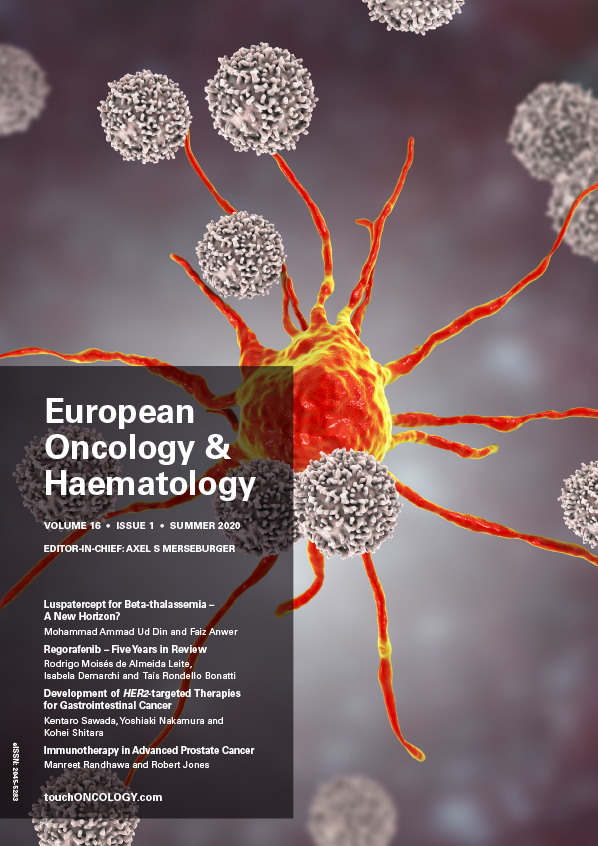
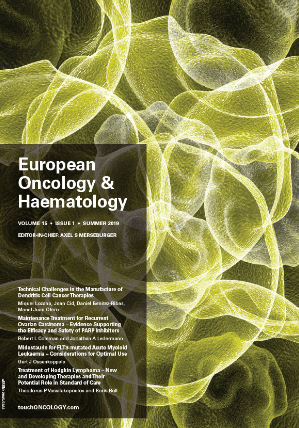
Comprising articles contributed by renowned thought leaders, European Oncology & Haematology is a peer reviewed, free-to-access, bi-annual journal that aims to disseminate best practice through review articles addressing the most important and salient developments in the Oncological & Haematology field in practical terms.
European Oncology & Haematology
Frequency: Two print issues per year (Summer & Winter); ePub ahead of print throughout the year.
Print ISSN: 2045-5275 Electronic ISSN: 2045-5283
Indexing: EMBASE, Google Scholar, Genamics JournalSeek
Log into your Touch Account
Keep track of your clinical interests and newsletter subscriptions.
Sign up with an Email
Or use a .
Register now for FREE access
Already registered? Login below.