
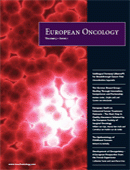
EUROPEAN ONCOLOGY – VOLUME 5 – SUMMER 2009
Welcome to European Oncology Volume 5 Issue 1. European Oncology reviews salient topics and invites discussion focused on these issues. This edition has endeavoured to bring the reader pertinent information about current research and dynamic successes being experienced in the field of oncology. Articles have been chosen for their evaluation of current practices and research […]
Supportive Oncology
Pain is a well recognised feature of cancer that usually becomes more common as the disease progresses.1 Pain is the most feared of all the cancer symptoms, so effective analgesia is essential to good patient management. Opioids have remained the mainstay of pharmacological management of cancer pain, and a number of studies have demonstrated that […]
Chemotherapeutic agents are associated with various adverse events and, with over one million intravenous (IV) chemotherapy infusions and injections given worldwide every day, the main patient safety focus for healthcare professionals is to minimise events and complications for patients. However, in a relatively small number of cases, accidental leakage of the chemotherapy drug from the […]
Pain does not appear as a cause of global mortality or disease burden in World Health Organization (WHO) statistics on leading causes of death and disease burden worldwide.1 However, pain causes immense suffering, especially in those with two of the world’s major causes of morbidity and death, which are most prevalent in developing countries: cancer […]
Head and Neck Cancer
Congenital brain tumours are infrequent and account for approximately 1–4% of all paediatric cases.1 One to four live births per 100,000 are estimated to be affected by a congenital brain tumour.2,3 The majority of these neoplasms reside in the supratentorial compartment and, as noted by Volpe, the clinical manifestations of congenital brain tumours usually involve […]
The term ‘head and neck cancer’ covers a large number of neoplasms with diverse natural history, most of which are uncommon and some of which are rare. These lesions, in over 85% of cases, represent squamous cell carcinomas of the mucosa of the upper respiratory and gastrointestinal tracts – head and necksquamous cell carcinoma (HNSCC) […]
Musculoskeletal Cancer
The majority of surgery performed for cancer by orthopaedic oncologists is curative surgery for primary bone and soft-tissue sarcomas. The principle is resection achieving wide margins in order to save lives, then worrying about saving the limb, then limb function and, finally, cosmesis and limb-length equalisation. On occasion, surgery for isolated renal or thyroid metastasis […]
Metastatic cancer is the most common malignant disease of the bone.1 Breast and lung carcinomas account for more than 80% of metastatic bone disease.2 Metastasis to the bone causes significant pain and morbidity to the patient early in the course of the disease.3 It can lead to fractures and reduced mobility, thus reducing performance status […]
Lung Cancer
Non-small-cell lung cancer (NSCLC) accounts for approximately 80% of all lung cancer cases. About 50% patients present with locally advanced or metastatic disease, and their five-year survival amounts to less than 5%.1 First-line chemotherapy in advanced NSCLC usually consists of a combination of cisplatin or carboplatin with a thirdgeneration agent (paclitaxel, docetaxel, gemcitabine or vinorelbine). […]
Breast Cancer
The German Breast Group (GBG) is a leading study group covering the complete field of clinical breast cancer research in Europe. It was created out of the German Adjuvant Breast Group (GABG), established in 1981. Since 2003 the GBG has been restructured and since the late 1990s not only adjuvant but also neoadjuvant breast cancer […]
At the beginning of the third millennium, one in three EU citizens will have to deal with cancer in the course of his or her life. Worldwide, the estimated number of new cancer cases is expected to rise from 10 million in 2000 to 15 million by 2020. Currently, cancer is the cause of 12% […]
Colorectal Cancer
Colorectal cancer (CRC) remains one of the most common tumour types and a leading cause of cancer death worldwide. The American Cancer Society (ACS) estimates that 148,610 people were diagnosed with, and 55,170 people died of, CRC last year in the US.1 Despite these statistics, mortality from CRC has decreased over the past 30 years, […]
Currently, quality of healthcare is a hot topic, and this is especially true for cancer care. Patients try to seek the best care available. As a result, several ranking lists can be found on the Internet and in the popular press worldwide. Unfortunately, many of those lists do not meet the requirements needed for a […]
Prostate Cancer
Prostate cancer is the most common malignancy in western societies and the second most common cause of male cancerrelated death in the UK.1,2 When confined to the prostate gland, the disease is potentially curable with local therapy (radical prostatectomy or external-beam radiotherapy). However, in the UK one in five men has metastatic prostate cancer at […]
Gynaecological Cancer
The Clinical Problem Malignant epithelial ovarian cancer diagnosed during pregnancy is rare, with an estimated incidence of 1:12,000 to 1:50,000 pregnancies.1–3 A recent review4 identified 28 publications pertaining to maternal malignant epithelial ovarian cancer, spanning a time period of 49 years. The paucity of published data and low incidence of maternal epithelial ovarian cancer is […]
Endometrial carcinoma is the fourth most common female cancer and the most common malignancy of the female reproductive tract.1 Adenocarcinomas arise from the uterine epithelium and constitute 90% of endometrial cancers. The remaining histological types of endometrial carcinoma include adenocarcinoma with squamous differentiation, adenosquamous carcinoma, clear cell carcinoma and papillary serous carcinoma. Serous papillary carcinoma […]
Endometrial cancer (EC) is the most common gynaecological cancer in the developed world, and in 2002 it was estimated that worldwide around 200,000 women were diagnosed with the disease.1 In Sweden, between 1970 and 2006 the age-standardised incidence increased by 37%, but because of an ageing population the number of cases increased by 80% during […]
Haematological Malignancies
Allogeneic stem cell transplantation (alloSCT) has been utilised in the management of leukaemia for several decades and has established its role in producing long-term remission. In the context of multiple myeloma (MM), alloSCT induces the highest rate of remissions, including molecular remission, resulting in long-term disease-free survival (DFS) in 20 years, but there is good […]
Paediatric Oncology
In this article, the epidemiology and aetiology of childhood cancer are reviewed. The aetiology of childhood cancer is not clear. Both genetic predisposition and environmental agents are likely to be involved. There is a vast amount of literature on the subject, and PubMed (www.ncbi.nlm.nih.gov/PubMed) has been utilised to find key references. This review also synthesises […]
Geriatric Oncology
Cancer is mainly a disease of the elderly. As a result of increased life expectancy, over 60% of new cancer cases and over 70% of cancer deaths occur in people 65 years of age or older in Europe and in the US.1 Ageing is associated with progressive but extremely uneven decline of functional reserves and […]
Trending Topic
Paediatric low-grade gliomas (pLGGs) most commonly develop in the cerebellum and can be resected safely, with minimal neurological complications and long-term cure achieved following surgery alone.1 However, a large proportion of pLGGs that develop in other parts of the brain remain unresectable and ultimately manifest as a chronic disease.2 The most common location at which unresectable pLGG […]
Journal Archive
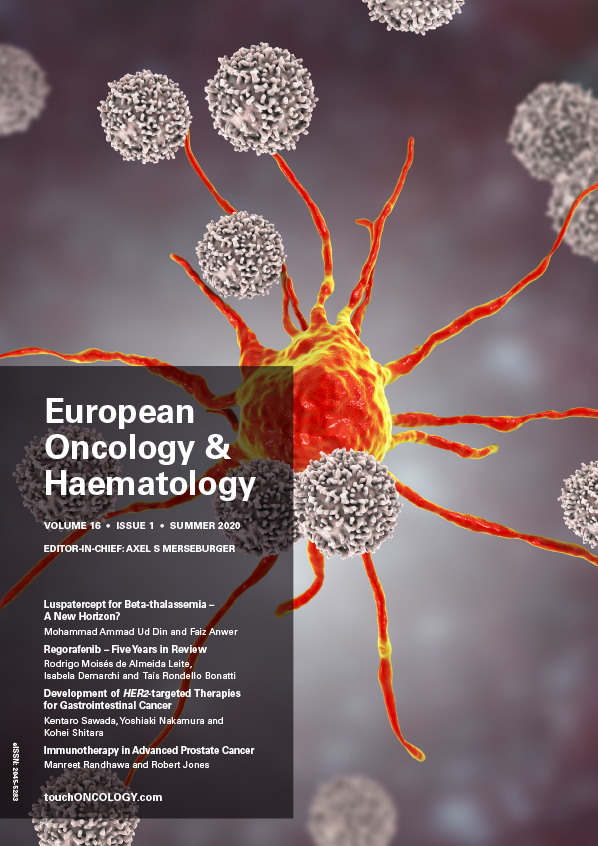
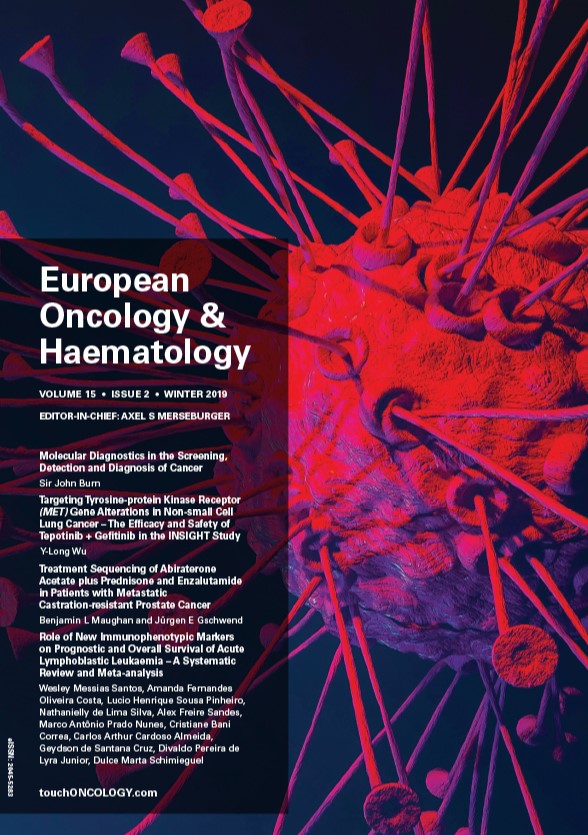
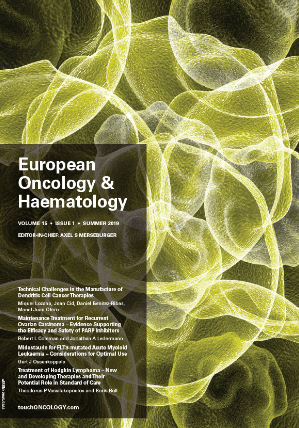
Comprising articles contributed by renowned thought leaders, European Oncology & Haematology is a peer reviewed, free-to-access, bi-annual journal that aims to disseminate best practice through review articles addressing the most important and salient developments in the Oncological & Haematology field in practical terms.
European Oncology & Haematology
Frequency: Two print issues per year (Summer & Winter); ePub ahead of print throughout the year.
Print ISSN: 2045-5275 Electronic ISSN: 2045-5283
Indexing: EMBASE, Google Scholar, Genamics JournalSeek
Log into your Touch Account
Keep track of your clinical interests and newsletter subscriptions.
Sign up with an Email
Or use a .
Register now for FREE access
Already registered? Login below.