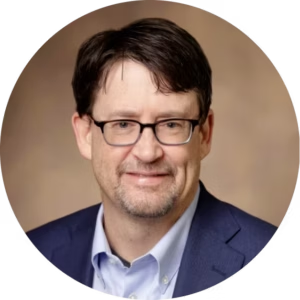
Oesophageal cancer is entering a new era of innovation, as emerging data from the European Society for Medical Oncology (ESMO) 2025 congress, highlight meaningful advances in both adenocarcinoma and squamous-cell subtypes. In this interview, Dr Michael K. Gibson (Vanderbilt-Ingram Cancer Center, Vanderbilt University Medical Center, Nashville, TN, USA) reviews the much-anticipated follow-up results from two pivotal phase III trials – the MATTERHORN and SKYSCRAPER‑07. He outlines the key challenges, the current standpoint and where the field is heading next.
Q1. To begin, could you summarize the significance of the MATTERHORN trial in the oesophageal cancer field?
The MATTERHORN trial is a landmark in upper-gastrointestinal oncology, and while technically focused on resectable gastric and gastroesophageal-junction (GEJ) adenocarcinomas, it has clear implications for oesophageal adenocarcinoma treatment.1 The study randomized 948 patients to perioperative chemotherapy with FLOT (fluorouracil, leucovorin, oxaliplatin, docetaxel) versus that same regimen plus the PD-L1 checkpoint inhibitor durvalumab. At ESMO25 the final overall survival (OS) analysis was presented (LBA81): the hazard ratio (HR) for death was 0.78 (95 % CI 0.63–0.96; p = 0.021). At 36 months, survival was 68.6 % in the durvalumab arm versus 61.9 % in the FLOT-alone arm.
Importantly, the benefit was observed regardless of PD-L1 (TAP) or CPS score, nodal negativity or pathological response. In effect, we are shifting the curative-intent survival numbers from the low-20 % range (what we used to expect from surgery plus adjuvant chemo/radiation) into the 60s. That is meaningful progress.
Q2. What are the clinical take-home points for a multidisciplinary team treating resectable oesophageal adenocarcinoma?
First, this data reinforces the movement toward aggressive perioperative therapy rather than surgery that was shown by the MAGIC and AIO studies.2,3 Second, it proves that adding immunotherapy (durvalumab) to a proven regimen (FLOT) offers a tangible survival improvement – so teams should consider this standard of care where applicable. Third, the independence of PD-L1 means we may not need to restrict immunotherapy to biomarker-positive patients in this setting. Lastly, since nodal negativity (ypN0) and pCR rates were higher in the durvalumab arm (e.g., nodal negativity ~58.2 % vs 44.8 %). We might anticipate improved long-term outcomes, and this invites surgeons, medical oncologists and radiologists to optimize staging, surgical timing and patient selection collaboratively.
Q3. What were the design and principal results of the SKYSCRAPER-07 trial, and how do its findings shape our understanding of adjuvant checkpoint inhibition in locally advanced ESCC?
SKYSCRAPER-07 (2094O) enrolled 760 patients with unresectable, locally advanced oesophageal squamous cell carcinoma (ESCC) who had completed definitive chemoradiotherapy (dCRT) and had no progression. They were randomized 1:1:1 to tiragolumab + atezolizumab, atezolizumab alone, or placebo arms. The primary endpoint (PFS, tiragolumab+atezolizumab vs placebo) was not met: HR for PFS was 0.82 (95 % CI 0.65–1.03; p = 0.0947).
However, in the descriptive analysis, the atezolizumab monotherapy arm showed a median PFS of 29.1 months vs 16.6 months for placebo, and OS improved (median not reached vs 36.4 months for placebo; HR 0.74). Although the primary hierarchical testing strategy was not fulfilled, this signal suggests adjuvant PD-L1 monotherapy after dCRT may merit further prospective investigation in ESCC.
Q4. Given that the dual investigational arm failed the primary endpoint, how should clinicians interpret the atezolizumab monotherapy results?
Caution is warranted. Since the primary endpoint failed, the subsequent positive findings for atezolizumab alone are descriptive, not formally statistically validated. Yet, from a research perspective the data are hypothesis-generating: they suggest that we may not need dual checkpoint + TIGIT inhibition, but that PD-L1 inhibition alone may suffice in selected patients. Clinicians should not yet change practice on this basis alone, but keep an eye on follow-up trials that may refine patient selection, biomarker stratification and sequence of therapy in squamous oesophageal disease.
Q5. What do these two studies tell us about the future of oesophageal cancer management?
They signal a maturation in how we treat oesophageal cancer with curative intent. For adenocarcinoma (and GEJ) we now have level-one evidence supporting immunotherapy integration in the perioperative setting – transitioning what has been incremental improvement over decades into a meaningful survival gain. For squamous subtype, we are probing adjuvant immunotherapy strategies after chemoradiation to raise the bar from historically low cure rates (around 20–30 %) toward something more substantial. Overall, the future will involve optimised multimodal therapy (surgery, chemoradiation, systemic immuno/immunochemotherapy), improved biomarkers for patient selection, and more robust integration across disciplines. The ‘light at the end of the tunnel’ is not hype – it is grounded in the data we now see.
Q6. Finally, what challenges and unanswered questions remain in this space?
First, long-term follow-up is still needed – especially for overall survival beyond three years and durability of response. Second, patient populations in trials may differ from everyday practice (age, comorbidities, performance status). Third, cost, access and toxicity remain relevant: immunotherapy adds complexity and expense, so health systems will need to evaluate implementation pragmatically. Fourth, biomarker refinement: even though PD-L1 independence was reported in MATTERHORN, I believe deeper translational science (tumour microenvironment, T-cell infiltration, ctDNA) will help tailor and optimize therapy further. And lastly, sequencing: how to integrate immunotherapy with surgery and radiation optimally remains a work in progress.
To summarize, ESMO25 delivered actionable gains for oesophageal cancer, and we as a field must now translate those into practice thoughtfully.
References
- Janjigian YY, Al-Batran SE, Wainberg ZA, et al. Perioperative Durvalumab in Gastric and Gastroesophageal Junction Cancer. N Engl J Med. 2025;393:217–30. doi: 10.1056/NEJMoa2503701.
- Cunningham D, Allum WH, Stenning SP, et al. Perioperative chemotherapy versus surgery alone for resectable gastroesophageal cancer. N Engl J Med. 2006;355:11–20. doi: 10.1056/NEJMoa055531.
- Al-Batran SE, Homann N, Pauligk C, et al. Perioperative chemotherapy with fluorouracil plus leucovorin, oxaliplatin, and docetaxel versus fluorouracil or capecitabine plus cisplatin and epirubicin for locally advanced, resectable gastric or gastro-oesophageal junction adenocarcinoma (FLOT4): a randomised, phase 2/3 trial. Lancet. 2019;393:1948–57. doi: 10.1016/S0140-6736(18)32557-1.
Disclosure: Michael K Gibson has nothing to disclose in relation to this interview.
This content has been developed independently by Touch Medical Media for touchONCOLOGY. It is not affiliated with the European Society for Medical Oncology (ESMO). Views expressed are the speaker’s own and do not necessarily reflect the views of Touch Medical Media.
Cite: ESMO25: MATTERHORN and SKYSCRAPER-07 mark new era for oesophageal cancer. touchONCOLOGY. November 11th, 2025
Related content
- Modulating Cancer Immunotherapy Through the Intestinal Microbiota: Mechanisms, Clinical Evidence and the Emerging Role of Faecal Microbiota Transplantation
- 5 exciting developments in oncology to watch in 2025 and beyond
- Advancements in Immune Checkpoint Inhibitors for Oesophageal Squamous Cell Carcinoma: Current Status and Future Perspectives